
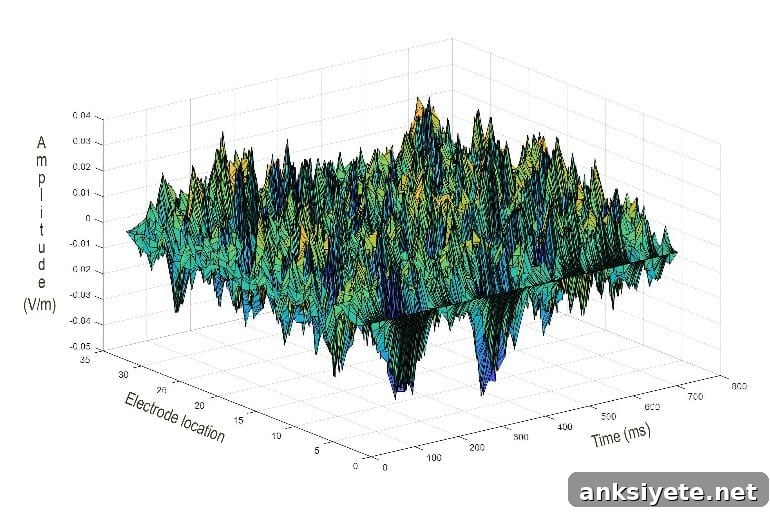
Summary: Electric fields generated by groups of neurons may carry working memory content, providing a stable representation that overcomes representational drift.
Source: MIT
A new study indicates that electric fields produced by neuronal populations can reliably represent information held in working memory, helping the brain maintain stable function despite changing participation of individual neurons.
When we hold information in mind—like a short shopping list—the brain must preserve that content across brief delays. Recent research suggests that, rather than relying on the precise activity of specific neurons, the brain may rely on the larger-scale electric fields those neurons collectively produce. These fields provide a consistent signal even when the individual neurons contributing to the activity change from one trial to the next, a phenomenon known as representational drift.
Researchers at The Picower Institute for Learning and Memory at MIT and the University of London explored whether electric fields generated by neural populations could contain stable, task-relevant information. Their findings, published in NeuroImage, show that although individual cells vary in their participation across trials, the overall electric field created by the ensemble remained a reliable marker of what the animal was holding in working memory.
Lead author Dimitris Pinotsis describes the relationship between fields and neurons with an orchestra analogy: the electric field acts like a conductor, organizing whoever happens to be playing so the same piece is produced. Even if individual musicians change, a consistent conductor can preserve the same performance. In neural terms, the field imposes a stable coordination pattern on neuron ensembles, so the brain can produce the same output without needing the exact same set of neurons active each time.
Co-author Earl Miller, Picower Professor of Neuroscience at MIT, emphasizes that electric fields offer a higher-level representation that is more abstract and integrated than the detailed patterns of single neurons or small circuits. This abstraction may allow the brain to operate reliably on the level of task-relevant information even as the fine-grained neural details drift.
Measurements and mathematical modeling
To test their hypothesis, the team combined direct neural recordings from animals performing a working memory task with mathematical modeling to estimate the electric fields associated with task performance. Directly measuring the relevant fields is difficult: implanted electrode arrays capture individual neuron activity, while external EEG captures only broad patterns that lack the spatial specificity needed to reflect localized memory representations. Instead, the researchers recorded detailed neuronal signals and then used computational methods to infer the fields those signals would create.
During the task, animals viewed a dot displayed at one of six positions around the screen’s edge. After the dot disappeared and a short delay period followed, the animals had to saccade to the remembered location. The delay period is when working memory is engaged, so the researchers recorded electrical activity from cortical surface electrodes while the animals held the cued direction in mind.
As expected, raw recordings were noisy and variable. Individual neuron participation fluctuated across trials, and electrodes recorded activity from neurons unrelated to the task. To overcome this, Pinotsis developed a mathematical approach to identify correlated activity patterns among neurons during the delay. By determining which neurons were acting together, the team inferred connectivity and information flow within the ensemble. Applying standard biophysical principles to these inferred interactions allowed them to reconstruct the electric field surrounding the relevant cortical patches.
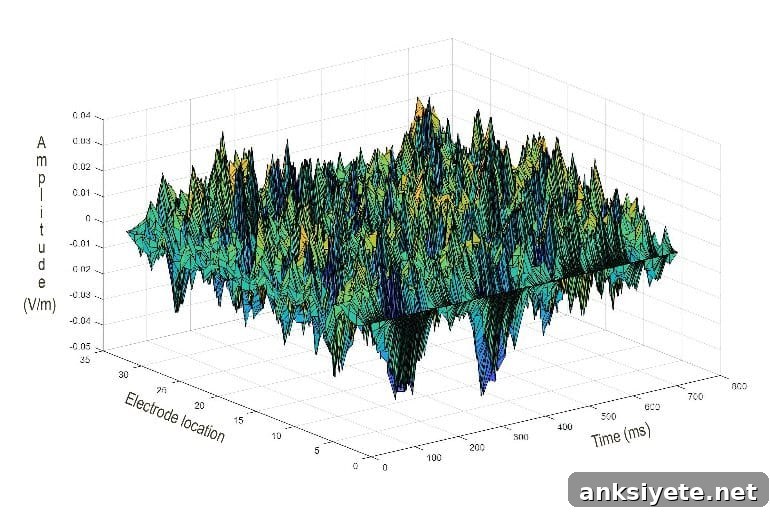
These reconstructed fields displayed features consistent with carrying the remembered information. Electric fields were more stable across trials that cued the same direction than the underlying neural activity was. They also varied in distinct, repeatable ways depending on which position was to be remembered—more reliably than the neuron-level signals. When the researchers trained a decoder to infer the remembered direction, it performed better using the estimated electric fields than using the raw neural activity.
Pinotsis and Miller stress that trial-to-trial variability in individual neurons is not merely meaningless noise; it may reflect genuine, moment-to-moment differences in internal state, attention, or computation. However, at the level of electric fields, the brain can filter out much of this variability and preserve a stable, task-relevant signal. In this way, what appears as representational drift at the microscopic level can coexist with stable, functionally meaningful representations at a larger spatial scale.
The researchers further propose that electric fields might play an active role in shaping neural dynamics. By favoring the emergence of a particular field configuration, the system could direct information flow among neurons to produce a desired outcome. One of the team’s next questions is whether fields can not only reflect but also control neuronal activity—whether influence can flow from the macroscale field down to individual neurons.
“We are now investigating whether information flows from the macroscale level of the electric field down to the microscale level of individual neurons,” Pinotsis says. “Put in orchestra terms, we want to know whether a conductor’s style changes how each musician plays.”
About this electrophysiology research news
Author: Anne Trafton
Source: MIT
Contact: Anne Trafton – MIT
Image: The image is credited to Dimitris Pinotsis
Original Research: Open access.
Title: “Beyond dimension reduction: Stable electric fields emerge from and allow representational drift” by Dimitris Pinotsis et al., NeuroImage
Abstract
Beyond dimension reduction: Stable electric fields emerge from and allow representational drift
The set of neurons that maintain a particular memory can change across trials, raising the question of how stable memory representations are achieved despite this representational drift. This work shows that stability can emerge at the level of the electric fields produced by neural activity. These fields carry information about working memory content and can act as “guard rails” that channel variable, high-dimensional neural activity into stable, lower-dimensional trajectories. By extracting a latent space for each memory, mapping that space to different cortical patches, and reconstructing information flow between patches, the study demonstrates how stable electric fields could enable transfer of latent states between brain areas, consistent with contemporary engram theory.