
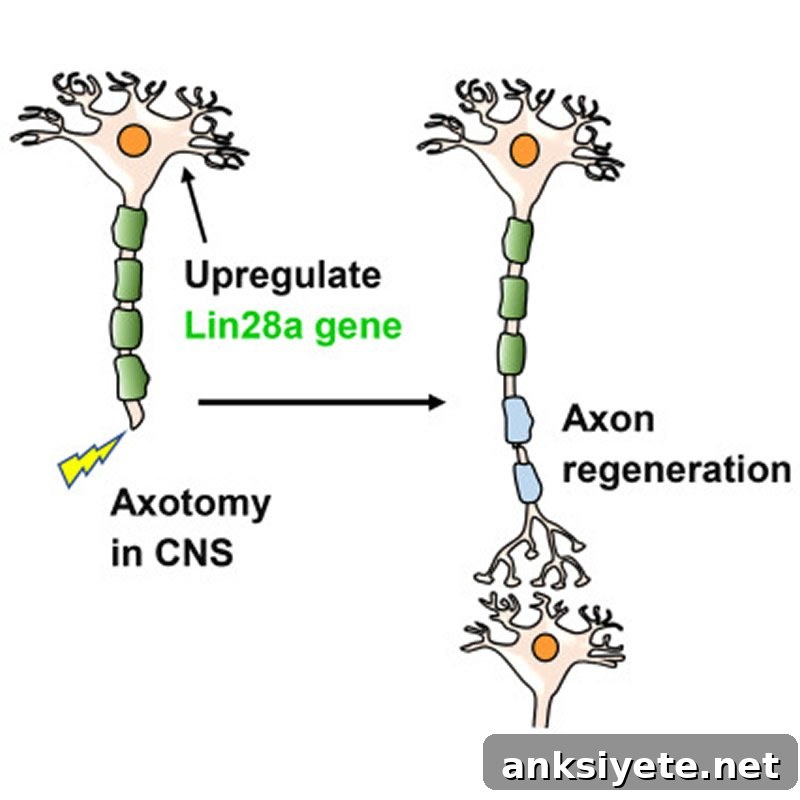
Summary: LIN28, a regulator of cell growth, shows promise for treating spinal cord and optic nerve injuries. When increased above normal levels, LIN28 stimulates axon regrowth in mice, helping restore neural connections that carry sensory and motor signals.
Source: Temple University Health System
Like power lines in an electrical grid, long, wire-like projections that extend from neurons—called axons—form the communication networks that connect the brain to the rest of the body. Unlike a broken utility line, however, damaged axons in the adult central nervous system do not repair themselves naturally. Each year, many people face permanent losses of sensation and movement after spinal cord injury or optic nerve damage because these connections fail to regenerate.
Researchers at the Lewis Katz School of Medicine at Temple University (LKSOM) report that Lin28, a molecule known for regulating cell growth and stem cell activity, can substantially promote axon regeneration in adult mice. Published in Molecular Therapy, the study shows that raising Lin28 levels in injured animals stimulates significant axon regrowth in both the spinal cord and optic nerve, restoring aspects of neural connectivity that underpin sensory and motor function.
“Our results identify Lin28 as a major regulator of axon regeneration and a promising therapeutic target for central nervous system injuries,” said Shuxin Li, MD, PhD, Professor of Anatomy and Cell Biology and senior investigator at the Shriners Hospitals Pediatric Research Center at LKSOM. This work is the first to demonstrate that upregulating Lin28 can drive regeneration in the injured spinal cord of adult animals.
Lin28 attracted interest because of its established role as a gatekeeper of stem cell activity. “Lin28 helps control whether stem cells remain in a pluripotent state or begin to differentiate,” Dr. Li explained. “That regulatory control suggested Lin28 could influence mature neurons’ ability to reactivate growth programs needed for axon regeneration.”
To test this idea, the team engineered mice that overexpress Lin28a under a neuron-specific Thy1 promoter, targeting multiple projection neurons including corticospinal tracts and retinal ganglion cells. Adult transgenic mice and control animals were then subjected to either spinal cord injury or optic nerve lesion. In a parallel approach, the researchers delivered Lin28 to injured wild-type mice using an adeno-associated viral vector (AAV2) injected after injury to evaluate post-injury therapeutic effects.
Across experiments, elevated Lin28 produced substantial long-distance axon regeneration. Post-injury AAV2-Lin28 treatment produced particularly strong results: spinal cord axons extended more than three millimeters beyond lesion sites, while optic nerve axons regrew along the full length of the nerve tract. Behavioral tests showed meaningful improvements in motor coordination and sensory function following Lin28 treatment, indicating that anatomical regeneration translated into functional recovery.
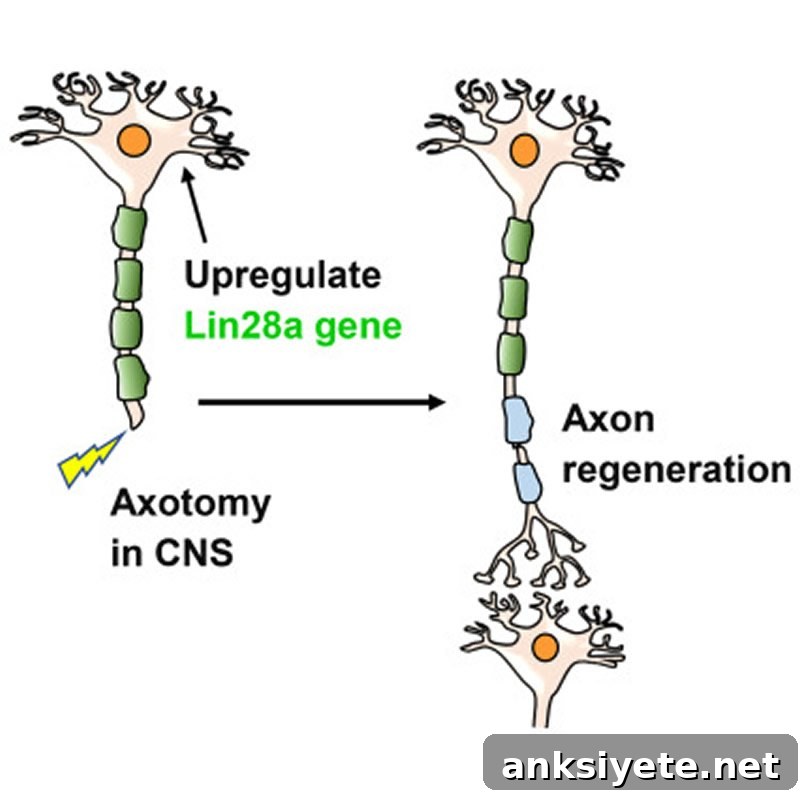
“We observed robust axon regrowth, which could be clinically significant because current options for regenerating central nervous system axons are extremely limited,” Dr. Li said. Moving toward clinical application will require a reliable, safe delivery system to bring Lin28 to injured human tissues. The research team aims to develop vectors that can be administered systemically but selectively target damaged axons and affected neuron populations.
Beyond delivery, the researchers plan to map the molecular pathways Lin28 engages to promote growth. Preliminary evidence links Lin28 upregulation to increased activity in the Akt signaling pathway, and Lin28 likely interacts with multiple growth-related signaling molecules. Understanding these connections could enable combination strategies—packaging Lin28 alongside complementary factors to enhance repair.
Contributors to this study include Fatima M. Nathan, Yosuke Ohtake, Shuo Wang, Xinpei Jiang, Armin Sami, Hua Guo (Shriners Hospitals Pediatric Research Center and the Department of Anatomy and Cell Biology, Lewis Katz School of Medicine), and Feng-Quan Zhou (Department of Orthopaedic Surgery and The Solomon H. Snyder Department of Neuroscience, Johns Hopkins University School of Medicine).
Funding: This research was supported in part by National Institutes of Health grants R01NS105961, 1R01NS079432, 1R01EY024575 and by Shriners Research Foundation funding.
About this neuroscience research
Source: Temple University Health System
Media contacts: Jeremy Walter, Temple University Health System
Image credit: Shuxin Li et al.
Original research: “Upregulating Lin28a Promotes Axon Regeneration in Adult Mice with Optic Nerve and Spinal Cord Injury” by Shuxin Li et al., published in Molecular Therapy. DOI: 10.1016/j.ymthe.2020.04.010
Abstract (summary)
Adult central nervous system (CNS) axons typically fail to regenerate, and effective regenerative therapies are lacking. Several genes influence mature neurons’ intrinsic growth capacity. Lin28a, known for roles in development and pluripotency, was tested for its ability to enhance regenerative capacity across CNS neuron populations. Neuron-specific Lin28a overexpression in transgenic mice promoted long-distance regeneration of corticospinal axons and optic nerve axons. Post-injury AAV2-mediated Lin28a overexpression also stimulated dramatic regeneration. Lin28a upregulation increased Akt pathway activity in mature CNS neurons, indicating Lin28a’s central role in regulating neuronal growth potential and identifying it as a promising molecular target for CNS injury repair.
Feel free to share this neurology news.