
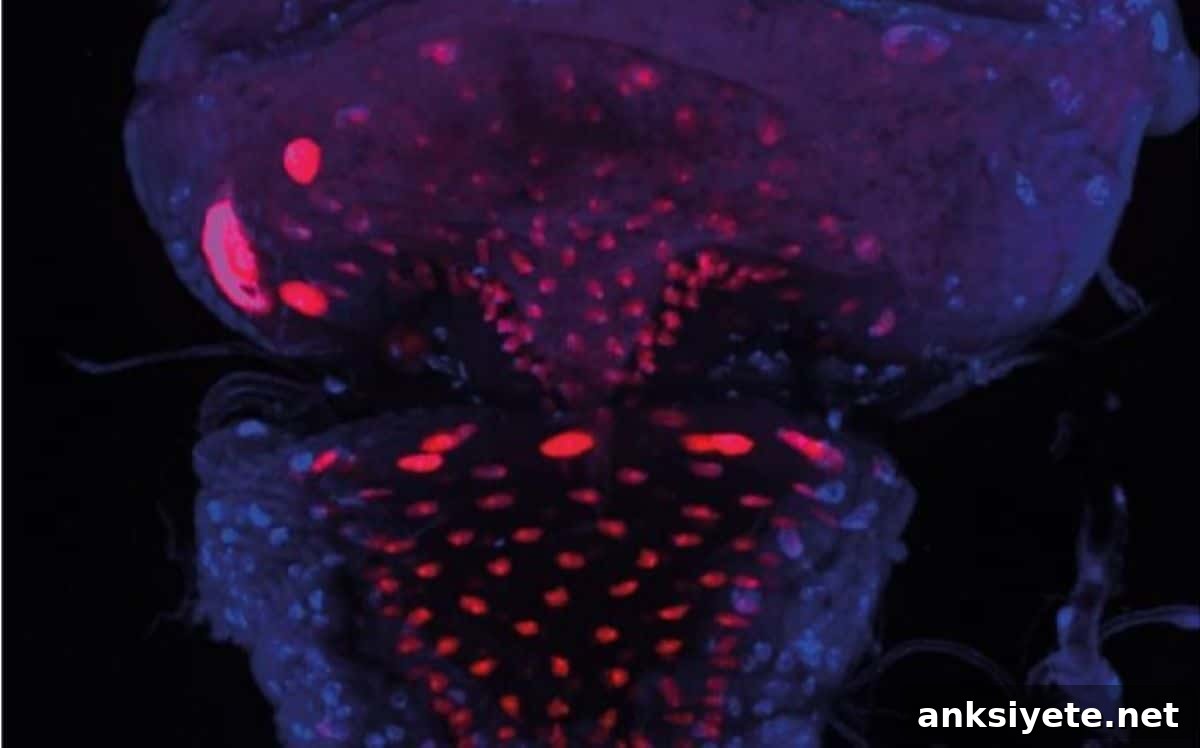
Summary: Researchers have solved a 112-year-old genetic mystery while mapping a vital gut–brain signaling loop that controls early-life survival. The study examined the immediate post-hatching behavior of the fruit fly Drosophila melanogaster and revealed how intestinal clearance and brain-driven feeding are tightly coordinated.
The team found that newly hatched flies must follow a rigid sequence: they must first expel their developmental waste, called meconium, before the brain permits independent feeding. By revisiting a historic mutation discovered in 1914, the researchers isolated a severe developmental defect that creates a physical hindgut plug—named the “Reinger’s knot.” This mechanical obstruction directly suppresses feeding behavior, triggers deep lethargy, and prolongs sleep, ultimately causing premature death.
Key Facts
- The 112‑Year‑Old Mutation Deciphered: Early geneticists noted in 1914 that flies with a mutated apterous gene failed to develop wings and died young. The Kempf Lab has now shown that apterous also controls hindgut formation, and its disruption leads to fatal intestinal blockage.
- The Post‑Hatching Survival Sequence: In healthy flies, the first hours after hatching require precise coordination. Meconium must be expelled before the central nervous system activates the appetite drive and independent feeding begins.
- Discovery of the Reinger’s Knot: First author Cindy Reinger identified the physical cause of the lethal blockage. Normal larvae form four specialized rectal papillae that reabsorb water and balance fluids. In apterous mutants, those papillae fail to form and instead fuse into a solid plug that seals the hindgut.
- Intestinal Obstruction Silences Hunger: Despite systemic starvation, flies with the hindgut plug avoid food. Mechanical fullness and pressure signals from the blocked gut override baseline neural hunger pathways.
- Hypersomnia as an Energy Conservation Strategy: Blocked flies become profoundly lethargic and sleep for extended periods. The researchers propose that this hypersomnia functions as a metabolic brake to conserve internal energy and extend survival while the organism attempts to clear the obstruction.
- Proboscis Rhythmic Movements: During prolonged sleep, affected flies make rhythmic proboscis movements. This reflexive behavior likely attempts to stimulate gut motility as a last effort to dislodge the plug.
- Relevance to Human Disease: The fly symptoms parallel human neonatal intestinal obstructions such as Hirschsprung’s disease and meconium ileus: constipation, loss of appetite, lethargy, gut swelling, and risk of tissue damage. These parallels highlight Drosophila as a rapid, powerful model for studying enteric nervous system disorders and gut–brain communication.
Source: University of Basel
The first hours of life are critical for survival. Two essential processes occur during this window: the elimination of developmental metabolic waste (meconium) and the initiation of independent feeding.
Until this study, how those two processes are linked—and how the gut influences eating and sleeping—remained unclear. Gut–brain communication is a growing area of interest because it has broad implications for health and disease across species, including humans.
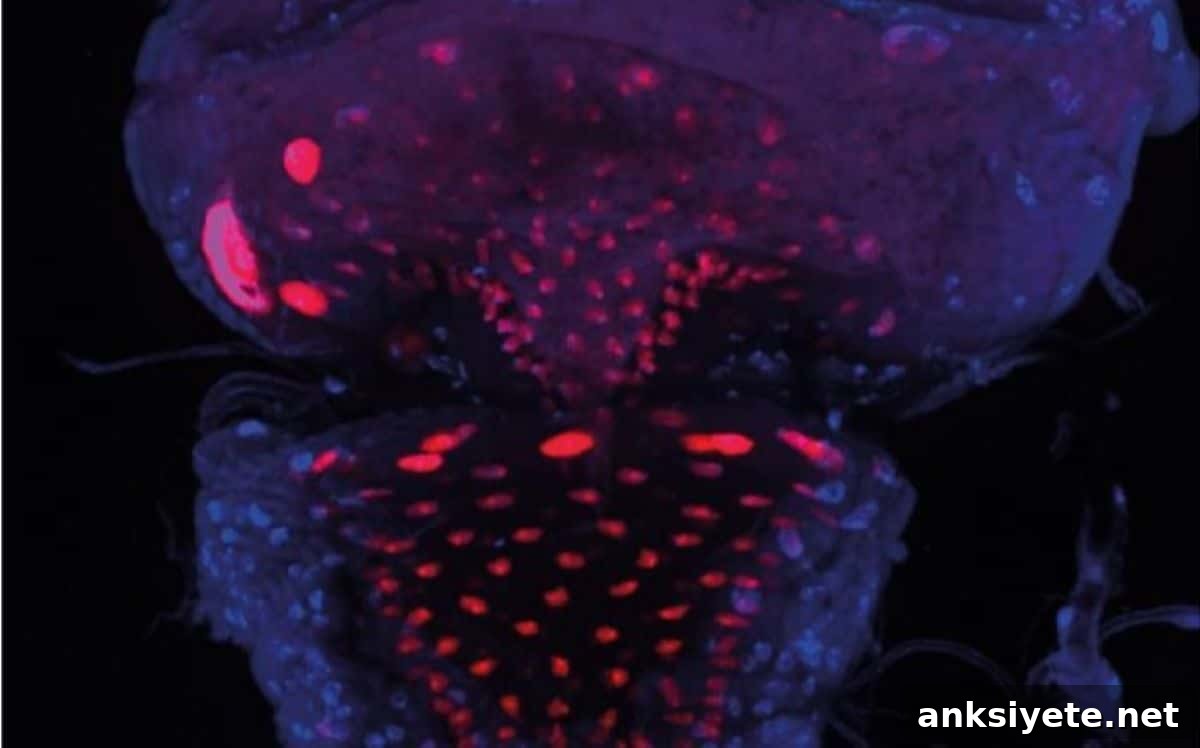
The fruit fly Drosophila melanogaster faces the same challenge immediately after hatching. Professor Anissa Kempf’s group at the Biozentrum, University of Basel, showed that timing is crucial: young flies only begin feeding after partial meconium elimination. Flies with intestinal obstruction, however, avoid food, exhibit prolonged sleep, and die prematurely—demonstrating that gut function directly affects feeding, sleep, and survival.
Genetic defect causes intestinal blockage
The developmental defect traces back to a regulatory element associated with the apterous gene. While apterous was historically linked to wing development, the new work reveals it is also essential for proper hindgut architecture. When the regulatory element is disrupted, rectal papillae do not form correctly; instead, a plug forms that prevents meconium excretion and obstructs the intestine.
Obstruction drives lethargy and food avoidance
Blocked flies cannot clear their meconium and over time become increasingly lethargic. Despite obvious internal starvation, they refuse food. The researchers interpret the increased sleep as an adaptive response that reduces energy expenditure. During these sleep bouts, rhythmic proboscis extensions persist—behaviors that may mechanically stimulate the gut in a last-ditch attempt to dislodge the plug.
“We believe flies increase sleep to conserve energy and survive longer,” explains Cindy Reinger, first author. “Proboscis movements during sleep could represent an involuntary reflex to promote gut motility and try to clear the obstruction.”
Parallels with human neonatal intestinal obstruction
The phenotype progression in flies reflects hallmark features of mechanical gut obstruction in newborn humans, including lack of appetite, profound lethargy, abdominal swelling, and risk of tissue damage. These similarities suggest the underlying physiological consequences of intestinal blockage—and the gut‑to‑brain signaling that follows—may be conserved across species.
Key Questions Answered:
A: A complete mechanical blockage by the Reinger’s knot prevents waste passage and new digestion, sending stress signals from the gut to the brain. That signaling triggers deep, prolonged sleep—an energy‑saving response that acts like a metabolic handbrake to extend survival while physiological attempts are made to clear the obstruction.
A: Fruit flies and humans share many core biological pathways and genetic programs. The enteric nervous system and gut–brain signaling principles are conserved, making Drosophila a fast, high-resolution model to identify genes, cell types, and circuits that govern digestion, feeding, and sleep—insights that can inform human health research.
A: Demonstrating that intestinal clearance directly gates feeding behavior establishes an enteroneurological checkpoint: when the digestive tract is full of developmental waste, neural circuits suppress appetite to prevent further intake. This mechanism helps explain why infants with serious intestinal blockages lose appetite, become lethargic, and can suffer systemic collapse.
Editorial Notes:
- This article was edited by a Neuroscience News editor.
- The journal paper was reviewed in full by our editorial team.
- Additional context and clarifications were added by staff to improve readability.
About this neuroscience and sleep research news
Author: Angelika Jacobs
Source: University of Basel
Contact: Angelika Jacobs, University of Basel
Image: Photo credit: Biozentrum, University of Basel
Original Research: Open access. “Intestinal obstruction impairs feeding and promotes sleep in Drosophila melanogaster” by Cindy Reinger, Laura Blackie, Alexandra M. Medeiros, Hugo Gillet, Carolin Kring, Pedro Gaspar, Dafni Hadjieconomou, Michèle Sickmann, Markus Affolter, Irene Miguel‑Aliaga, Martin Müller, and Anissa Kempf. Published in Science Advances. DOI: 10.1126/sciadv.ady2183
Abstract
Intestinal obstruction impairs feeding and promotes sleep in Drosophila melanogaster
At the onset of life, feeding must begin while developmental waste—the meconium—must be eliminated. Although these processes are interdependent, their mechanistic link has been poorly understood. Using Drosophila as a model, the study shows that meconium excretion begins shortly after eclosion and that feeding initiation follows only after partial meconium elimination. A cis‑regulatory element tied to the apterous gene is required for correct hindgut development; disruption of this element prevents meconium excretion and causes intestinal obstruction.
Flies with the defect avoid food and show increased proboscis‑extension sleep. Experimentally blocking excretion in newly eclosed flies reproduces these phenotypes, indicating that mechanical intestinal obstruction is sufficient to impair feeding and alter sleep–wake states. The phenotype progression mirrors clinical features of mechanical gut obstruction in humans, suggesting conserved physiological consequences. These findings reveal a link between intestinal clearance, feeding, sleep, and survival, with implications for understanding related processes across species.