To survive, animals must explore their surroundings to find food, water and shelter. This requires forming a mental map of the environment so they can navigate safe, efficient routes and predict when and where important events—such as finding a meal—will occur.
Until recently, studying navigation and reward anticipation together proved difficult because researchers could not easily measure both behaviors simultaneously while an animal was moving. To address this challenge and to learn how different brain regions process and integrate environmental cues, scientists at UCLA developed a multisensory virtual-reality environment that allowed rats to navigate on a floating trackball to locate a reward. The virtual world provided both visual and auditory cues, gave the rats the illusion of real movement through space, and let researchers control which cues were available.
The study, published in the journal PLOS ONE, produced surprising findings. Although rats are nocturnal, the animals relied heavily on visual information to navigate to a food reward: when visual cues were present, rats ignored auditory cues and used sight to move directly to the reward location. Their locomotion and reward anticipation became tightly synchronized—legs moved efficiently toward the goal while licking behavior, a measurable sign of anticipating the reward, increased as the rat entered the reward zone.
When visual cues were removed and only auditory cues remained, rats behaved very differently. Their locomotion became less directed: instead of approaching the reward location directly, they adopted a broader, more exploratory circling strategy to eventually find the food. Paradoxically, even in the auditory-only condition, licking behavior increased preferentially near the reward zone. In other words, the tongue signaled a spatial expectation of the reward while the legs did not—revealing a dissociation between navigation and reward anticipation under different sensory conditions.
This dissociation indicates that different parts of the brain can either coordinate or operate independently when processing multisensory information, and that various behaviors—such as walking and licking—may be driven by separate but interacting neural circuits. “This is a fundamental and fascinating new insight about two of the most basic behaviors: walking and eating,” said UCLA neurophysicist Mayank Mehta, senior author of the research. The findings could inform future studies on human learning, memory and reward processing and may have implications for understanding disorders that affect these functions, including Alzheimer’s disease and ADHD.
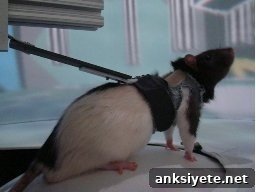
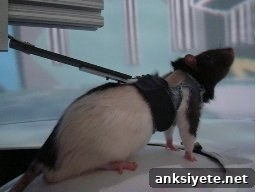
Mehta, a professor of neurophysics with appointments in neurology, physics and astronomy, has been exploring how brains form spatial maps and compute distance traveled. For this study, co-first authors Jesse Cushman and Daniel Aharoni and colleagues designed a virtual-reality apparatus that projected immersive visual scenes and played spatialized sounds while rats, secured in a harness, stood on a spherical treadmill that rotated as they moved. The researchers trained the rats to navigate to a precise location to receive sugar water delivered through a reward tube. By selectively turning visual and auditory components on or off, they could test navigation and reward anticipation across three conditions: audiovisual (both cues), visual-only, and auditory-only.
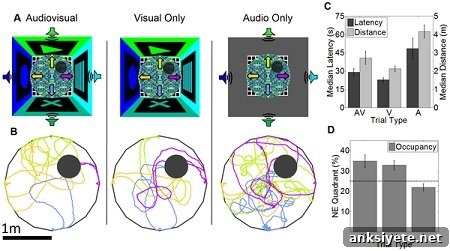
The virtual platform allowed the team to record precise locomotor paths and lick events simultaneously, providing the first clear measurements of how navigation and reward anticipation interact in a nearly real-world setting. Under audiovisual and visual-only conditions, rats developed accurate, direct paths to the reward and showed concentrated licking in the reward area. Under auditory-only conditions, however, locomotor accuracy dropped while licking still became concentrated near the reward location—a striking demonstration that sensory modality can differentially influence distinct behavioral outputs.
Prior assumptions held that all available stimuli would broadly influence behavior in similar ways. The new results challenge that view by showing that multisensory stimuli can have specialized effects: visual cues dominated locomotion and enabled precise navigation, while auditory cues alone were sufficient to evoke localized reward anticipation without guiding directed movement.
By revealing that the legs and the tongue can reflect different internal representations of space depending on sensory inputs, this research opens new avenues for exploring how multimodal information is integrated by the brain to support coordinated behavior. These insights also contribute to the broader understanding of how animals—and by extension humans—learn to predict rewards and choose efficient paths through complex environments.
Notes about this behavioral neuroscience research
Other authors on the study include Bernard Willers, Pascal Ravassard, Ashley Kees, Cliff Vuong, Briana Popeney and Katsushi Arisaka. Funding was provided by the National Science Foundation (Career award), the National Institutes of Health (grant 5R01MH092925-02) and the W. M. Keck Foundation to Mayank Mehta.
Contact: Mark Wheeler, UCLA
Source: UCLA press release and the open-access research article “Multisensory Control of Multimodal Behavior: Do the Legs Know What the Tongue Is Doing?” published online in PLOS ONE (2013).
Image Sources: Rat image adapted from UCLA. Second image adapted from the PLOS ONE research paper by Jesse D. Cushman, Daniel B. Aharoni, Bernard Willers, Pascal Ravassard, Ashley Kees, Cliff Vuong, Briana Popeney, Katsushi Arisaka and Mayank R. Mehta.
Video: Video of the task is available from UCLA.
Keywords: virtual reality, multisensory navigation, reward anticipation, rats, spatial mapping, behavioral neuroscience, PLOS ONE.