
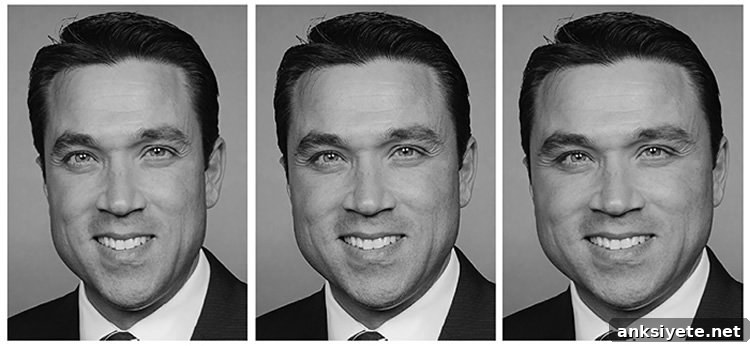
Summary: Researchers report that people can, with better-than-chance accuracy, judge whether a politician has been convicted of corruption simply by looking at a portrait.
Source: Caltech
An old joke says you can tell when a politician is lying by whether their lips are moving. New research suggests people can also pick up cues about a politician’s honesty from their face — not from speech, but from facial appearance.
Caltech researchers ran a series of studies showing that when people view photos of unfamiliar politicians, they can judge with greater-than-random accuracy which officials have been convicted of corruption. These judgments rely on rapid first impressions formed from a single portrait, and one facial feature in particular — face width — appears to play a key role.
Individually, observers scored only slightly above chance, though their performance was statistically significant. When combined, however, group judgments became much more reliable, indicating a consistent pattern in how people interpret facial cues.
Previous work has linked the facial width-to-height ratio — a measure of how wide a face is relative to its height — to aggressive behavior in men. Wide-faced men tend to be perceived as more aggressive and threatening, and some studies find they behave more aggressively on average. The Caltech team’s work extends these findings to perceptions of political corruption: observers consistently judged wider faces as more likely to be corruptible.
The researchers stress that their findings do not prove that wide-faced politicians are inherently more corrupt. The results show a correlation between facial appearance and conviction records, but several explanations are possible. For example, politicians who look untrustworthy may be targeted for bribes more often. Alternatively, they may simply attract more suspicion, investigations, and convictions because their appearance biases observers, prosecutors, or juries.
“People make rapid judgments from faces all the time,” says Chujun Lin, a Caltech graduate student and co-author. “On dating sites, for example, users often reject potential matches after seeing a photo without reading the profile. Faces drive first impressions.” Lin also notes that politicians labeled “clean” in the study may not actually be free of wrongdoing — they may simply have not been caught or convicted.
The study, published in the journal Psychological Science, consisted of four parts.
Part 1: The researchers collected 72 black-and-white, similarly cropped frontal portraits of male, Caucasian politicians who had held state or federal office. Half of the individuals had been convicted of corruption; half had no convictions on record. One hundred volunteers rated each photo on perceived corruptibility, dishonesty, selfishness, trustworthiness, and generosity. Aggregated across raters, the group successfully distinguished corrupt from non-corrupt politicians nearly 70 percent of the time based on faces alone.
Part 2: To replicate the first result, the team used 80 photos of California state and local officials. Half had violated the California Political Reform Act and half had clean records. Again, combined judgments distinguished the two groups at roughly the same rate.
Part 3: Using the images from Part 1, a new set of volunteers judged politicians on corruptibility as well as aggressiveness, masculinity, competence, and ambition. The only traits that reliably separated convicted officials from those with clean records were those related to corruptibility — perceptions of dishonesty, selfishness, aggressiveness, generosity, and trustworthiness. Perceived competence, ambition, or masculinity did not predict conviction history.
Part 4a: The team measured eight facial features for each politician — distances and sizes such as interocular distance, cheekbone prominence, nose length, and face width. Comparing those measurements to observer ratings and to corruption records revealed that higher facial-width-to-height ratios were associated with being judged more corruptible.
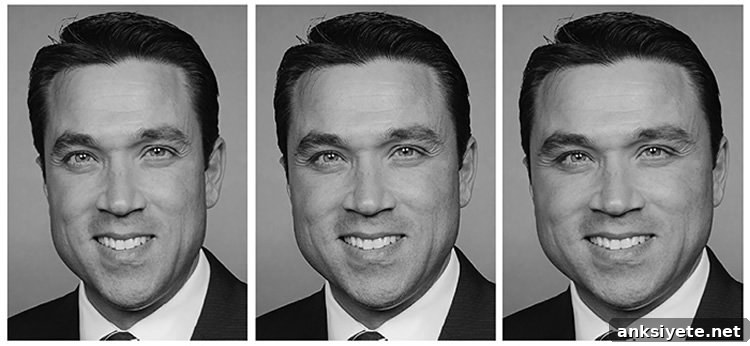
Part 4b: To test causality, the researchers digitally altered 150 political portraits to create wider and narrower versions of each face, producing 450 images including the originals. One hundred participants rated all images for perceived corruptibility. The wide-faced versions were judged consistently more corruptible than the narrow-faced versions, supporting the idea that face width causally influences these negative impressions.
Co-author Ralph Adolphs, Bren Professor of Psychology, Neuroscience, and Biology and director of the Caltech Brain Imaging Center, emphasizes that a photo is only one source of information. “In real life you see politicians speak and move,” he says. “A face may create a first impression, but behavior, speech, and context can override that initial judgment.”
Lin, who previously examined facial features and electoral success across cultures, plans to expand this line of work. Her next project will ask volunteers to judge a wider range of people on 100 characteristics — such as helpfulness, meanness, and health — based solely on facial appearance.
Funding: Research support came from the Caltech Conte Center for Neurosciences and the National Institute of Mental Health.
Source: Emily Velasco, Caltech
Publisher: Organized by NeuroscienceNews.com
Image credit: Caltech
Original research: “Inferring Whether Officials Are Corruptible From Looking At Their Faces” by Chujun Lin, Ralph Adolphs, and R. Michael Alvarez, published in Psychological Science (September 12, 2018). DOI: 10.1177/0956797618788882.
The authors investigated whether trait inferences from faces relate to a real-world behavioral outcome: political corruption. Across four preregistered studies with 325 participants rating unfamiliar officials from photos, convicted federal and state officials and local officials who violated campaign finance laws were judged as more corruptible, dishonest, selfish, and aggressive than peers with clean records. These differences did not extend to perceptions of competence, ambition, or masculinity. Mediation analyses and experiments in which photos were digitally widened or narrowed showed that perceived corruptibility was causally influenced by facial width. The findings illuminate complex links between facial appearance and social behavior.