
Summary: Struggling to quit smoking? New research shows a common genetic mutation can increase the likelihood of nicotine relapse by altering brain responses to nicotine.
Source: Institut Pasteur.
Genetic Mutation Increases Risk of Nicotine Relapse after Quitting
Why is it so hard to stop smoking, and why do some people relapse months after quitting? Researchers at the Institut Pasteur and the CNRS, together with teams from Sorbonne University and Inserm, have identified a genetic cause that helps explain this problem. Their study shows that a common mutation in the CHRNA5 gene, which affects the α5 subunit of nicotinic acetylcholine receptors, promotes relapse to nicotine-seeking behavior in a rat model. The findings were published in the journal Current Biology on October 4, 2018.
Tobacco addiction is a chronic, relapsing condition with a strong genetic component and remains a leading preventable cause of death globally. Nicotine, the primary psychoactive compound in tobacco, produces addiction by binding to nicotinic receptors in the brain, activating reward circuits and producing feelings of reinforcement and well-being. The sensitivity of those nicotinic receptors therefore plays a central role in determining an individual’s tobacco consumption and the likelihood of dependence.
Large-scale human genetic studies have previously linked a non-synonymous single nucleotide polymorphism (SNP) in CHRNA5—often referred to as the α5SNP—with a higher risk of nicotine dependence and greater difficulty quitting. This polymorphism is common: roughly 35% of Europeans and up to 50% of people in parts of the Middle East carry the variant. To investigate how this polymorphism contributes to tobacco addiction, the Integrative Neurobiology of Cholinergic Systems Unit used a precise genetic engineering approach to create rats that express the human α5 variant. The team then examined the animals’ behavior under controlled nicotine self-administration and relapse paradigms.
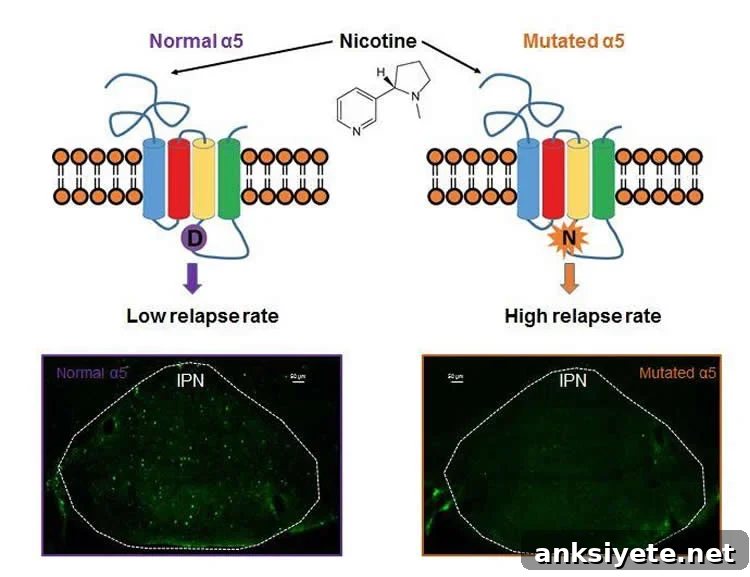
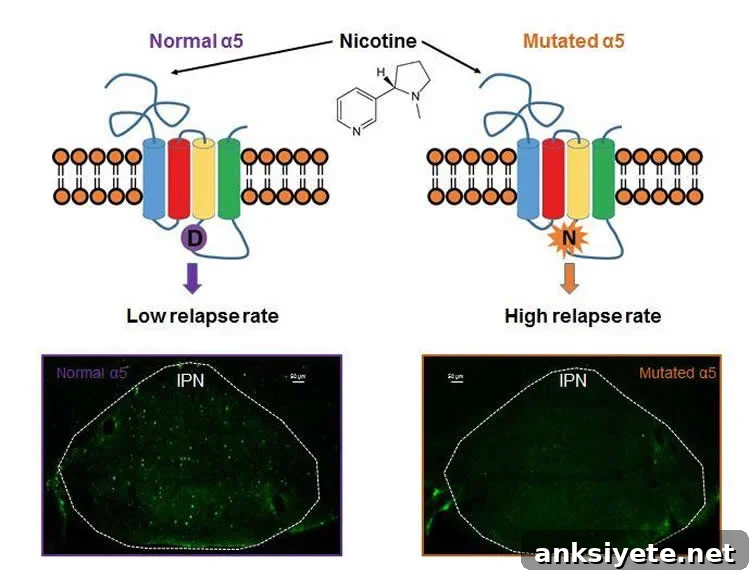
Key behavioral findings showed that rats carrying the α5 polymorphism self-administered more nicotine when higher doses were available and displayed a stronger tendency to reinstate nicotine-seeking behavior after a period of cessation. In other words, the mutation increased both high-dose nicotine intake and the propensity to relapse when animals were re-exposed to nicotine-associated cues or nicotine itself.
At the neural level, the increased relapse was associated with reduced activation in the interpeduncular nucleus (IPN), a brain region enriched in α5-containing nicotinic receptors and known to be part of networks that mediate aversive and regulatory responses to nicotine. Electrophysiological recordings confirmed that the IPN neurons of mutant rats responded differently to nicotine compared with wild-type animals, consistent with altered receptor function. The authors suggest that this reduced IPN reactivity may impair circuits that normally help limit nicotine-seeking after cessation, thereby promoting relapse.
These results give a clearer picture of how the α5 polymorphism contributes to multiple stages of nicotine dependence: it increases consumption at higher nicotine doses and raises vulnerability to relapse. Understanding this dual effect is important because it mirrors patterns seen in humans and points to neural circuits—particularly the IPN—that underlie the increased behavioral susceptibility.
Implications for Treatment and Prevention
The study suggests a potential therapeutic strategy: drugs that increase the activity of nicotinic receptors containing the α5 subunit might reduce tobacco consumption and lower the risk of relapse after quitting. Targeting receptor function in the IPN or related circuitry could be a promising route for new cessation aids, especially for individuals who carry the CHRNA5 polymorphism.
About this research
Lead author Benoit Forget and senior author Uwe Maskos report that this work used zinc finger nuclease technology to generate transgenic rats expressing the human CHRNA5 polymorphism and combined behavioral, electrophysiological, and anatomical approaches to probe mechanisms. The full study is titled “A Human Polymorphism in CHRNA5 Is Linked to Relapse to Nicotine Seeking in Transgenic Rats.” The research was funded by participating institutions, the French Foundation for Medical Research (FRM), the European Commission (FP7), and the French National Cancer Institute. Authors include Benoit Forget, Petra Scholze, Francina Langa, Alexandre Mourot, Philippe Faure, and Uwe Maskos. The paper appears in Current Biology and is associated with DOI 10.1016/j.cub.2018.08.044.
Abstract (Summary)
The CHRNA5 α5SNP is a frequent non-synonymous polymorphism associated with increased risk for tobacco dependence and delayed cessation. To dissect neuronal mechanisms that increase vulnerability in carriers of this polymorphism, researchers created transgenic rats carrying the human variant and evaluated nicotine self-administration, reinstatement of nicotine-seeking, and neuronal responses to nicotine. Mutant rats self-administered more nicotine at high doses and showed greater nicotine-induced reinstatement compared with wild-type rats. Elevated reinstatement correlated with altered activity across interconnected brain regions, notably the interpeduncular nucleus (IPN), which strongly expresses α5-containing receptors. Electrophysiology confirmed altered IPN neuron reactivity to nicotine in mutant animals. These findings indicate that the α5 polymorphism is a major risk factor for high-dose nicotine intake and relapse to nicotine seeking, and they highlight the IPN as a key structure in this increased vulnerability.
Source attribution: Institut Pasteur. Research organized and summarized from the published study in Current Biology (October 4, 2018).