

Carnegie Mellon psychologists uncover critical relationship between working memory and strength of information ‘chunks’.
People recall familiar acronyms like FBI, CIA, JFK, IRS and USA more easily than random letter strings such as BIC, IAJ, FKI, RSU and SAF. That difference illustrates a long-recognized learning principle: short-term or working memory capacity is influenced by whether discrete items can be “chunked” into larger, meaningful units. New research from Carnegie Mellon University expands this principle by demonstrating that not only does chunking matter, but the familiarity or strength of those chunks directly affects how easily new facts are learned.
Published in Psychonomic Bulletin & Review, the study shows that novel information built from more familiar constituents is learned faster and more accurately than information composed of less familiar pieces. The findings carry practical implications for classroom instruction, curriculum design, and second-language teaching. They also challenge the assumption that children have strictly lower working memory capacity than adults; differences in chunk familiarity may explain apparent developmental disparities.
Lynne Reder, professor of psychology in the Dietrich College of Humanities and Social Sciences and a leading expert on memory and cognition, explained the core idea: “Working memory capacity is not a fixed quantity. It interacts with how familiar the elements are that must be processed. When components are familiar, comprehension and knowledge building are easier; when components are unfamiliar, the same task quickly becomes difficult or impossible.”
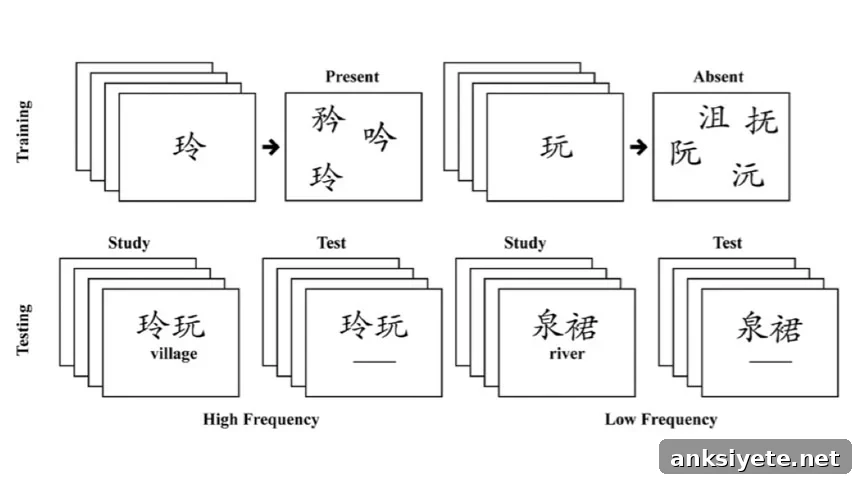
To test this hypothesis, the research team recruited 20 Carnegie Mellon undergraduates who had no prior experience with Chinese characters. Over the course of a month, participants attended three-hour study sessions once per week. During these sessions they practiced visual search tasks that required discriminating among 64 visually similar Chinese characters. Half of those characters were shown at a much higher frequency—about 20 times more often—so that those characters became significantly more familiar; the remainder were presented infrequently and remained low in familiarity.

Each week participants took a memory test that required them to learn associations linking a pair of Chinese characters to an arbitrary English word. Importantly, each pair was novel each week and constructed either from two high-frequency (familiar) characters or two low-frequency (less familiar) characters. Across sessions, participants showed clear improvement on the cued-recall task. Crucially, pairs built from the more familiar characters were learned more easily than pairs composed of less familiar characters, even though every pair itself was new.
Reder and her colleagues reasoned that stronger, more familiar chunks consume fewer working memory resources, leaving more capacity available to form new associations. To test this mechanism directly, participants also performed a standard working-memory test (an N-back task) using the same characters. Performance on the N-back task was markedly better when it used the high-frequency characters, consistent with the idea that familiar constituents are less demanding on working memory.
The study has immediate applications for instructional design. Concepts and building blocks should be presented and practiced until they become familiar before teachers ask students to combine them into more complex structures. This staged approach minimizes working-memory load and promotes more efficient learning. The research may also shed light on why children sometimes appear to learn certain skills—like new software or languages—more readily than adults. Children might actually possess comparable working memory resources but rely on smaller, weaker knowledge chunks; adults’ broader knowledge can mask differences in raw working-memory capacity.
Reder summarized the broader educational takeaway: “Building knowledge requires bricks, not sand. When constituents are strong and familiar, learners can combine them into new knowledge more effectively.”
The research team included Lynne Reder, Xiaonan Liu, Alexander Keinath, and Vencislav Popov. The study received partial support from the National Institute of Mental Health. The work appears as “Building knowledge requires bricks, not sand: The critical role of familiar constituents in learning” in Psychonomic Bulletin & Review (published online July 3, 2015). DOI: 10.3758/s13423-015-0889-1.