Summary: New laboratory research shows that the SARS‑CoV‑2 nucleocapsid (N) protein can bind to the neuronal protein alpha‑synuclein and accelerate the formation of amyloid fibrils—structures implicated in Parkinson’s disease.
Source: ACS
Several case reports describing relatively young people who developed Parkinson’s-like symptoms weeks after COVID‑19 infection have raised questions about a possible biological link between SARS‑CoV‑2 and Parkinson’s disease.
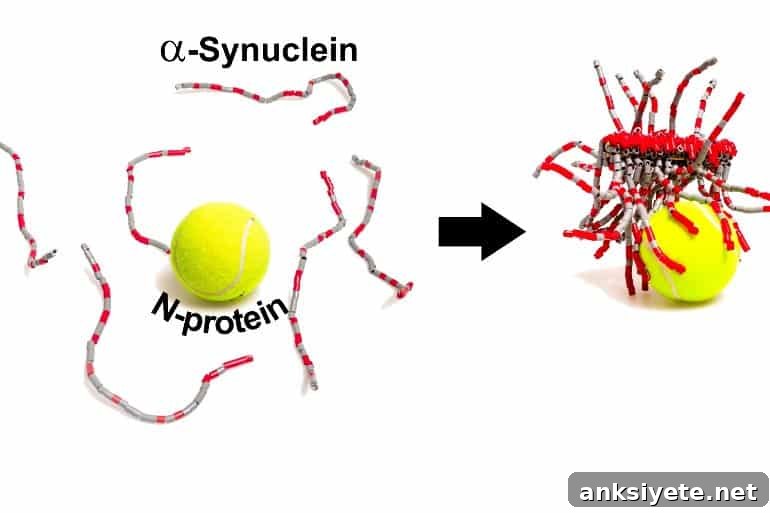
A new study published in ACS Chemical Neuroscience provides laboratory evidence that one viral protein—the nucleocapsid or N‑protein—can directly interact with α‑synuclein, a neuronal protein that forms abnormal amyloid fibrils in Parkinson’s disease. In controlled test‑tube experiments, researchers found that the presence of N‑protein dramatically speeds α‑synuclein aggregation, while the spike (S) protein shows no such effect.
SARS‑CoV‑2 infection is known for respiratory illness, but many patients also report neurological symptoms such as loss of smell, persistent headaches, and cognitive disturbances often described as “brain fog.” It remains unclear whether those symptoms arise from direct viral invasion of the brain or from immune responses and chemical signaling triggered by infection. The new findings focus on a third possibility: direct molecular interactions between viral proteins and neuronal proteins that might promote pathological protein aggregation.
In Parkinson’s disease, α‑synuclein misfolds and aggregates into dense amyloid fibrils that accumulate in neurons and contribute to the degeneration of dopamine‑producing cells. Notably, early loss of smell is a common pre‑motor sign in Parkinson’s disease, prompting the study’s authors to investigate whether SARS‑CoV‑2 proteins could influence α‑synuclein behavior.
The research team studied the two most abundant SARS‑CoV‑2 structural proteins: the spike protein, which mediates viral entry into host cells, and the nucleocapsid protein, which packages the viral RNA genome. Using an amyloid‑sensitive fluorescent probe in vitro, they tracked the kinetics of α‑synuclein aggregation. Without viral proteins, α‑synuclein required more than ten days (over 240 hours) to form detectable fibrils under the chosen conditions. Addition of the spike protein produced no measurable change, but inclusion of the N‑protein shortened aggregation time to under 24 hours—an acceleration of several orders of magnitude in these experiments.
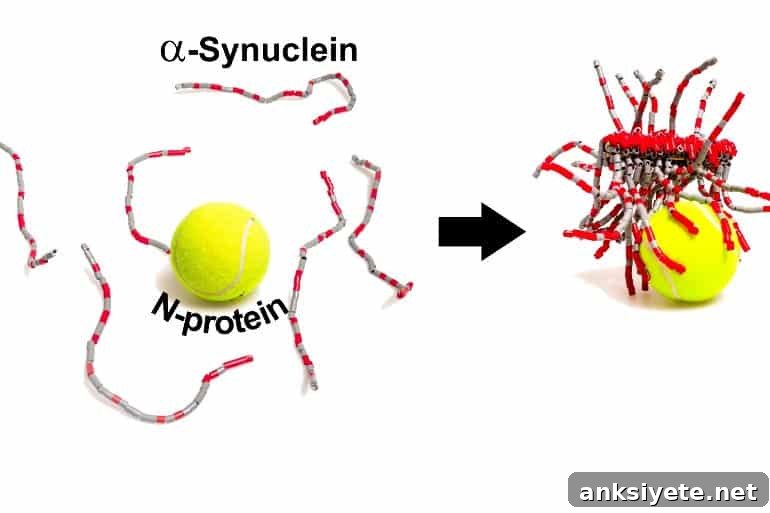
Biophysical assays indicated a direct interaction between N‑protein and α‑synuclein, driven in part by complementary electrostatic charges. The investigators estimated that each N‑protein particle can bind multiple α‑synuclein molecules—at least three to four copies per N‑protein—forming multiprotein complexes that appear to nucleate fibril formation.
To explore cellular consequences, the team microinjected N‑protein together with fluorescently labeled α‑synuclein into a neuronal cell model commonly used to study Parkinson’s disease. They used a concentration of N‑protein comparable to levels expected within an infected cell. Compared with cells injected with α‑synuclein alone, co‑injection with N‑protein roughly doubled cell death. The distribution of α‑synuclein within injected cells was also altered, and elongated intracellular structures were observed; however, the investigators did not definitively confirm those structures as amyloid fibrils within the cell model.
These results do not prove that the same interactions occur in human brains during COVID‑19, but they provide a plausible molecular mechanism that could contribute to post‑infection neurological complications or to the rare Parkinson’s‑like cases reported after SARS‑CoV‑2 infection. The authors emphasize caution: laboratory findings in vitro and in cellular models are initial steps that require follow‑up studies in biological systems that more closely replicate human brain tissue.
About this COVID‑19 research news
Author: Press Office
Source: ACS
Contact: Press Office – ACS
Image: The image is credited to the researchers / ACS Chemical Neuroscience
Original Research: Open access.
“Interactions between SARS‑CoV‑2 N‑Protein and α‑Synuclein Accelerate Amyloid Formation” by Slav A. Semerdzhiev et al., ACS Chemical Neuroscience
Abstract
Interactions between SARS‑CoV‑2 N‑Protein and α‑Synuclein Accelerate Amyloid Formation
Early clinical reports have suggested a potential association between SARS‑CoV‑2 infection and the appearance of Parkinsonism in some patients, but a causal relationship remains unproven. To investigate a possible molecular link, the authors examined how SARS‑CoV‑2 structural proteins influence the aggregation of α‑synuclein into amyloid fibrils, a hallmark of Parkinson’s disease.
In vitro experiments showed that the viral spike protein had no measurable effect on α‑synuclein aggregation, while the nucleocapsid (N) protein markedly accelerated fibril formation. The data reveal formation of multiprotein complexes that promote amyloid assembly. Microinjection of N‑protein into a neuronal cell model disturbed α‑synuclein homeostasis and increased cell death. These findings suggest direct interactions between SARS‑CoV‑2 N‑protein and α‑synuclein as a possible molecular basis for observed correlations between SARS‑CoV‑2 infection and Parkinsonism, warranting further investigation in more physiologically relevant systems.