
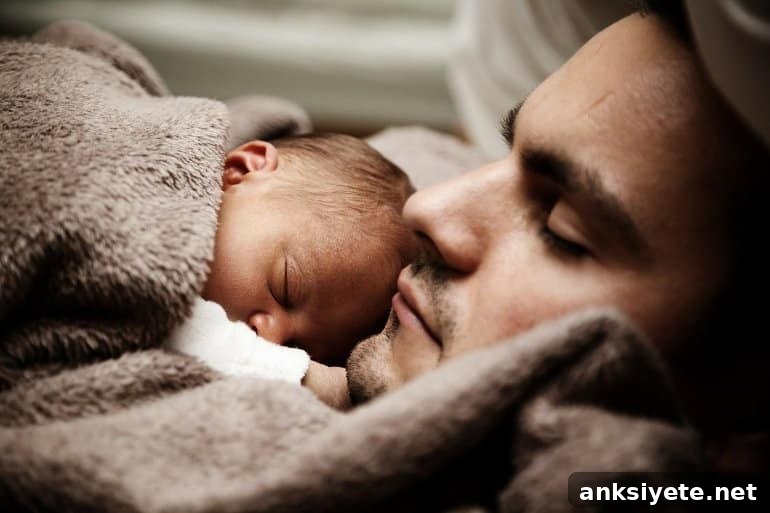
Summary: Expectant fathers who show stronger brain activation in theory-of-mind regions and higher prenatal oxytocin tend to endorse a more “baby-led,” empathetic parenting style after their child is born.
Source: USC
When a baby cries, caregivers must interpret needs without words. That ability depends on mentalizing—the imaginative capacity to infer another person’s thoughts, feelings and intentions. Mentalizing engages brain regions tied to “theory of mind,” which support understanding and empathy.
Although intuition about an infant is often associated with mothers, new research from USC Dornsife College of Letters, Arts and Sciences shows that expectant fathers also recruit mentalizing processes. Moreover, patterns of prenatal brain activation measured during mentalizing appear to relate to how fathers later describe their parenting approach.
Published in Developmental Psychobiology, the study examined first-time expectant fathers and found that stronger activation in theory-of-mind brain regions during a mentalizing task correlated with higher prenatal oxytocin levels. Those same fathers, after their child’s birth, were more likely to report a parenting style characterized by physical closeness and responsiveness to infant cues—a “baby-led” or attuned approach.
“Our findings suggest prenatal neural activation in theory-of-mind regions is linked to a postpartum father’s self-reported, intuitive parenting style,” says Sofia Cardenas, a psychology Ph.D. student at USC Dornsife and lead author of the study. In intuitive parenting, a close bond with the infant helps the parent recognize and respond to the child’s needs instinctively.
Cardenas began this work as a master’s project and has continued it as part of her doctoral research at USC Dornsife.
Activating fatherhood
The research involved 39 first-time expectant fathers who completed the Why-How Localizer task while undergoing functional MRI. The task presents images of people performing everyday actions—such as helping someone zip a dress or looking to the side—and asks participants to consider either “how” the action was done or “why” it was performed.
Focusing on “how” tends to activate brain systems involved in bodily and action-oriented processing. Focusing on “why” recruits social cognition and mentalizing networks associated with understanding intentions and emotions. Comparing the “why” versus “how” responses allowed researchers to isolate brain activity specifically tied to theory-of-mind processing.
While participants completed the task, the MRI recorded blood-flow changes, and researchers also collected blood samples to measure oxytocin. Several months after the birth, fathers returned to report their parenting beliefs and philosophies. Those who exhibited stronger theory-of-mind activation during the prenatal scan reported greater endorsement of attunement and baby-led parenting approaches.
Importantly, the study also found that higher prenatal oxytocin levels were associated with greater activation in specific brain regions during mentalizing. This is one of the first investigations to examine expectant fathers’ prenatal oxytocin alongside neural indicators of social cognition.
The sample size is modest, so the findings are preliminary, but they point to promising directions for understanding biological and cognitive contributors to fathering. “Fathers have been relatively understudied in neurobiological research on parenting,” Cardenas notes. She hopes the results will encourage larger studies focused on how men prepare for and adapt to parenthood.
Learning dad skills
Darby Saxbe, associate professor of psychology and the study’s corresponding author, highlights the practical implications. “Parenting is often framed as an intuitive skill tied to motherhood, while fathers may feel less naturally equipped,” she says. “But empathy and mentalizing are skills that can be developed. Training and practice could help fathers feel more confident and connected.”
Saxbe, who directs the Neuroendocrinology of Social Ties (NEST) Lab at USC Dornsife, and Cardenas are continuing research on hormonal and neural changes across pregnancy and the postpartum period for both parents. Their work aims to expand understanding of how biological and cognitive processes relate to caregiving behaviors.
About this parenting research news
Source: USC
Contact: Margaret Crable, USC
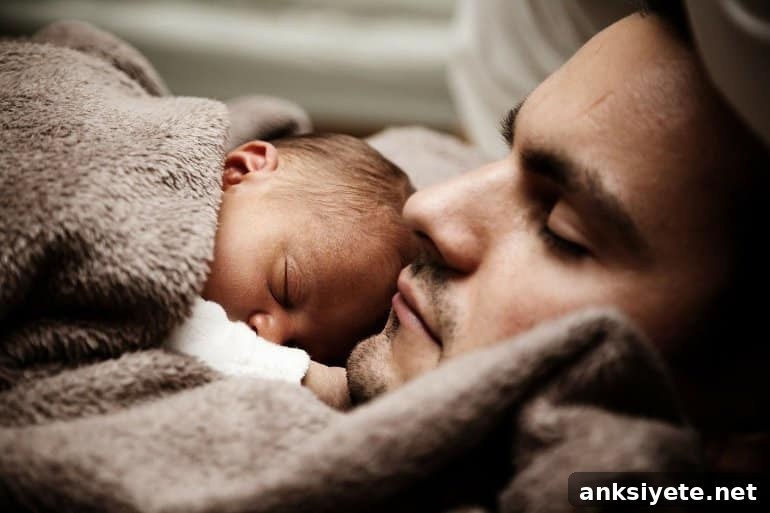
Image: The image is in the public domain
Original Research: Open access. “Theory of mind processing in expectant fathers: Associations with prenatal oxytocin and parental attunement” by Darby Saxbe et al., Developmental Psychobiology (citation via ResearchGate)
Abstract
Theory of mind processing in expectant fathers: Associations with prenatal oxytocin and parental attunement
Social cognition may support fathers’ sensitive caregiving. The study administered the Why-How Task, an fMRI paradigm that elicits theory-of-mind processing, to 39 expectant fathers who provided prenatal plasma samples for oxytocin assay. Three months postpartum, fathers reported their parenting beliefs.
The Why > How contrast revealed activation in theory-of-mind regions, including the dorsomedial prefrontal cortex and superior temporal sulcus. Prenatal oxytocin predicted greater signal change in the inferior parietal lobule for the Why > How contrast. Prenatal oxytocin and attunement parenting beliefs were associated with Why > How activation in the dorsolateral prefrontal cortex, a region implicated in emotion regulation.
Activation in the posterior parahippocampal gyrus and dorsolateral prefrontal cortex during the Why > How contrast predicted fathers’ attunement parenting beliefs. Overall, fathers’ neural responses during a theory-of-mind task were associated with prenatal oxytocin and with subsequent attuned parenting beliefs, suggesting intertwined biological and cognitive components to fathering.