
Summary: Mothers who report higher levels of parenting stress show reduced brain-to-brain synchrony with their young children compared with less stressed mothers. The findings reveal how everyday parenting stress can weaken mother-child attunement at a neural level.
Source: Nanyang Technological University
Overview
A study led by Nanyang Technological University (NTU Singapore) examined how parenting stress affects the neural connection between mothers and their children. The research measured brain activity in 31 mother-child pairs while they watched animated clips together and found that greater parenting stress was linked to diminished synchrony in the prefrontal cortex. This result suggests that parenting stress can interfere with a mother’s ability to share and understand her child’s perspective during routine interactions.
Study participants and setting
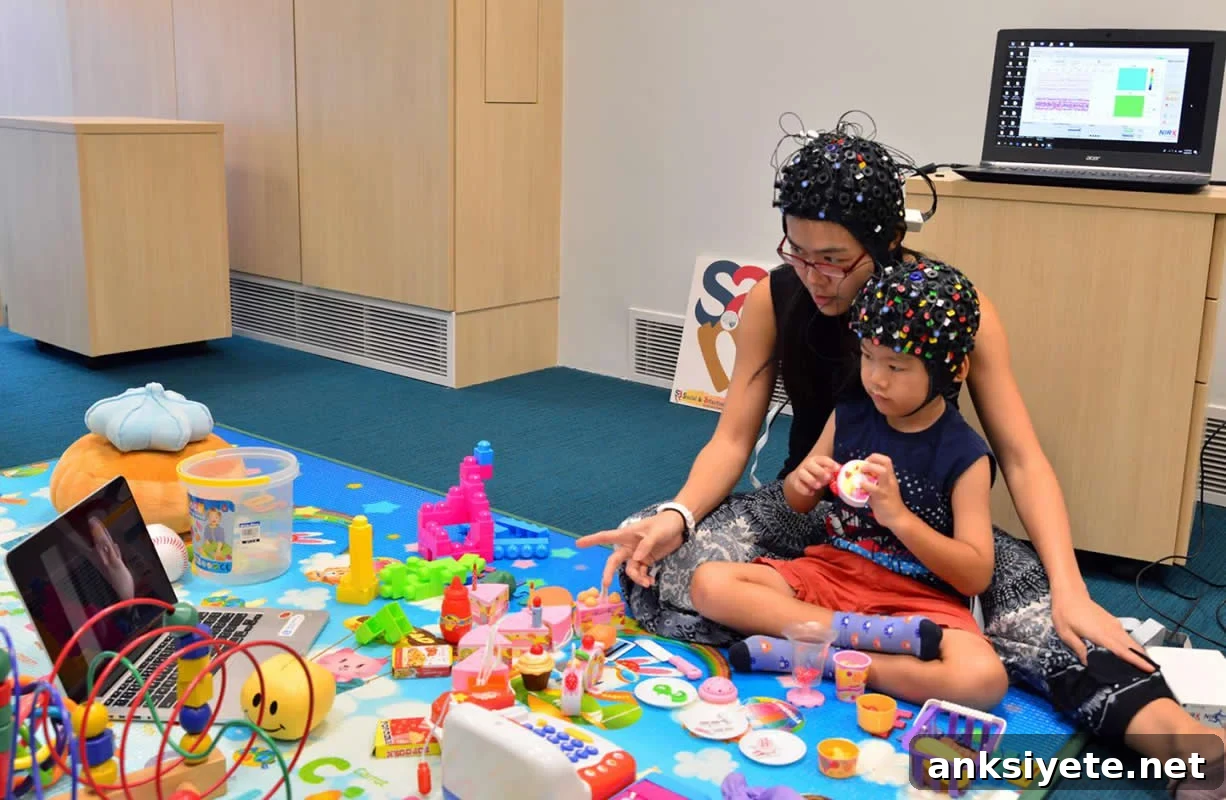
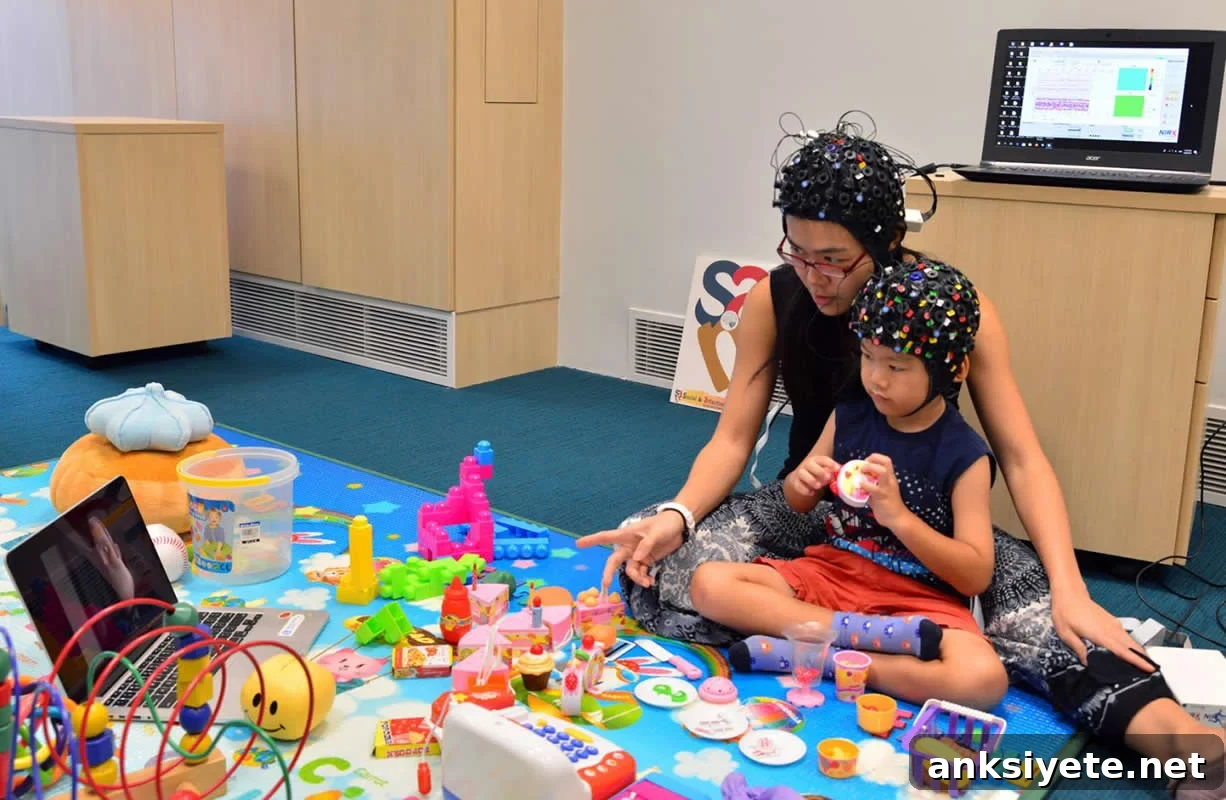
The study involved 31 mother-child dyads from Singapore. The children were about three years old. Each child sat on the mother’s lap while both wore non-invasive functional Near-infrared Spectroscopy (fNIRS) caps to record brain activation. During the measurement sessions, mother and child watched short animation clips together, drawn from commonly known children’s films and shows.
Methods
Researchers combined fNIRS with a hyperscanning approach that records the brain activity of two people simultaneously. Before the joint viewing task, mothers completed a validated parenting stress questionnaire that assesses the perceived demands of parenting relative to available coping resources. The core analysis compared neural signals from mothers and children to calculate brain-to-brain synchrony, focusing on the prefrontal cortex, a region linked to social cognition and perspective-taking.
Key findings
The primary result showed that mothers with higher self-reported parenting stress had significantly reduced synchrony with their children in a medial left cluster of the prefrontal cortex. This cortical area overlaps with regions implicated in inferring others’ mental states, attentional control, and executive function. By contrast, mothers reporting lower parenting stress demonstrated greater neural alignment with their children while engaging in the same, everyday activity.
High brain-to-brain synchrony is understood to reflect mutual attunement and shared emotional and cognitive engagement. The study therefore links elevated parenting stress to an erosion of this neural attunement, even during a passive, routine interaction like watching animations together.
Interpretation and implications
Assistant Professor Gianluca Esposito, senior author and head of the Social and Affective Neuroscience Lab (SAN-Lab) at NTU Singapore, noted that parenting stress may weaken early stages of mother-child communication by reducing a mother’s capacity to adopt her child’s perspective. This reduced perspective-taking may lower the quality of daily parental engagement and could, over time, undermine the mother-child relationship.
First author Atiqah Azhari, a PhD candidate at SAN-Lab, added that the strong association between parenting stress and brain synchrony during such a simple shared activity highlights the importance of maternal mental well-being for optimal cognitive and emotional engagement with young children.
Research context
Parenting stress arises when parents feel the demands of caregiving exceed their perceived coping resources. Excessive stress has been associated with reduced maternal sensitivity, more punitive responses, and poorer long-term parent-child outcomes. Previous work showed that parenting stress impacts behavioural synchrony; this study extends that knowledge by demonstrating an effect at the neural level using hyperscanning and fNIRS.
The research was conducted in collaboration with colleagues from the United States and Italy and was published in August 2019 in Scientific Reports. The authors emphasize that mother-child brain-to-brain asynchrony may partly explain the strong link between parenting stress and difficulties in dyadic co-regulation.
Source:
Nanyang Technological University
Image credit:
Nanyang Technological University
Original research: Azhari, Leck, Gabrieli, Bizzego, Rigo, Setoh, Bornstein & Esposito. “Parenting Stress Undermines Mother-Child Brain-to-Brain Synchrony: A Hyperscanning Study.” Scientific Reports. DOI: 10.1038/s41598-019-47810-4.
Abstract (summary)
Synchrony denotes coordinated behavioural and physiological signals that reflect mutual attunement. In mother-child pairs, synchrony indicates parental sensitivity and effective co-regulation. While parenting stress is known to reduce behavioural synchrony, its effect on brain-to-brain synchrony during everyday shared activities had not been clear. This study demonstrates that higher parenting stress correlates with reduced mother-child neural synchrony in a medial left prefrontal cluster during joint viewing of animation. This area is involved in mental-state inference and social cognition. The findings point to a neural mechanism by which parenting stress may impair mother-child interaction and provide a foundation for further studies on how stress undermines parent-child relationships.