
Summary: Using advanced live-cell super-resolution imaging, researchers have observed new patterns of molecular organization that form as neuronal connections grow stronger during learning-like stimulation.
Source: Thomas Jefferson University.
When we learn, the connections between neurons grow stronger. Conditions such as addiction and some neurodevelopmental disorders are associated with abnormally strengthened synapses. But what exactly changes at the cellular and molecular level during learning? Using live-cell super-resolution microscopy, researchers at Thomas Jefferson University examined synapses as they strengthened and discovered structural behaviors previously unseen.
The study was published April 23 in Nature Neuroscience.
“These observations offer a new framework for thinking about both healthy learning and maladaptive changes that occur in disorders such as addiction or autism,” said Matthew Dalva, Professor of Neuroscience at The Vickie and Jack Farber Institute for Neuroscience and Director of the Synaptic Biology Center at Jefferson.
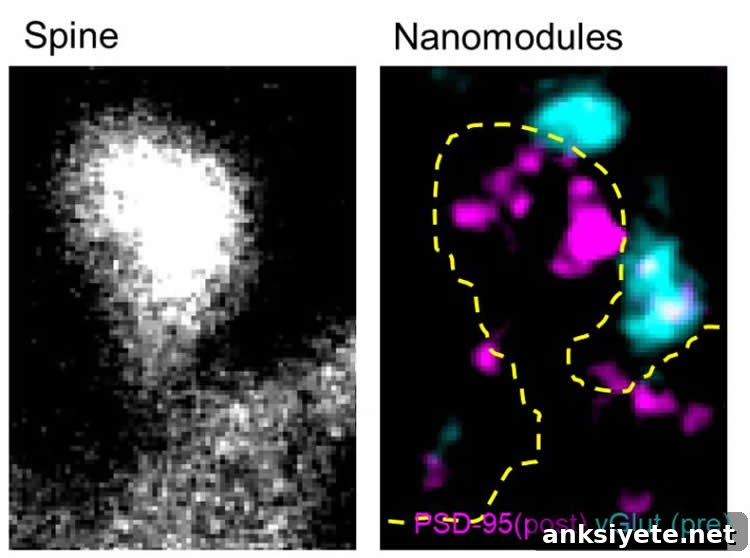
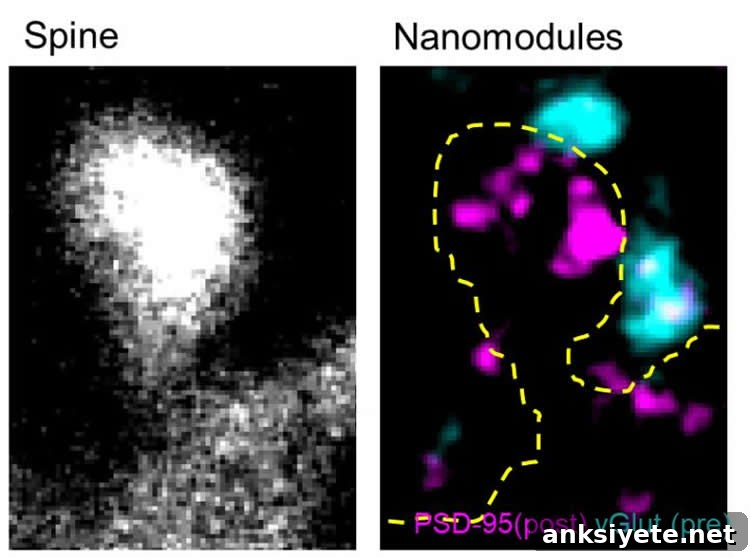
Instead of simply finding larger synaptic contacts during plasticity, Dr. Dalva and colleagues observed that key molecules on both sides of the synapse organize into compact clusters they call “nanomodules.” These nanomodules not only move in a coordinated way but also increase in number when the synapse is stimulated in patterns that mimic learning.
The team visualized living neurons in real time to examine synapses—the specialized sites where information is transmitted from one neuron to another. Using two-color imaging, they labeled presynaptic molecules (in green) and postsynaptic molecules (in red) to follow how the sending and receiving machinery behaved during stimulation.
Several unexpected findings emerged. Molecules on the presynaptic side aggregated into discrete clusters that tracked in close coordination with matching clusters on the postsynaptic side. These aligned pre- and postsynaptic clusters, or nanomodules, showed a consistent unit size across synapses. When neurons received stimulation that induced spine enlargement (spines are small protrusions on dendrites that house synapses), the number of nanomodules increased, and spine size grew in proportion. “This suggests synaptic strength may be adjusted by adding uniform modular units rather than by continuously scaling existing structures,” Dr. Dalva explained.
Another striking result was the dynamic behavior of nanomodules after stimulation. “A previously stable nanomodule began to oscillate and shift position around the synaptic spine when we applied signals that strengthen synaptic connections,” said first author Dr. Martin Hruska, an Instructor in Dr. Dalva’s lab. Importantly, the presynaptic and postsynaptic components moved together, remaining aligned throughout the activity-induced motion.
Although it remains uncertain how nanomodules behave in disease states, the new observations present a tangible set of features to investigate in conditions characterized by altered synaptic strength.
As with most advances, the findings raise additional questions for future research: What cellular mechanisms produce nanomodules of such uniform size? Do new nanomodules form de novo or split from existing ones as their number increases? What drives their coordinated motion during synaptic activation? And how are these modular units altered in disorders such as addiction or autism?
Funding: This research was supported by grants from the National Institute on Drug Abuse (NIDA), the National Institute of Mental Health (NIMH), and the Vickie and Jack Farber Foundation. The funders did not influence the study design, experimental conduct, or interpretation of results.
Source: Edyta Zielinska — Thomas Jefferson University
Publisher: Organized by NeuroscienceNews.com.
Image source: Matthew Dalva Lab, Jefferson (Philadelphia University + Thomas Jefferson University).
Original research: Hruska, M., Henderson, N., Le Marchand, S. J., Jafri, H., & Dalva, M. B. “Synaptic nanomodules underlie the organization and plasticity of spine synapses.” Published in Nature Neuroscience, April 23, 2018. DOI: 10.1038/s41593-018-0138-9.
Thomas Jefferson University. “What Learning Looks Like in the Brain.” NeuroscienceNews, April 23, 2018.
Abstract
Synaptic nanomodules underlie the organization and plasticity of spine synapses
Experience produces long-lasting increases in dendritic spine size, but the molecular reorganization underlying that structural plasticity has been unclear. Using multicolor stimulated emission depletion (STED) and confocal imaging in rodent preparations, the investigators show that synapses are composed of discrete, aligned subdiffraction-scale modules of pre- and postsynaptic proteins whose number scales with spine size. Live-cell, time-lapse super-resolution imaging revealed that NMDA receptor–dependent spine enlargement is accompanied by increased mobility of aligned pre- and postsynaptic modules and by a coordinated increase in their number. These results support a model in which experience-dependent structural plasticity is achieved through the addition and dynamic coordination of modular nanomolecular units at synapses, rather than by continuous, uniform expansion of existing molecular assemblies.