
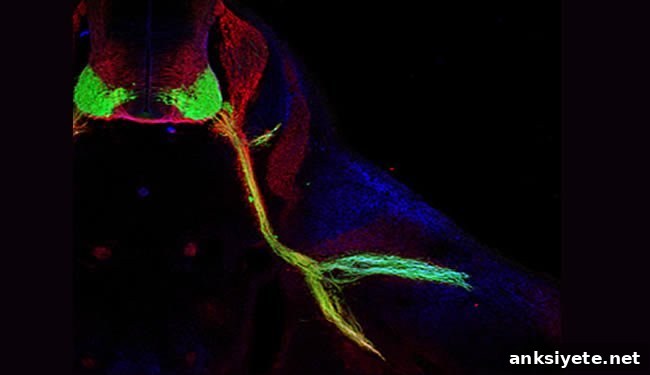
Discovery provides clues to development of neurological diseases and cancer.
Researchers at the Salk Institute have revealed a surprising feature of early nervous system development that helps explain how complex neural wiring is programmed by a relatively small set of genes. Published in Cell, the study identifies how motor neuron axons interpret local cues during embryonic development and offers new avenues for understanding neurodevelopmental disorders, neurodegeneration such as amyotrophic lateral sclerosis (ALS), and certain cancers.
The team found that only a few key proteins located on the leading edge of a motor neuron’s axon—its outgoing electrical “wire”—and in the extracellular environment guide the growing nerve as it exits the spinal cord. These molecules act as attractants or repellents depending on the specific route the axon must take to reach and connect with its target muscle. By combining these signals in different ways, a limited set of genes can generate the vast diversity of wiring patterns required for proper nervous system function.
“A budding neuron must sense the environment it is moving through and decide whether to continue straight, turn left or right, or stop,” says Sam Pfaff, senior investigator on the study, professor in Salk’s Gene Expression Laboratory and a Howard Hughes Medical Institute investigator. “It accomplishes this by mixing and matching only a handful of protein products to form complexes that steer the growth cone, much like a GPS uses multiple signals to guide a car through an unfamiliar city.”
The study addresses a core problem in developmental neurobiology: how millions of distinct neuronal connections arise from a genome containing far fewer genes than the number of possible wiring outcomes. By focusing on motor neurons, which control muscle movements, the researchers traced how axons integrate multiple guidance cues to navigate long and often circuitous paths to their muscle targets. The researchers emphasize that similar mechanisms operate throughout embryonic nervous system development, where millions of axons continually interpret local information to make trillions of growth and branching decisions.
First author Dario Bonanomi, a postdoctoral researcher in Pfaff’s laboratory, notes the clinical relevance: “These motor neurons are the same cells that degenerate in diseases like ALS and are implicated in genetic conditions such as spinal muscular atrophy. Understanding how axons interpret guidance signals during development could inform efforts to promote regeneration or reestablish functional connections after injury or in disease.”
Central to the study is the role of the receptor tyrosine kinase Ret, which the team identified as a multifunctional coreceptor that integrates both diffusible and contact-mediated axon guidance signals. Ret can mediate both attractive and repulsive responses depending on the molecular context encountered by the growth cone. The researchers also describe how Eph receptors contribute to this combinatorial signaling network, further refining directional decisions made by growing axons.
Because both Ret and Eph family receptors have been linked to cancer when mutated or aberrantly activated, the findings provide a useful perspective on how mechanisms that guide neuronal growth during development can be repurposed or dysregulated in tumor formation. “The way cells detect and respond to signals in their environment appears to be a broadly conserved strategy,” Pfaff explains. “Many genes and proteins that play critical roles in embryonic development are also associated with cancer when their signaling is misregulated.”
The study’s insights into axon guidance and receptor cooperation deepen our understanding of the molecular logic that creates precise neural circuits. They also suggest potential targets and strategies for therapeutic development aimed at neurodegenerative disease, congenital wiring defects, and possibly cancer types linked to these signaling pathways. Continued research into how motor neurons combine limited molecular cues to produce specific wiring outcomes may help inform regenerative approaches that seek to repair or rewire damaged neural circuits.
Notes about this neuroscience research article
Funding: The work was supported by the National Institute of Neurological Disorders and Stroke and by the Howard Hughes Medical Institute.
Co-authors: Onanong Chivatakar, Ge Bai, and Karen Lettieri (Salk); Houari Abdesselem and Brian A. Pierchala (University of Michigan School of Dentistry); Till Marquardt (European Neuroscience Institute-Göttingen, Germany).
Contact: Salk News
Source: Salk Institute for Biological Studies press release
Image Source: Neuroscience image adapted from Salk News press release image with credit to Dario Bonanomi, Salk Institute for Biological Studies
Original Research: Abstract for “Ret Is a Multifunctional Coreceptor that Integrates Diffusible- and Contact-Axon Guidance Signals” by Dario Bonanomi, Onanong Chivatakarn, Ge Bai, Houari Abdesselem, Karen Lettieri, Till Marquardt, Brian A. Pierchala and Samuel L. Pfaff in Cell