
Researchers reveal how the alteration of a single nucleotide, the basic building block of DNA, could initiate fragile X syndrome, the most common inherited form of intellectual disability. The study appears in The Journal of Cell Biology.
Fragile X syndrome arises from a problem in the FMR1 gene on the X chromosome. In many people this begins with a premutation: a moderately expanded series of DNA repeats at one end of the FMR1 gene. Estimates suggest that about 1 in 230 women and 1 in 360 men carry this premutation. When the premutation is transmitted from a mother to her child, these repeats can expand further, converting the premutation into a full mutation that switches the FMR1 gene off. Loss of FMR1 expression prevents production of the FMRP protein, which plays a critical role in brain development and cognitive function, and this loss underlies the intellectual and developmental impairments seen in fragile X syndrome.
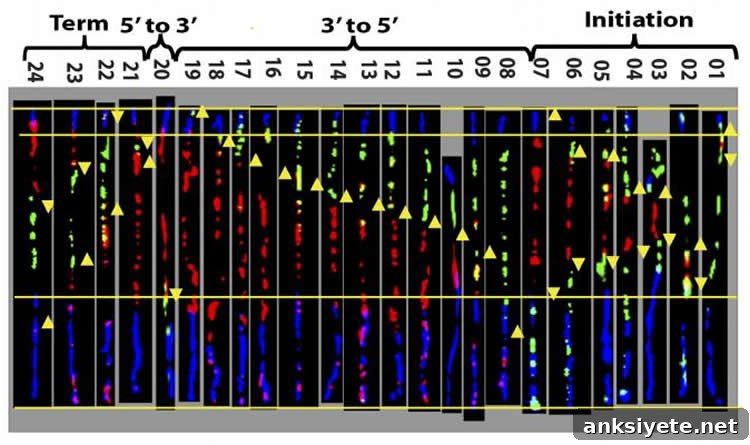
A team at Albert Einstein College of Medicine of Yeshiva University investigated how changes in DNA sequence and DNA replication behavior near the FMR1 gene might contribute to repeat expansions. Their earlier work showed that a DNA replication origin located adjacent to FMR1 is active in normal cells but becomes inactivated in embryonic stem cells derived from fragile X patients. Because replication origin activity determines how DNA is copied during cell division, inactivation of this origin can change the replication program for the region and create conditions that favor expansion of the repeat tract within FMR1.
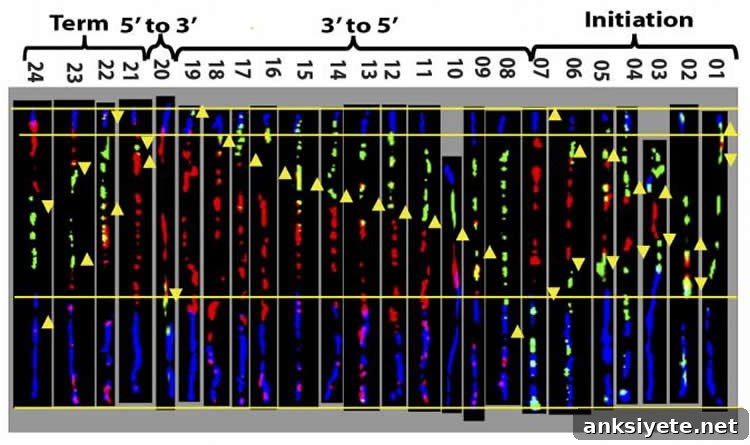
The researchers focused on a specific single-nucleotide polymorphism (SNP) located within the sequence that overlaps the replication origin near FMR1. A SNP is a change of one base in the DNA sequence—one of the four nucleotide bases: adenine, thymine, cytosine, or guanine. The team found that the base present at this SNP correlates with whether the replication origin is active or inactive in embryonic stem cells.
In their experiments, normal embryonic stem cells carried a thymine base at the SNP site and showed a robust, active replication origin. In contrast, fragile X embryonic stem cells that were prone to repeat expansion carried a cytosine at that position and displayed an inactive replication origin. To test how this SNP behaves in a maternal context, the researchers derived embryonic stem cells from women who carry the fragile X premutation. These maternal-derived stem cells carried the thymine base and maintained a normal replication pattern; importantly, they did not show progressive expansion of the repeat tract over time in culture.
Together these observations support a model in which a single-nucleotide substitution—cytosine replacing thymine—can disable a nearby replication origin during early development. When that inactivation occurs in the maternal germline or in early embryos, it may alter how the FMR1 region is copied during DNA replication and increase the probability that the repeat tract will further expand to a full mutation. Expansion to a full mutation silences FMR1 and leads to the clinical features of fragile X syndrome.
The study clarifies a specific molecular mechanism linking a common genetic variant (a SNP) with a change in DNA replication dynamics and with risk for repeat expansion at the FMR1 locus. By pinpointing a cis-acting DNA sequence that influences origin activity and repeat stability, the findings provide a clearer picture of the early molecular events that can initiate fragile X full mutation.
Research reported in this press release was supported by the National Institute of General Medical Sciences and the National Institute of Child Health and Human Development of the National Institutes of Health, the Empire State Stem Cell Fund, the Starr Tri-Institutional Stem Cell Initiative, and Neurogenomics.
Contact: Rita Sullivan King – Rockefeller University Press
Source: Rockefeller University Press press release
Image Source: The image is credited to Gerhardt et al. and is adapted from the Rockefeller University Press press release
Original Research: Abstract for “Cis-acting DNA sequence at a replication origin promotes repeat expansion to fragile X full mutation” by Jeannine Gerhardt, Nikica Zaninovic, Qiansheng Zhan, Advaitha Madireddy, Sarah L. Nolin, Nicole Ersalesi, Zi Yan, Zev Rosenwaks, and Carl L. Schildkraut in Journal of Cell Biology. Published online September 1, 2014 doi:10.1083/jcb.201404157