
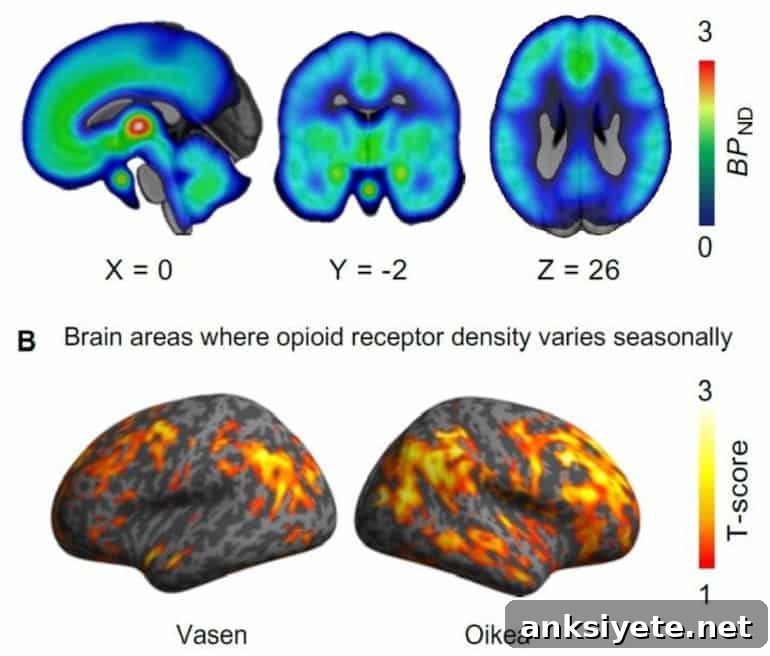
Summary: The length of daylight across seasons alters the availability of opioid receptors in the brain. These findings point to a possible biological mechanism contributing to seasonal affective disorder.
Source: University of Turku
Seasons influence mood and social behavior: negative emotions and social withdrawal are generally reduced in summer, while rates of seasonal affective disorder rise during the darker winter months. Opioid signaling in the brain plays a key role in regulating both mood and sociability.
Researchers at the Turku PET Centre in Finland examined how seasonal differences in daylight duration affect the brain’s µ-opioid receptors in both humans and rats. Using positron emission tomography (PET), they measured receptor availability across different times of year and under controlled daylength conditions in animals.
“We found that µ-opioid receptor availability depended on the time of year when the brain was imaged. The most pronounced changes occurred in brain regions that govern emotion and social behavior. These daylight-driven alterations in opioid receptors may be an important factor in seasonal affective disorder,” explains Postdoctoral Researcher Lihua Sun from the Turku PET Centre and the University of Turku.
Animal experiments confirm the effect of photoperiod
To determine whether daylight duration itself—rather than other seasonal variables—drives the observed changes, the team conducted controlled experiments in rats. Animals were housed under lighting schedules that simulated seasonal changes in daylength while control animals experienced a constant light cycle. PET imaging of the rats showed patterns similar to those seen in the human data.
“These results indicate that the duration of daylight is a particularly critical factor in the seasonal variation of µ-opioid receptors. Understanding this mechanism brings us closer to explaining how seasonal changes in mood and social behavior arise at the molecular level,” says Professor Lauri Nummenmaa from the Turku PET Centre.
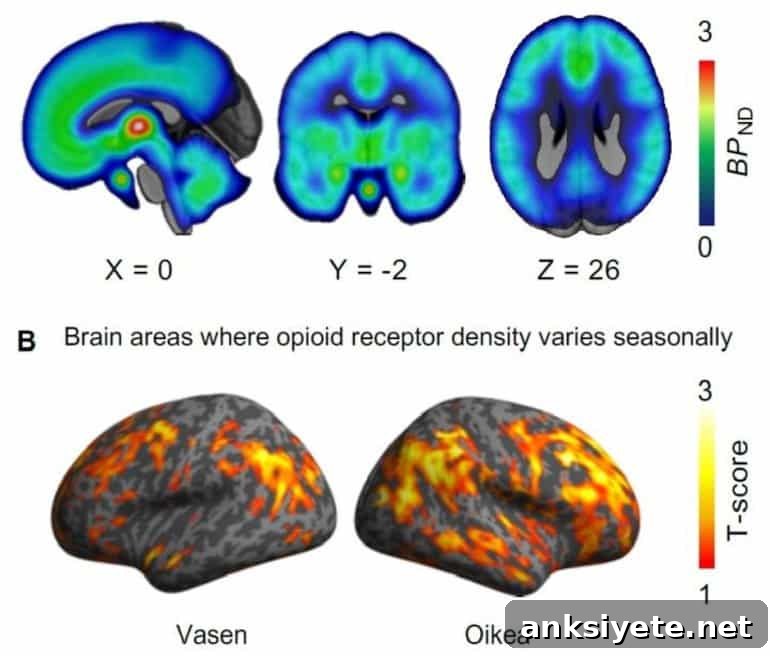
The human study used PET imaging and included 204 healthy volunteers. Participants received a small dose of a radioactive tracer that selectively binds to µ-opioid receptors, and tracer binding was quantified using PET scans. The human dataset was drawn from the AIVO database hosted by Turku University Hospital and the Turku PET Centre, a resource that contains in vivo molecular brain scans for extensive analyses. Complementary PET imaging in rats was performed at the Central Animal Laboratory, University of Turku, with technical support from the animal imaging team.
Findings and implications
Analysis revealed a distinct seasonal pattern in µ-opioid receptor availability. In humans, receptor availability followed an inverted U-shaped relationship with daylength: levels were highest at intermediate daylengths, peaking around spring. Regions that showed the strongest seasonal variation included areas involved in socioemotional processing and regulation.
In rats, similar effects were observed: µ-opioid receptor availability in the neocortex, thalamus, and striatum reached maximum levels under intermediate daylength conditions. In addition to receptor changes, varying daylength influenced physiological measures such as weight gain and stress hormone concentrations in the animals, demonstrating that photoperiodic changes produce measurable effects on both the brain and body.
Taken together, the human and animal results support the conclusion that cerebral µ-opioid receptor availability shows significant seasonal variation, predominantly linked to changes in daylight duration. Because µ-opioid receptor signaling is closely connected to mood regulation and social behavior, these findings suggest that seasonal modulation of the opioid system may underlie part of the seasonal fluctuations in human emotions and sociability, including susceptibility to seasonal affective disorder.
About this neuroscience research
Source: University of Turku
Contact: Lihua Sun – University of Turku
Image: The image is credited to University of Turku
Original Research: Closed access. “Seasonal Variation in the Brain μ-Opioid Receptor Availability” by Lihua Sun et al., Journal of Neuroscience
Abstract
Seasonal Variation in the Brain μ-Opioid Receptor Availability
Seasonal rhythms influence mood and sociability. The brain’s µ-opioid receptor (MOR) system modulates many socioemotional functions that vary by season, yet direct in vivo evidence for seasonal changes in MOR availability has been lacking. This study combined cross-sectional human PET data with controlled animal experiments to test whether daylength drives seasonal variation in MOR availability.
The human component analyzed previously acquired [11C]carfentanil PET scans from 204 healthy participants (132 male, 72 female) to assess seasonal patterns in MOR availability. The animal component exposed rats to simulated seasonal daylength cycles, with control animals kept under constant daylength; animals underwent repeated [11C]carfentanil PET imaging to track changes over time.
Results showed an inverted U-shaped relationship between daylength and MOR availability in humans, with peak availability at intermediate daylengths and effects concentrated in socioemotional brain circuits. In rats, MOR availability in neocortex, thalamus, and striatum also peaked at intermediate daylengths, and varying daylength affected weight gain and stress hormone levels. These findings indicate that MOR availability in both humans and rats varies seasonally, primarily in association with photoperiod.
SIGNIFICANCE STATEMENT
This study demonstrates that central µ-opioid receptor levels in human and rat brains change with daylength, peaking at intermediate photoperiods. Given the close relationship between MOR signaling and socioemotional behavior, seasonal modulation of the opioid system may help explain seasonal variations in mood and social behavior, including features of seasonal affective disorder.