
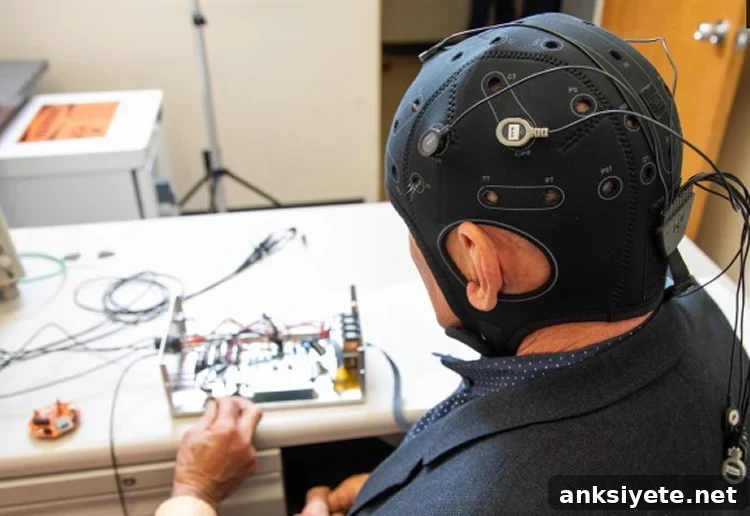
Summary: A new device that combines targeted electrical stimulation with simultaneous EEG recording could help restore lost brain function and improve treatments for neurological disorders.
Source: SLAC
A device under development at the U.S. Department of Energy’s SLAC National Accelerator Laboratory in collaboration with Stanford University aims to restore impaired brain function by delivering controlled electrical stimulation while measuring the brain’s real-time responses with EEG.
Researchers say the approach could enable new therapies for brain disorders and offer tools to selectively activate or suppress specific brain activities. Anthony Norcia, a professor of psychology at Stanford who initiated the project, explains that the ability to observe neural responses during stimulation is critical for understanding and optimizing treatments.
Noninvasive neurostimulation using electrodes on the scalp has shown therapeutic promise for conditions such as epilepsy, chronic pain, depression, and visual disorders. However, studying immediate brain responses to stimulation has been difficult because the stimulation pulses are many orders of magnitude stronger than the brain’s natural electrical signals. Traditionally, scientists had to record brain waves and behavior in separate sessions before and after stimulation. The new device is designed to record the brain’s electrical activity essentially at the same time stimuli are applied, providing a direct link between stimulation parameters and neural effects.
“The system functions much like radar: it sends an intentionally strong signal and then listens for the subtler responses,” says SLAC senior scientist Christopher Kenney. “We send brief electrical pulses into the head through EEG electrodes and then use the same electrodes, in the intervals between pulses, to detect the much weaker electrical signals generated by brain activity.”
Stimulating the Electrical Brain
The human brain is an intricate network of hundreds of billions of neurons. Disruption of that network, whether from abnormal development, injury, stroke, or other causes, can produce severe disorders including visual impairment, movement deficits, mood disorders, chronic pain, and sensory dysfunction.
Targeted electrical stimulation can change how groups of neurons fire and promote the formation of new neural connections. Norcia’s research team is applying these techniques to visual disorders such as amblyopia (lazy eye) and strabismus (misaligned eyes), and to investigate perceptual phenomena such as binocular rivalry—where two conflicting images presented to each eye compete for conscious awareness.
The team develops computational models that predict how electrical activity originating in visual brain areas propagates to the scalp and can be measured by EEG. They also model how applied electrical pulses can be shaped and targeted to influence specific brain regions associated with vision. These models help design electrode arrays and stimulation patterns intended to reach particular brain volumes while minimizing unwanted effects.
“Our modeling gives us a solid basis for designing electrode layouts to target specific locations inside the head,” Norcia says. “Crucially, we want to listen to the brain’s response during stimulation so we can determine whether a given pulse produced the intended change.”
A New Type of EEG
To overcome the technical barrier of recording neural signals during stimulation, Norcia partnered with SLAC experts in detector and electronics development, including Christopher Kenney and Martin Breidenbach. Their background in high-energy physics and multidisciplinary engineering helped tackle the problem of extracting weak brain signals amid strong stimulation pulses.
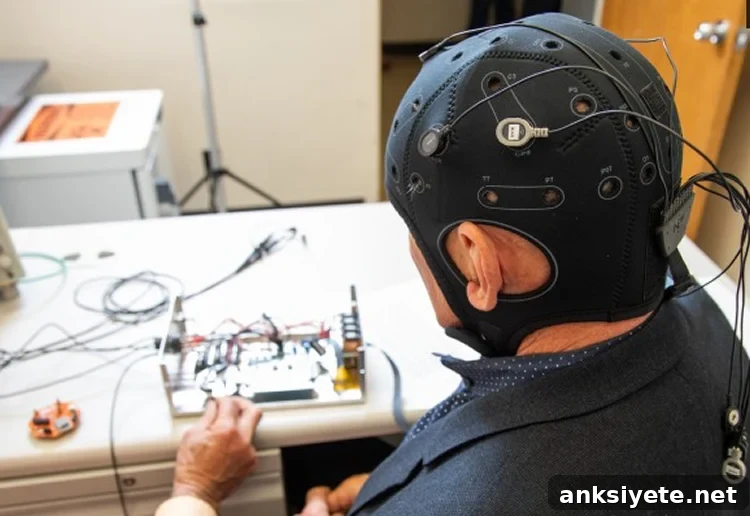
About a year after receiving funding through Stanford Bio-X, the group built and tested a prototype EEG system that can both deliver electrical stimulation and measure ongoing brain activity in near real time. The prototype pairs the electronics board from a conventional EEG monitor with a custom-built stimulation board powered by batteries. The team performed initial safety and functionality tests on themselves to validate the concept.
Toward Medical Therapy
Additional development is required before larger clinical studies can begin. Future versions of the system will include more electrodes and greater control over stimulation waveforms and targeting. Enhanced programmability will let researchers choose different pulse shapes, timing, and synchronization with external stimuli such as visual displays.
“At present we can switch stimuli on and off and adjust intensity and duration,” says Jeff Olsen, an electrical engineer at SLAC working on the project. “Next-generation devices will allow programmable waveforms and precise synchronization with other experimental triggers to study how combined sensory and electrical inputs shape neural plasticity.”
Longer-term goals include miniaturizing the electronics to a chip-scale device so that neurostimulation and monitoring could become portable and accessible to patients outside the laboratory or clinic.
Other collaborators on the project include Stephen Boyd, chair of Stanford’s Department of Electrical Engineering, and Nolan Williams, clinical assistant professor of psychiatry and behavioral sciences at Stanford. The work brings together expertise in psychology, neuroscience, electrical engineering, and detector technology to address a significant clinical and scientific challenge.
Source: Andrew Gordon – SLAC National Accelerator Laboratory
Publisher: NeuroscienceNews (article organized by NeuroscienceNews)
Image Source: Dawn Harmer / SLAC National Accelerator Laboratory
SLAC. “Next Generation EEG Could Help Bring Back Lost Brain Function.” NeuroscienceNews, June 27, 2018.
Feel free to share this article.