
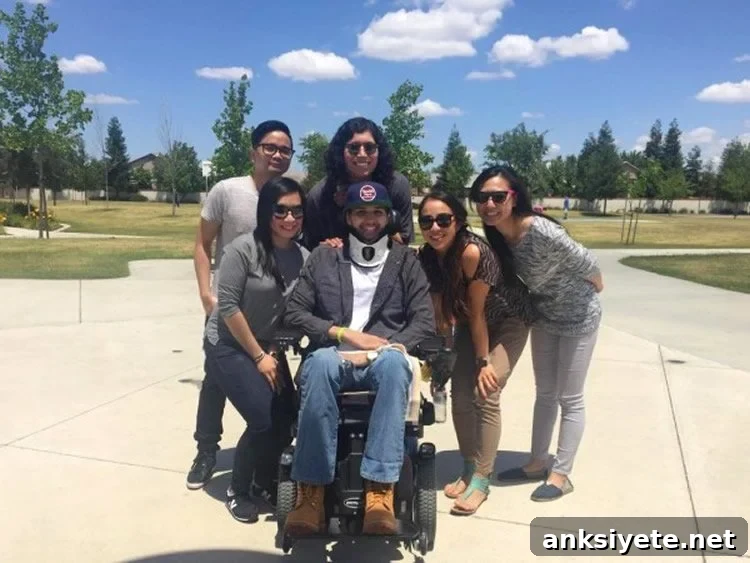
Summary: Doctors injected an experimental stem cell therapy, AST-OPC1, into the injured cervical spinal cord of a recently paralyzed young man, restoring meaningful hand and arm function.
Source: USC.
Initial results offer hope for patients to reclaim independence after severe spinal injury
Keck Medical Center of USC announced that a surgical team became the first in California to deliver an investigational stem cell treatment, AST-OPC1, into the damaged cervical spine of a recently paralyzed 21-year-old man as part of a multi-center clinical trial. The procedure aims to improve neurological recovery after severe spinal cord injury and restore functions that are critical for independent living.
On March 6, just days before his 21st birthday, Kristopher (Kris) Boesen of Bakersfield suffered a traumatic cervical spinal injury when his car fishtailed on a wet road, struck a tree and collided with a telephone pole. Initially, his parents, Rodney and Annette Boesen, were told their son faced a high likelihood of permanent paralysis from the neck down. They also learned Kris might qualify for a clinical study that offered a potential path toward recovery.
Working in collaboration with Rancho Los Amigos National Rehabilitation Center and Keck Medicine of USC, Charles Liu, MD, PhD, director of the USC Neurorestoration Center, led the surgical team that injected 10 million AST-OPC1 cells directly into Kris’ cervical spinal cord in early April. The procedure was performed within a narrow postoperative window defined by the clinical trial.
“Typically, spinal cord injury patients undergo surgery that stabilizes the spine but generally does very little to restore motor or sensory function,” said Dr. Liu. “With this study, we are testing a procedure that may improve neurological function, which could mean the difference between being permanently paralyzed and being able to use one’s arms and hands. Restoring that level of function could significantly improve the daily lives of patients with severe spinal injuries.”
Two weeks after the procedure Kris began to show measurable improvement. By three months he was able to feed himself, use his cell phone, write his name, operate a motorized wheelchair and embrace friends and family. He also gained improved sensation and movement in both arms and hands, making everyday self-care tasks and greater independence more attainable.
“As of 90 days post-treatment, Kris has gained significant improvement in his motor function, up to two spinal cord levels,” said Dr. Liu. “In Kris’ case, two spinal cord levels means the difference between using your hands to brush your teeth, operate a computer or do other things you wouldn’t otherwise be able to do, so having this level of functional independence cannot be overstated.”
Physicians remain cautious about predicting long-term outcomes, but the early functional gains are encouraging. Kris, who enjoys restoring and driving sports cars and had been studying to become a life insurance broker, said, “All I’ve wanted from the beginning was a fighting chance. But if there’s a chance for me to walk again, then heck yeah! I want to do anything possible to do that.”
Qualifying for the study and care coordination
Enrollment required careful timing and rapid coordination among surgeons, rehabilitation specialists, respiratory therapists and research staff. Because informed consent required Kris to confirm his participation verbally, he needed to breathe without a ventilator. While weaning from assisted breathing usually takes about three weeks, Kris achieved this in five days with intensive respiratory care. He completed a week of pre-surgery evaluations, imaging and testing before the injection.
The surgical team administered 10 million AST-OPC1 cells into Kris’ cervical spinal cord in early April. He was monitored closely and discharged nearly six weeks later to continue rehabilitation in Bakersfield. Post-treatment assessments took place at seven days, 30 days, 60 days and 90 days after injection, with additional detailed evaluations planned at 180 days, 270 days and one year.
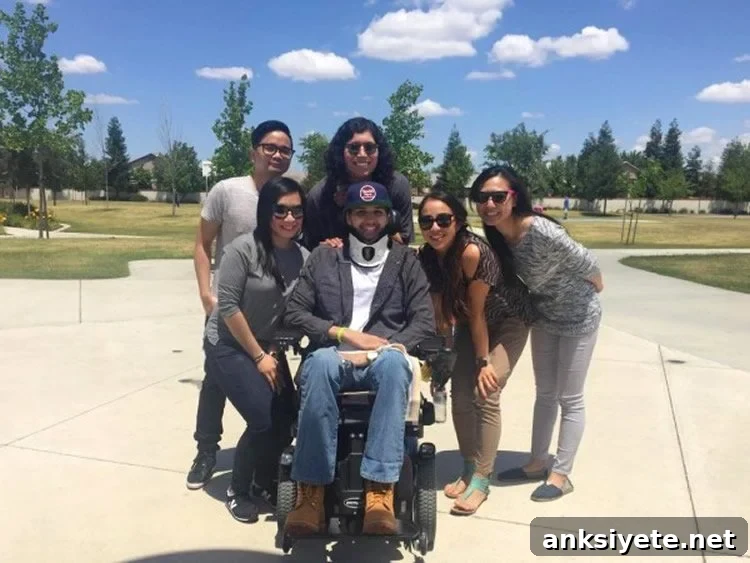
Rodney and Annette Boesen praised the level of teamwork that allowed Kris to participate. “So many things had to happen, and there were so many things that could have put up a roadblock,” Rodney said. “The people at Keck Medical Center of USC and elsewhere moved heaven and earth to get things done. There was never a moment through all of this when we didn’t think our son was getting world class care.”
About the AST-OPC1 study and regenerative approach
This pioneering surgery highlights progress in neurorestoration and regenerative medicine and their potential to change outcomes for people with severe spinal cord injuries. The treatment Kris received is part of a Phase 1/2a clinical trial assessing the safety and potential efficacy of escalating doses of AST-OPC1 cells, developed by Asterias Biotherapeutics in Fremont, California.
AST-OPC1 cells are derived from embryonic stem cells and differentiated into oligodendrocyte progenitor cells (OPCs), a cell type found in the brain and spinal cord that supports nerve cell function. Preclinical laboratory studies indicated that AST-OPC1 can produce neurotrophic factors, promote vascularization and encourage remyelination of denuded axons—processes that support neuron survival, axon regrowth and improved nerve impulse conduction at the injury site.
“At the 10 million cell level, we’re now in a dose range that is the human equivalent of where we were when we saw efficacy in pre-clinical studies,” said Edward D. Wirth III, MD, PhD, chief medical director of Asterias and lead investigator of the SCiStar study. “While we continue to evaluate safety first and foremost, we are also now looking at how well treatment might help restore movement in these patients.”
To be eligible for the clinical trial, participants must be 18 to 69 years old and receive an injection of AST-OPC1 between 14 and 30 days after injury, once their condition is stable. Keck is one of six U.S. sites authorized to enroll and treat eligible subjects at the clinical trial dosage.
The SCiStar clinical trial is being conducted at multiple centers, including Indiana University, the Medical College of Wisconsin, Rush University Medical Center, Shepherd Center, Stanford University/Santa Clara Valley Medical Center, and Rancho Los Amigos/Keck Medicine of USC. Early group results from the study were scheduled to be released in mid-September 2016.
This case underscores how coordinated acute care, rehabilitation and experimental regenerative therapies can work together to offer new possibilities for recovery after cervical spinal cord injury, potentially restoring hand and arm function that dramatically improves quality of life.
Source: Madeline McCurry-Schmidt, USC. Image credit: Marissa Hernandez, Keck Medicine of USC.