
A new study reveals how the brain rapidly constructs inferred contexts and rules when learning new tasks—even when such structure does not actually exist. The research, which identified reliable individual differences, explains how people generalize task knowledge to similar situations and may guide future work on learning disabilities and adaptive learning strategies.
Many everyday tasks are governed by unspoken contexts and consistent rules. People naturally look for patterns: for instance, a smartphone user switching platforms might expect display settings and brightness sliders to be found in a “settings” menu. This tendency to infer structure can speed learning when the world is organized, but it can also lead to mistakes if a context changes or if no higher-level structure exists. Brown University neuroscientists harnessed this human inclination to trace how the frontal cortex forms inferred rule structures during task learning and how those neural signals predict how a person will apply that structure to learn new tasks quickly.
“People live in an organized world, and over time they form priors that structure will exist,” said Anne Collins, a postdoctoral scholar in Brown’s Department of Cognitive, Linguistic, and Psychological Sciences and lead author of the study published in the Journal of Neuroscience. “When structure is present, learners can reduce the complexity of what they must learn by generalizing across situations in which the same elements tend to occur together. Generalization is efficient when structure exists, and in many real-world settings, some structure does.”
Imagined rules
To observe how inferred rules emerge in the brain, Collins and colleagues recorded EEG from the frontal region of 35 volunteers as they learned a set of simple stimulus-response tasks. Participants viewed combinations of colored shapes and learned by trial and error which response button was correct for each combination. After this initial learning phase, they encountered two additional tasks that used new colors or shapes.
The key experimental manipulation was that the base task had no underlying hierarchical rule structure: each color-shape pair could be learned independently. Nevertheless, participants were free to impose a higher-level rule in which one feature—either color or shape—served as a contextual cue governing how to respond to the other feature. That internally generated hierarchy could make later learning easier when subsequent tasks shared the same imposed structure, and harder when the new tasks demanded a different mapping.
Behaviorally, participants tended to impose one of these two plausible structures. Roughly half the subjects adopted a color-based context and the other half adopted a shape-based context, revealing a split in how people naturally organize experience when faced with ambiguous task structure.
Tangible signals
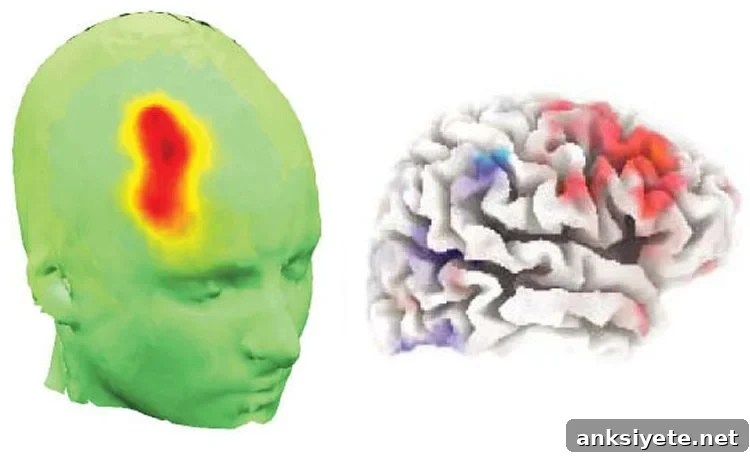
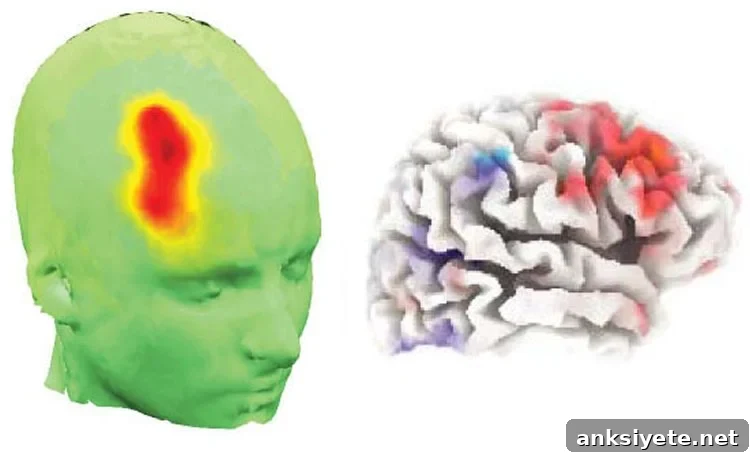
Using a cognitive model to guide their predictions, the researchers examined the timing and location of EEG signals across frontal brain regions. The model predicted a temporal sequence: first the prefrontal cortex would represent the abstract task structure, and only later would premotor regions formulate a concrete movement plan for the button press. The EEG data supported this sequence, showing a reliable progression from frontal (prefrontal) signals associated with inferred structure to more posterior frontal signals linked to action planning.
Crucially, the neural patterns revealed not only that participants were forming structure but also which structure they favored. EEG signatures allowed the researchers to decode whether an individual was using color as the contextual cue or shape as the contextual cue—information that was not available from the stimuli themselves but emerged from the brain activity patterns.
Individual variation
The study highlighted meaningful individual differences. The strength of the neural signature for structure formation correlated with how readily a person applied that inferred structure in subsequent tasks. Participants whose EEG showed a clearer representation of hierarchical structure in prefrontal regions were more likely to generalize that structure advantageously when new task environments matched their inferred organization.
“We see predictable neural signatures indicating when brains represent structure in the way our models predict,” said Michael Frank, associate professor of cognitive, linguistic, and psychological sciences and the paper’s corresponding author. “Those signatures relate to how well people generalize later on. This suggests the organization of prefrontal cortex supports searching for structure and using abstract rules to guide behavior.”
Beyond advancing basic understanding of cognition and frontal cortex dynamics, the findings may have applied value. Frank notes that individual variability in the tendency to infer structure could inform research on developmental conditions or learning disabilities in which forming abstract, generalizable representations is impaired. Mapping these neural differences could help explain why some learners struggle to generalize rules across contexts and may point to new assessment or intervention strategies.
Authors of the study include Anne Collins, Michael Frank, and James Cavanaugh. The research was supported by the National Institutes of Health and the National Science Foundation.
Contact: David Orenstein – Brown University
Source: Brown University press release
Image Source: Image credited to the Frank lab and adapted from Brown University materials.
Original Research: The study appears in the March edition of the Journal of Neuroscience.