
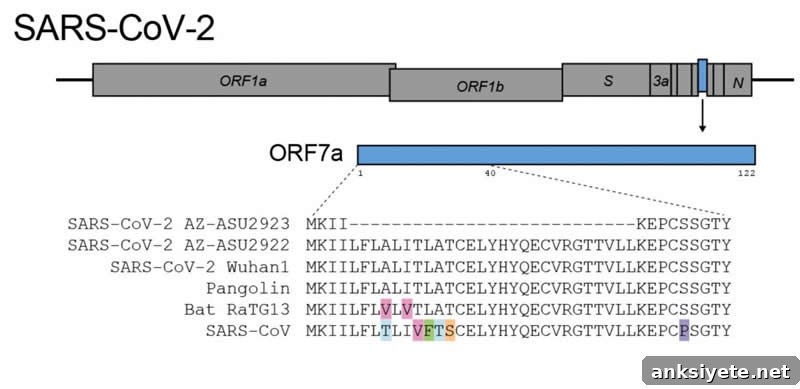
Summary: A new genetic sequencing study from Arizona State University shows that SARS-CoV-2—the virus that causes COVID-19—traces back to a single origin in Wuhan, China. Genomic data from early U.S. cases, however, indicate many infections were most likely introduced from Europe. The ASU team also discovered a previously unreported mutation: an 81-nucleotide deletion that removes 27 amino acids from the accessory protein ORF7a. This large deletion resembles a deletion observed during the 2003 SARS outbreak, which accumulated during later epidemic stages and was associated with virus attenuation and milder disease.
Source: Arizona State University
Tracking the virus through genomic sequencing
As the COVID-19 pandemic spread across the United States, researchers not only tracked case numbers but also worked to map how SARS-CoV-2 is evolving and moving through populations. Efrem Lim and his team at Arizona State University’s Biodesign Institute redirected their genomics expertise—originally focused on seasonal influenza—to rapidly sequence SARS-CoV-2 genomes from local cases.
Using next-generation sequencing at ASU’s Genomics Facility, Lim’s group reads the full SARS-CoV-2 genome—roughly 30,000 nucleotides—to identify mutations and trace chains of transmission. Each genome sequence is deposited into the global repository managed by the GISAID initiative. To date, over 16,000 SARS-CoV-2 genomes have been contributed to GISAID’s EpiCoV database, enabling worldwide comparisons that show a single origin in Wuhan while revealing regional introductions from other areas such as Europe.
Discovery of a novel 81-nucleotide deletion
From a set of 382 nasal swab specimens collected in Arizona, the ASU team identified a novel mutation: an in-frame deletion of 81 nucleotides in the gene that encodes the accessory protein ORF7a. This deletion removes 27 amino acids from ORF7a, a protein similar to the SARS-CoV ORF7a/X4 immune antagonist identified during the 2003 outbreak.
The study describing this finding was published online in the Journal of Virology. When Lim posted the manuscript as a preprint on medRxiv, it drew immediate interest from the scientific community, including inquiries from the World Health Organization.
Potential implications of the ORF7a deletion
Accessory proteins such as ORF7a help SARS-CoV-2 interact with host cells, counter immune defenses, and promote viral replication and spread. The ASU team notes that the 27–amino-acid deletion could alter how ORF7a functions. In the 2003 SARS epidemic, large deletions that accumulated over time were associated with attenuation—reduced virulence—potentially providing a selective advantage if a less severe virus transmits more effectively through asymptomatic or mildly symptomatic carriers.
While the new deletion has not been seen before in the GISAID database, its discovery provides an opportunity to study viral biology and pathogenesis. The ASU researchers are conducting follow-up experiments to determine the functional consequences of the ORF7a deletion, including how it might affect the virus’s ability to evade host defenses, induce cell death, or influence the timing and severity of disease symptoms.
Genetic diversity and local transmission in Arizona
Genomic analysis of positive cases in Arizona revealed that viral genomes from different patients were distinct from one another, indicating independent introductions rather than a single chain of transmission tied to the first Arizona case reported on January 26, 2020. Many of the early Arizona genomes analyzed were most consistent with introductions from Europe rather than direct spread from China.
Lim emphasizes the limited scope of current sequencing: only about 16,000 SARS-CoV-2 genomes have been sequenced so far, representing less than 0.5% of the more than 3.5 million confirmed COVID-19 cases worldwide at the time of the study. Expanded genomic surveillance is critical to understanding transmission routes, tracking mutations, and informing public health responses.
Collaboration and next steps
The ASU group has partnered with the Translational Genomics Research Institute (TGen), the University of Arizona, and Northern Arizona University to form the Arizona COVID-19 Genomics Union (ACGU). This collaboration aims to combine genomic mapping and big-data approaches to support healthcare providers and policymakers across Arizona in responding to the pandemic.
Funding
The research was supported by NSF STC Award 1231306, NIH grants R01 LM013129 and R00 DK107923, the J.M. Kaplan Foundation’s One Water One Health initiative, Arizona State University Foundation project 30009070, and ASU Core Facilities Seed Funding.
Authors and publication
The study authors include LaRinda A. Holland, Emily A. Kaelin, Rabia Maqsood, Bereket Estifanos, Lily I. Wu, Arvind Varsani, Rolf U. Halden, Brenda G. Hogue, Matthew Scotch, and Efrem S. Lim. The full research article, titled “An 81 nucleotide deletion in SARS-CoV-2 ORF7a identified from sentinel surveillance in Arizona (Jan–Mar 2020),” appeared as an open-access paper in the Journal of Virology.
About this research
Source: Arizona State University
Media contact: Joseph Caspermeyer – Arizona State University
Image credit: Efrem Lim, ASU Biodesign Institute
Abstract
An 81 nucleotide deletion in SARS-CoV-2 ORF7a identified from sentinel surveillance in Arizona (Jan–Mar 2020)
On January 26, 2020, the first COVID-19 case was reported in Arizona. Early sentinel surveillance in Tempe, Arizona identified a SARS-CoV-2 isolate encoding a 27 amino acid in-frame deletion in accessory protein ORF7a, the ortholog of the SARS-CoV immune antagonist ORF7a/X4.
Feel free to share this COVID-19 news.