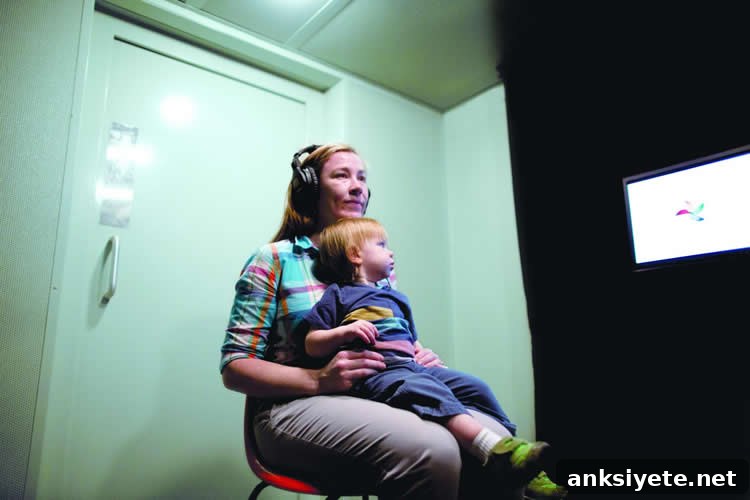
Summary: A new study examines how lexical tones influence infants’ ability to link spoken labels with objects.
Source: University of Tennessee
Infants show more sensitivity to non-native speech sounds than previously assumed, according to research published in the Journal of Memory and Language. The study provides new insight into how babies begin to map words to meanings.
Researchers Jessica Hay, an associate professor in the University of Tennessee, Knoxville’s Department of Psychology, and Ryan Cannistraci, a PhD student in experimental psychology, investigated how lexical tones affect a young child’s ability to associate words with objects.
Lexical tone refers to the way pitch contour—the rise and fall of pitch across a syllable—changes word meaning in many languages. Although English does not use pitch contour within single words to signal differences in meaning, more than half of the world’s languages do. Languages such as Mandarin Chinese, Cantonese, and Thai rely on these pitch patterns to distinguish words. For example, in Mandarin the syllable ma can mean “mother,” “horse,” “hemp,” or “to scold” depending on its pitch contour.
What sets this study apart from much of the prior research on early word learning is its deliberate focus on non-English sound structures and how they are mapped to meaning by infants who are being raised in English-speaking homes.
“Most research on early word learning has focused on what is referred to as intonation languages, where pitch changes occur at the phrase level but do not mark differences in word meaning,” Hay explained. “However, over half of the world’s languages use pitch contours to communicate meaning, so it is important to consider these structures when studying how children learn words.”
The experiments used a task-switching paradigm to assess infants’ ability to shift attention and learn new label-object pairings. The participants were 14-month-old infants from households where English is the primary language. During the study, each infant was shown two novel objects and heard a novel pseudoword paired with each object. After familiarization with the object-label pairings, the infants were tested in two types of trials.
In the “same” trials the objects were presented with their original, correct labels. In the “switch” trials the labels were swapped between objects. Researchers measured infants’ average attention to the displays during same and switch trials to determine whether the infants had formed stable associations between the labels and the objects. Longer attention in switch trials compared with same trials indicates that infants detect the mismatch and therefore have learned the original label-object mapping.
One might assume that infants would have an easier time discriminating labels when those labels differ dramatically in pitch contour. However, the findings were more specific than a simple salience explanation. The infants in this study were more successful at forming object-label associations when one of the labels featured a rising pitch contour—an acoustic pattern commonly heard in English infant-directed speech—than when labels differed only in other pitch shapes.
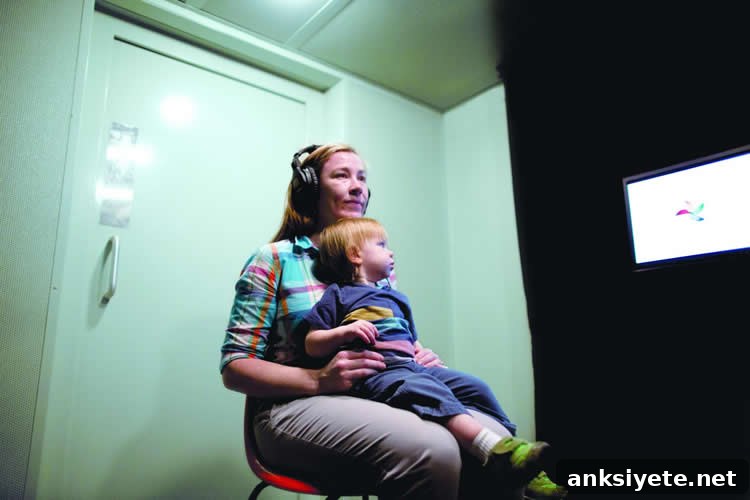
“We think English-learning infants are able to use the rising pitch contour in our experiment because they encounter rising contours in everyday life,” Cannistraci said. “In English, rising pitch contours are common in infant-directed speech and are often used to attract attention or to signal a question.”
The pattern of results suggests that infants rely on their experience with the prosody of their native language when interpreting novel sounds. Instead of treating all pitch differences as equally useful for distinguishing words, infants appear to privilege pitch patterns that are familiar and meaningful in their native input.
These findings encourage a broader, more inclusive approach to studying early language acquisition. Examining how infants respond to non-native tone systems helps researchers understand which aspects of sound structure infants treat as potential cues to meaning and which they discount.
“To generalize our understanding of how children learn language, it is important to study a variety of languages,” Hay said. “By incorporating non-native lexical tones into our studies, we find that infants can apply knowledge about their own language’s prosody when learning words in a new language. This suggests infants are motivated to learn language and will use any potentially relevant information available to them.”
Source: Andrea Schneibel, University of Tennessee
Publisher: Organized by Neuroscience News
Image source: Image credited to Daryl Johnson / University of Tennessee
Original research: Hay, J. F., Cannistraci, R. A., and Qian Zhao. “Mapping non-native pitch contours to meaning: Perceptual and experiential factors.” Journal of Memory and Language. Published February 20, 2019.
DOI: 10.1016/j.jml.2018.12.004
Abstract
Mapping non-native pitch contours to meaning: Perceptual and experiential factors
Infants demonstrate both flexibility and constraint early in word learning. This research investigates perceptual and experiential factors that affect associative learning of labels that differ in pitch contour. Contrary to a simple salience account, English-learning 14-month-olds failed to map acoustically distinctive level and dipping labels to novel objects, even though they could discriminate those labels when no referents were present. By contrast, infants readily mapped less acoustically distinctive rising and dipping labels. A second experiment ruled out mere pitch variation as the driving factor: infants learned only when one of the labels contained a rising pitch contour. The results suggest that experience with native prosody may lead infants to over-interpret the role of rising pitch in distinguishing words. Overall, multiple factors influence whether particular acoustic forms will be treated as candidate object labels.