
Summary: A new study shows that some exceptionally gifted dogs can sort objects not only by appearance but by how they are used. After owners used verbs like “pull” or “fetch” during regular play, these dogs later applied those action-based categories to unfamiliar toys without formal training or explicit labeling.
The research indicates that dogs can form mental representations of objects grounded in function rather than physical traits. These results deepen our understanding of canine cognition and offer clues about the cognitive building blocks related to human language and memory.
Key Facts
- Functional categorization: Dogs grouped toys according to their use (tugging versus fetching) rather than by perceptual similarity.
- Acquired through play: The ability emerged from natural play with owners, not from formal training programs.
- Language-related insight: The findings suggest shared cognitive mechanisms between dogs and humans in how verbal labels and object functions are linked.
Source: Cell Press
Human infants naturally link words to meanings—recognizing, for example, that forks and bowls are connected because both are used during eating. In a study published on September 18 in the Cell Press journal Current Biology, researchers show that dogs can likewise generalize verbal labels to objects based on their function.
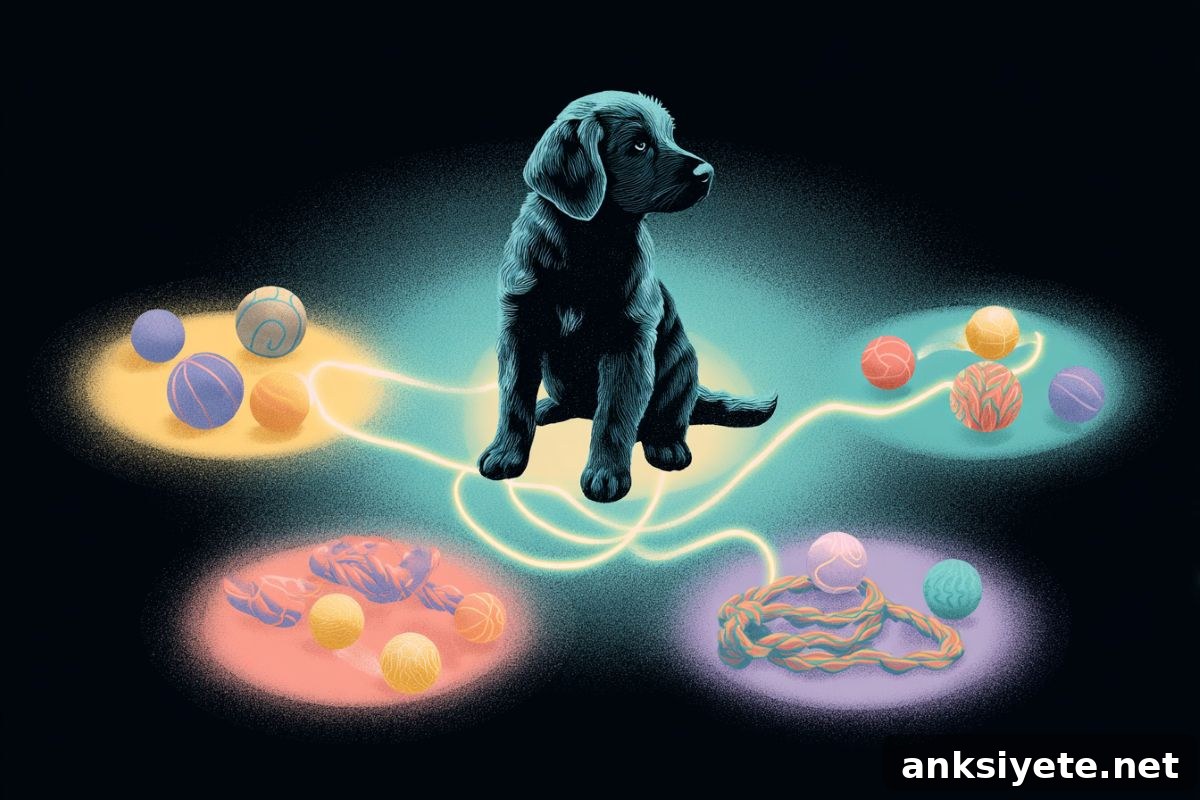
The study focused on a group known as Gifted Word Learner (GWL) dogs—individuals who spontaneously learn verbal object labels during everyday interactions with their owners. During a series of playful sessions in the dogs’ home environments, owners consistently used the words “pull” and “fetch” with specific toys. Crucially, the toys designated for each action did not share obvious visual similarities.
After several days of natural play, researchers tested whether the dogs had associated the verbal cues with the functional categories. In follow-up trials, owners introduced novel toys the dogs had not previously encountered. Although owners did not use the labels “pull” or “fetch” during the test, many dogs reliably selected the new toys that matched the action category they had experienced.
“We discovered that these Gifted Word Learner dogs can extend labels to items that have the same function or that are used in the same way,” says Claudia Fugazza of Eötvös Loránd University in Budapest, one of the study’s authors. She compares the dogs’ behavior to a person calling both a traditional hammer and a rock by the same name because both can serve the same function: “The rock and the hammer look physically different, but they can be used for the same function. So now it turns out that these dogs can do the same.”
The experiments were intentionally naturalistic: no extensive training regimens or artificial testing setups were used. Owners simply played with their pets for a short period, consistently pairing action words with play routines. The dogs’ ability to generalize labels to new objects based on function suggests they form durable, experience-based mental representations that go beyond perceptual features.
Researchers highlight that this form of functional classification linked to verbal labels has previously been documented only in a small number of extensively trained animals. Demonstrating it in dogs during ordinary human–animal interactions broadens our view of how language-related cognitive processes might evolve and operate in non-linguistic species.
The study also raises questions for future research. The team recommends investigating whether dogs that do not naturally acquire object labels might still classify objects by function, and to what extent different breeds or individual histories influence this ability. Understanding the limits and flexibility of dogs’ categorization skills could reveal more about the intersection of language, memory, and problem-solving across species.
“We have shown that dogs learn object labels very quickly and remember them over long periods, even without rehearsal,” Fugazza adds. “Their ability to extend labels beyond perceptual similarities points to the potential breadth of what those labels mean to dogs.”
Funding
This research was supported by the National Brain Research Program NAP 3.0 of the Hungarian Academy of Sciences, the MTA-ELTE Comparative Ethology Research Group, and TRIXIE.
About this animal cognition research news
Author: Julia Grimmett
Source: Cell Press
Contact: Julia Grimmett – Cell Press
Image: The image is credited to Neuroscience News
Original Research: Open access. “Dogs extend verbal labels for functional classification of objects” by Claudia Fugazza et al., published in Current Biology.
Abstract
Dogs extend verbal labels for functional classification of objects
The relationship between language and thought remains a central question in cognitive science, with debate over whether language shapes object categorization. In humans, words facilitate early perceptual categorization, yet the tendency to prioritize object function over perceptual similarity when generalizing new words typically appears later in development.
It is unclear whether non-human animals can use object function, rather than just perceptual features, to guide label extension. Past studies that documented functional label extension relied on a few individuals after extensive formal training, a procedure that differs from how human infants naturally acquire words.
By studying dogs that spontaneously learn object labels through everyday interactions, the researchers show that these animals can generalize verbal labels to novel items that share only functional properties. During naturalistic play, dogs classified new objects according to how they are used—pulling versus fetching—rather than by shared visual traits. This finding demonstrates functional classification tied to verbal labels in a non-linguistic species under natural conditions and offers insight into the diverse evolutionary pathways of language-related cognitive abilities.