
Rare, pathologic version of tau protein can pass directly from neuron to neuron.
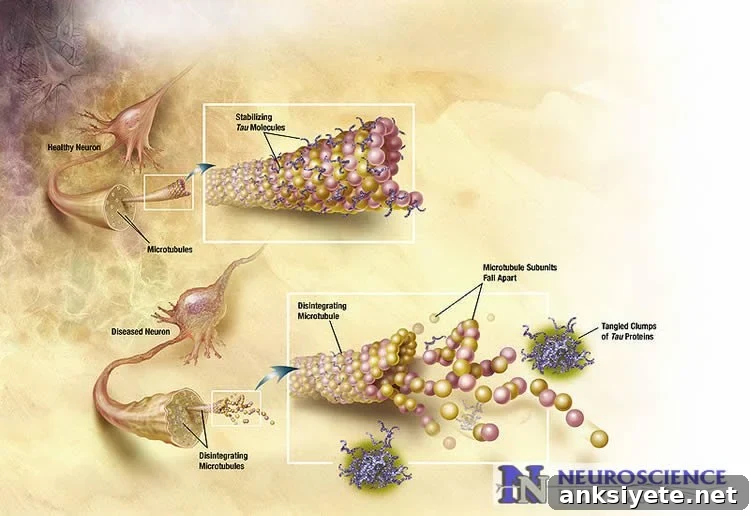
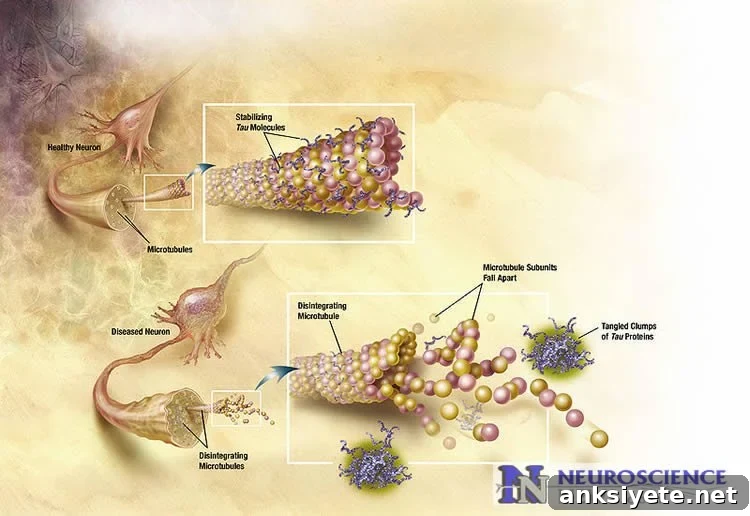
Researchers at Massachusetts General Hospital (MGH) have identified a specific mechanism that helps explain how neurofibrillary tangles — one of the defining hallmarks of Alzheimer’s disease — spread through the brain. Published in the journal Nature Communications, the study pinpoints a rare form of the tau protein that, despite being present at very low levels in affected brains, can move from one neuron to another and propagate along neural pathways.
“It has been proposed that tau tangles — the abnormal, intraneuronal accumulations of tau protein seen in Alzheimer’s disease — propagate through the brain as the disease advances,” says Bradley Hyman, MD, PhD, director of the MGH Alzheimer’s Disease Research Center and senior author of the study. “Our findings indicate that a distinct, uncommon tau species displays the properties required for spread: it is released by neurons, taken up by nearby neurons, transported along axons in both directions, and released again to continue propagation.”
Previous neuropathological and animal studies have documented that tau tangles typically first appear in the entorhinal cortex, a deep-brain structure that mediates communication between the hippocampus and cerebral cortex. Tangles then emerge in adjacent memory-related regions, a pattern consistent with trans-neuronal spread but not definitive proof of it. Earlier 2013 studies, including work from Hyman’s group, showed that mutant tau can move between brain regions in mouse models and cause neurodegeneration, and that this process might be interruptible. What remained unclear was which endogenous tau species in human Alzheimer’s brain are actually responsible for neuron-to-neuron transfer.
In the current study the team analyzed brain extracts from a tau-transgenic mouse model and from human Alzheimer’s disease cortices. When these brain samples were applied to cultured neurons, only a small fraction — roughly 1 percent — of total tau was taken up by neurons. The tau species that entered cells had distinct properties: it was high molecular weight (HMW), meaning that multiple tau molecules or fragments were assembled into larger complexes; it was soluble rather than insoluble aggregated material; and it was heavily phosphorylated, a modification commonly associated with tau pathology in Alzheimer’s disease.
To visualize and track this process, investigators used a microfluidic device developed at the MGH BioMEMS Resource Center. The device contains three connected chambers: neurons plated in the first two chambers extend axons through microgrooves to reach the next chamber. When the researchers applied the rare phosphorylated HMW tau prepared from the mouse model to neurons in the first chamber, those neurons internalized the tau. Within five days the tau appeared at the ends of axons originating in chamber one and in neurons housed in the second chamber. A few days later, tau was detectable at axon termini that projected from the second chamber toward the third, which contained no cell bodies.
Importantly, when the researchers removed the tau source from the first chamber, the protein continued to be detected in the second chamber. This indicates that once neurons have internalized a critical amount of the pathological tau species, they can maintain and relay it onward even after the initial external source is gone. Parallel experiments using human Alzheimer’s brain extracts produced comparable results: the phosphate-rich, soluble HMW tau species was preferentially taken up by neurons and transmitted between them.
“These results suggest that release and uptake of this rare phosphorylated HMW tau is a key step in the regional spread of tau pathology,” Hyman explains. “Because tau propagation likely drives clinical progression, interfering with the mechanisms by which this tau species spreads could represent a viable strategy to slow or stabilize disease.”
The study’s lead author is Shuko Takeda of the MGH Alzheimer’s Disease Research Center (ADRC). Co-authors include Susanne Wegmann, Sarah DeVos, Caitlin Commins, Allyson Roe, Samantha Nicholls, Chloe Nobuhara, Isabel Costantino, Matthew Frosch, Hansang Cho, Daniel Irimia, George Carlson, Rose Pitstick, Daniel Müller and Bradley T. Hyman. Contributors represent MGH ADRC, the MGH BioMEMS Resource Center, the McLaughlin Research Institute, and Eidgenössische Technische Hochschule.
Funding: The work was supported by National Institutes of Health grants AG026249, P50AG05134 and GM092804, and grants from the Massachusetts Life Sciences Center and The JPB Foundation.
Source: Terri Ogan – Massachusetts General Hospital
Image Credit: The image is in the public domain.
Abstract
Neuronal uptake and propagation of a rare phosphorylated high-molecular-weight tau derived from Alzheimer’s disease brain
Tau pathology spreads in a hierarchical pattern during Alzheimer’s disease progression, most likely through trans-synaptic transfer of tau between neurons. To identify which tau species mediate this propagation, the authors examined uptake and transfer of tau derived from postmortem human cortex, brain interstitial fluid of tau-transgenic mice, and cortical extracts. They found that a PBS-soluble, phosphorylated high-molecular-weight (HMW) tau species, although very low in abundance, is preferentially internalized by neurons, transported along axons, and transmitted to synaptically connected neurons. These findings indicate that a rare soluble phosphorylated HMW tau is the endogenous form implicated in inter-neuronal propagation and point to this species as a potential target for therapeutic intervention and biomarker development.