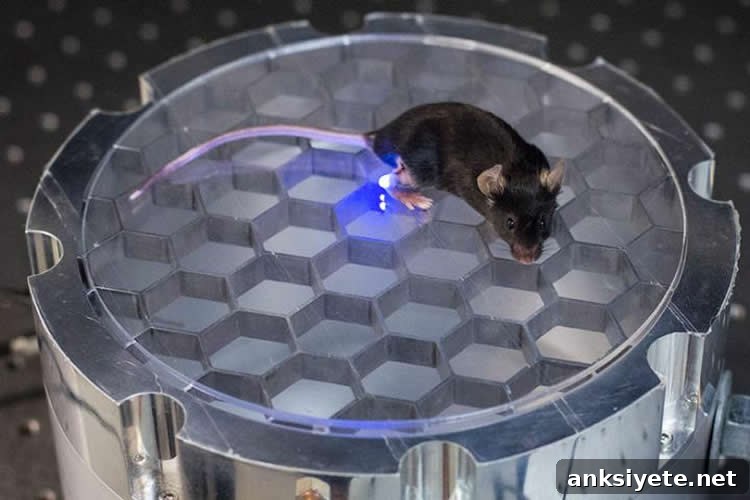
A miniature, fully implantable device that merges optogenetics—using light to control neural activity—with a novel method for wirelessly powering implanted electronics is the first entirely internal system for delivering optogenetic stimulation in mice.
This wireless optogenetics platform greatly expands the types of behavioral experiments possible, enabling studies of animals moving within enclosed environments, burrowing, or interacting freely with cage-mates. The work was reported in the August 17 issue of Nature Methods and demonstrates a practical, scalable approach to untethered optogenetic control in freely behaving mice.
“This is a new way of delivering wireless power for optogenetics,” said Ada Poon, assistant professor of electrical engineering at Stanford. “It’s dramatically smaller than earlier systems, and the mice can move naturally during experiments.”
The implant can be assembled and adapted for different laboratory uses, and the researchers have shared plans for the RF power source to support broader adoption. “We expect other labs will be able to adapt these designs for their own optogenetics studies,” Poon added.
Scaling down
Historically, optogenetics depended on fiber-optic tethers attached to an animal’s head to deliver light to genetically sensitized neurons. While tethered approaches permit many experiments, they restrict natural movement: a mouse wearing fiber optic headgear can roam an open cage but cannot easily enter enclosed spaces, dig into nesting material, or freely interact with other animals. Handling required to attach tethers also stresses animals and can influence experimental outcomes.
Those limitations have constrained some lines of research. Optogenetics has already illuminated neural mechanisms underlying tremor control in Parkinson’s models, pain circuits, and stroke recovery. Yet studies that probe social behavior, anxiety, depression, or navigation through mazes are more challenging when animals are physically tethered.
Poon was already known for designing tiny, implantable, wirelessly powered devices. After learning about optogenetics at a neural engineering workshop that brought neuroscientists and engineers together, she began collaborating with labs experienced in optogenetic techniques.
Her collaborations evolved after meeting graduate students from labs led by Karl Deisseroth and Scott Delp at Stanford. Kate Montgomery (an interdisciplinary fellow through Stanford Bio-X) and Alexander Yeh were co–first authors on the study, working across engineering and neuroscience groups to integrate the implant and wireless powering method.
One important clarification for readers: optogenetics only affects neurons that have been genetically prepared to express light-sensitive proteins. In laboratory practice, researchers either breed mice with targeted expression of opsins or inject viral vectors to deliver light-sensitive protein genes to specific, tiny neural targets. Shining light on neurons that lack these proteins produces no effect.
Powering up
Designing a tiny light-emitting implant was straightforward for the team; the greater challenge was delivering sufficient power to that implant across an entire behavioral arena while preserving efficiency and avoiding bulky external trackers or head-mounted receivers.
Many groups have tried to localize wireless power using large skull-mounted antennas or complex coil arrays combined with position-tracking sensors. Instead, the Stanford team adopted a simpler, unconventional strategy: they engineered a radio-frequency (RF) chamber that stores RF energy at a wavelength chosen to resonate within a mouse’s body. The animal’s body itself becomes the pathway that draws energy from the chamber to a small 2 mm coil embedded in the implant.
To confine energy within the chamber, the researchers placed a perforated conductive grid over the cavity. The holes in the grid are smaller than the RF wavelength, so most energy remains trapped. Small gaps in that grid allow a portion of the stored RF field to reach the animal at the chamber surface. When a mouse touches or comes near those boundaries, its body couples to the field, which transfers RF energy into the implanted coil. Wherever the mouse moves inside the chamber, it effectively serves as its own localizing antenna for power delivery, while stray energy remains contained.
This innovative wireless power approach enabled a dramatic reduction in device size. The smallest implant reported is approximately 20 mg and 10 mm3—two orders of magnitude smaller than previously published wireless optogenetic systems—permitting complete subcutaneous implantation. Because the system delivers sufficient light power for opsin activation with minimal tissue heating (<1 °C), it supports safe, untethered optogenetic control of central and peripheral targets, including spinal and peripheral nerve endings.
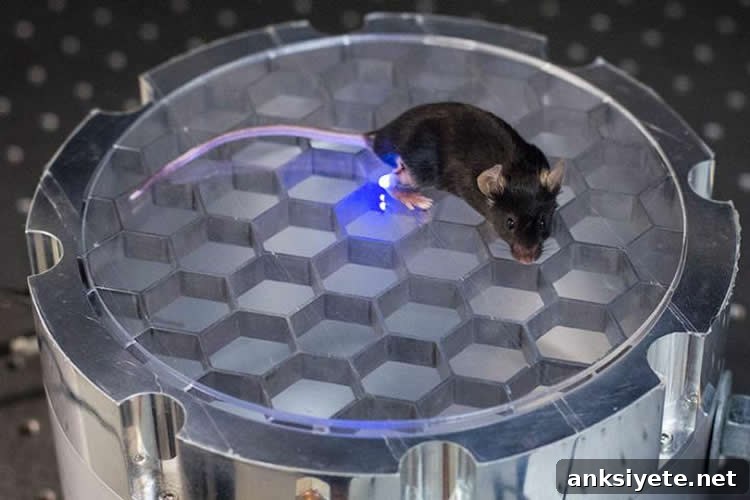
The size and fully implanted nature of this device make it the first wireless optogenetic system small enough to be placed under the skin and allow stimulation of muscle or some internal targets previously inaccessible to surface-mounted or head-mounted systems. The team reports that the implant and powering method open new possibilities for studying and treating disorders that involve both central and peripheral circuits, including mental health conditions, movement disorders, and pain. The researchers have additional funding from a Stanford Bio-X grant to explore applications related to chronic pain.
Funding: This research was supported by the NIH/National Institute of Neurological Disorders and Stroke, the National Science Foundation, Stanford Bio-X NeuroVentures, the Stanford Bio-X Interdisciplinary Initiatives Program, and the Stanford Interdisciplinary Graduate Fellowship.
Additional information: The related physics work describing the RF chamber and resonance mechanisms was published in Physical Review Applied, and the full optogenetics implant study appears in Nature Methods (published online August 17, 2015).
Source: Amy Adams, Stanford University
Image credit: Austin Yee, Ada Poon and Stanford News Service
Original research: “Wirelessly powered, fully internal optogenetics for brain, spinal and peripheral circuits in mice” by Kate L. Montgomery et al., Nature Methods. Published online August 17, 2015. doi:10.1038/nmeth.3536
Abstract
Wirelessly powered, fully internal optogenetics for brain, spinal and peripheral circuits in mice
To enable sophisticated optogenetic manipulation of neural circuits across the nervous system while minimizing disruption to natural behavior, light-delivery solutions beyond fiber-optic tethers and large head-mounted receivers are needed. The authors report an easy-to-construct, fully implantable wireless optogenetic device. The smallest version (around 20 mg, 10 mm3) is roughly two orders of magnitude smaller than earlier wireless optogenetic systems, allowing subcutaneous implantation. With an RF power source and a controller, the implant produces adequate light for optogenetic stimulation with minimal tissue heating (<1 °C). The study describes three implant adaptations that permit untethered optogenetic control of brain, spinal cord, and peripheral circuits in freely behaving mice. This technology enables experiments in which animals exhibit natural behaviors while receiving targeted optogenetic manipulation of both central and peripheral nervous system targets.