
Summary: New research frames arrogance as a spectrum. Psychologists identify three distinct types of arrogance and outline their implications for interpersonal behavior and future research.
Source: University of Missouri Columbia
On a first date, people often try to make a favorable impression. But when someone consistently boasts or dismisses others, that behavior typically reflects some degree of arrogance.
Across history and culture, arrogance has been described in many ways—from ancient myths about leaders whose overconfidence led to disaster to contemporary discussions in psychology. A team of researchers at the University of Missouri has now produced one of the first comprehensive literature reviews that synthesizes existing work on arrogance and proposes a practical framework for classifying it along a spectrum. Nelson Cowan, Curators Distinguished Professor of Psychological Sciences in the MU College of Arts and Science, led a group of graduate students and postdoctoral fellows to assemble this review, building on decades of interest in the topic.
“We were surprised by how limited modern empirical work on arrogance is,” Cowan said. “Research on arrogance is spread across multiple disciplines, so we aimed to create a single, accessible resource that highlights what is known and points to important gaps. Our goal is to stimulate more focused research, including studies that could inform clinical assessment and diagnostic thinking.”
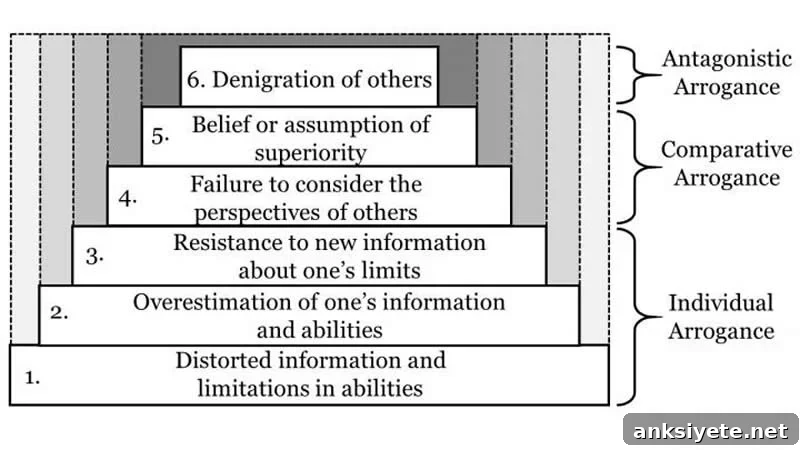
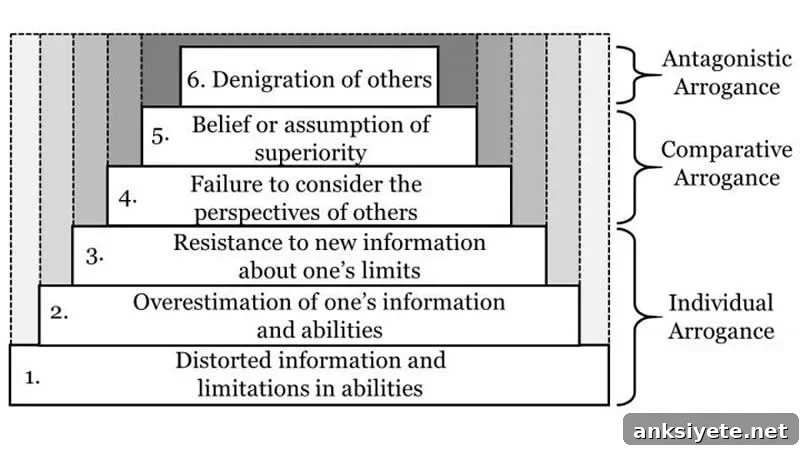
The authors emphasize that traits associated with arrogance appear to occur to some degree in most people. To organize existing findings and guide future study, the team proposes a three-part classification that captures different expressions of arrogance:
- Individual arrogance — an inflated self-view regarding one’s abilities, traits, or achievements that deviates from objective reality.
- Comparative arrogance — an overstated ranking of oneself relative to other people, claiming superiority on dimensions where that claim is unfounded.
- Antagonistic arrogance — active denigration, contempt, or dismissive behavior toward others founded on a sense of superiority.
These three types form a conceptual foundation for describing arrogance in more precise terms. Rather than treating arrogance as a single, uniform trait, the framework highlights distinct ways it can present and escalate.
In addition to categorizing types of arrogance, the review outlines six interrelated components that contribute to arrogant behavior. These components form a logical progression: imperfect or incomplete knowledge and abilities; unrealistic assessment of those abilities; an unwarranted attitude of superiority; and finally, derisive or demeaning behavior toward others. The authors note that while each component may be present to some degree when the next occurs, causal relationships can run in either direction—misperception can foster contempt, and antagonistic behavior can further distort self-assessment.
“This framework is not intended as a definitive clinical manual,” Cowan explained, “but rather an analytical perspective that can help researchers across cognitive, motivational, social, and clinical domains speak the same language. It should be useful for studies of everyday social interaction as well as investigations of personality and psychopathology.”
Source:
University of Missouri Columbia
Media Contacts:
Eric Stann – University of Missouri Columbia
Image Source:
The image is credited to University of Missouri.
Original Research: Closed access
Article: “Foundations of Arrogance: A Broad Survey and Framework for Research” by Nelson Cowan et al.
Review of General Psychology, doi: 10.1177/1089268019877138.
Abstract summary
The authors examine arrogance from a multidisciplinary perspective and propose three types (individual, comparative, and antagonistic) plus six contributing components arranged in a logical sequence. These components progress from limited knowledge and ability to unrealistic self-assessment, a sense of superiority, and consequent derisive actions. Although components typically co-occur, causal interactions may be bidirectional. Clarifying the components and mechanisms of arrogance should reduce confusion across research fields and encourage rigorous study of arrogance in both normal social life and clinical contexts. The review argues that understanding cognitive constraints and motivational biases that jointly foster arrogance can benefit individuals and societies, and it aims to spark cross-disciplinary research on the topic.