
New technique could yield knowledge useful to understanding the human brain.
Researchers at Northwestern University have developed a novel method that lets them identify which neural connections were active during a specific sensory experience or behavior in the fruit fly. By using engineered fluorescent tags that reveal synaptic activity in distinct colors, the team can map the exact synapses engaged when the fly smells a banana, experiences heat, or detects light. These maps of individual synapses offer a new way to study the computations that underlie brain function and may inform how similar processes operate in humans.
In the study, the scientists applied three different colored fluorescent reporters to label synapses that were active during an experience that occurred minutes to hours earlier. Because the fluorescent signal persists after the event, researchers can later examine the brain under a microscope and read out which connections were involved in the behavior. This retrospective capability makes it possible to study complex behaviors that are difficult to capture live under the microscope.
Marco Gallio, an assistant professor of neurobiology in Northwestern’s Weinberg College of Arts and Sciences and the study’s lead author, explains that much of neural computation happens at synapses—the points where neurons exchange information. “Our technique gives us a window of opportunity to see which synapses were engaged in communication during a particular behavior or sensory experience. It is a unique retrospective label,” Gallio said.
The labels are based on a split fluorescent protein approach. The researchers engineered variants of green fluorescent protein into three distinct colors—green, yellow and cyan—and split each into complementary halves. One half is expressed in the presynaptic (talking) neuron and the other half in the postsynaptic (listening) neuron. When those two neurons communicate at an active synapse, the halves reassemble into a fluorescent molecule and light up specifically at that synaptic site. This reconstitution happens only where synaptic transmission occurs, and the signal remains visible for one to several hours after the event.
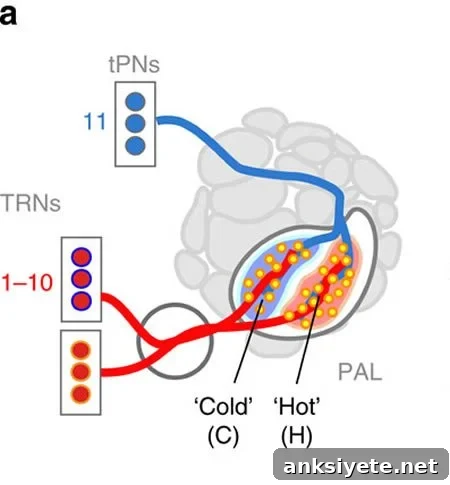
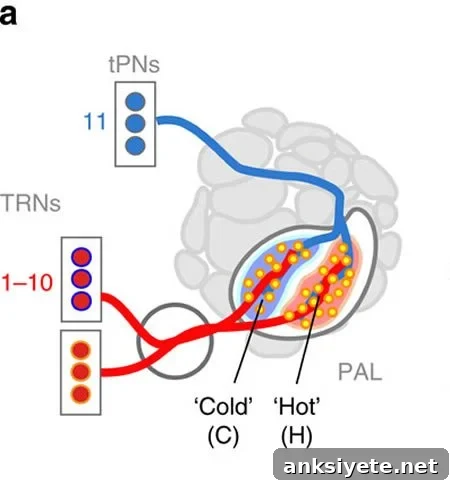
Using these color-coded reporters, the team could determine whether a fly had experienced heat or cold for a ten-minute interval even an hour after the exposure. They also observed distinct patterns of olfactory synaptic activation when flies smelled banana versus jasmine, demonstrating that different sensory inputs recruit different synaptic pathways even within the same animal. By combining multiple colors in a single animal, the method permits comparison of multiple experiences or behaviors within the same brain.
The researchers validated the system across three prominent sensory systems in Drosophila melanogaster—the olfactory system, the visual system and the thermosensory system. Flies were exposed to controlled sensory inputs such as odors, light, or temperature changes, and subsequent imaging revealed the specific synapses that had been active during those experiences. Because the fluorescent markers are stable for hours, experiments no longer require continuous live imaging of complex behaviors, enabling more flexible experimental designs.
Gallio and colleagues emphasize that this technique—referred to in the paper as an activity-dependent, multi-color trans-synaptic fluorescence complementation system—expands the tools available for circuit mapping. As individual synapses can serve as computational units within neural circuits, being able to tag active synapses retrospectively in multiple colors opens new possibilities for dissecting how information is processed and routed through the brain. The approach should be adaptable to other genetically tractable systems beyond Drosophila.
The paper is titled “Dynamic labelling of neural connections in multiple colours by trans-synaptic fluorescence complementation.” Authors include Lindsey J. Macpherson, Emanuela E. Zaharieva, Patrick J. Kearney, Michael H. Alpert, Tzu-Yang Lin, Zeynep Turan, Chi-Hon Lee and Marco Gallio. The study demonstrates synaptobrevin-GRASP chimeras and cyan/yellow variants that achieve activity-dependent, multicolor fluorescence reconstitution across synapses, enabling retrospective labeling of individual synapses based on their activity in the same animal.
Source: Megan Fellman – Northwestern University
Image Credit: Gallio et al./Nature Communications
Original Research: “Dynamic labelling of neural connections in multiple colours by trans-synaptic fluorescence complementation” by Lindsey J. Macpherson et al., published in Nature Communications. DOI: 10.1038/ncomms10024
Abstract
Dynamic labelling of neural connections in multiple colours by trans-synaptic fluorescence complementation
Mapping activity at the level of individual synapses can reveal how neural circuits compute. The authors develop strategies to label active synapses in Drosophila by activity-dependent trans-synaptic fluorescence complementation. A synaptobrevin-GRASP chimera acts as a strong activity-dependent synaptic marker in vivo. Cyan and yellow variants extend the system to multiple colors (X-RASP), allowing retrospective, multi-color labeling of synapses rather than whole neurons in the same animal. Because synapses often function as distinct computational units, this method enables experiments that existing techniques cannot, and the approach can be adapted for circuit mapping in other genetic systems.