
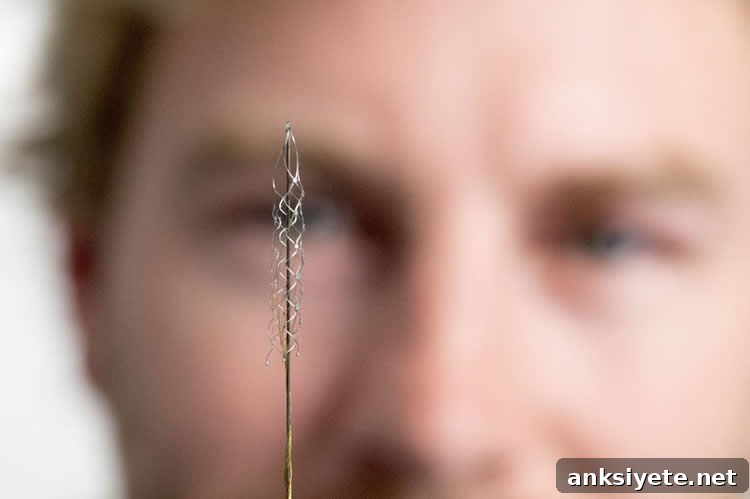
Scientists have validated a world-first, minimally invasive brain-machine interface designed to control an exoskeleton using thought.
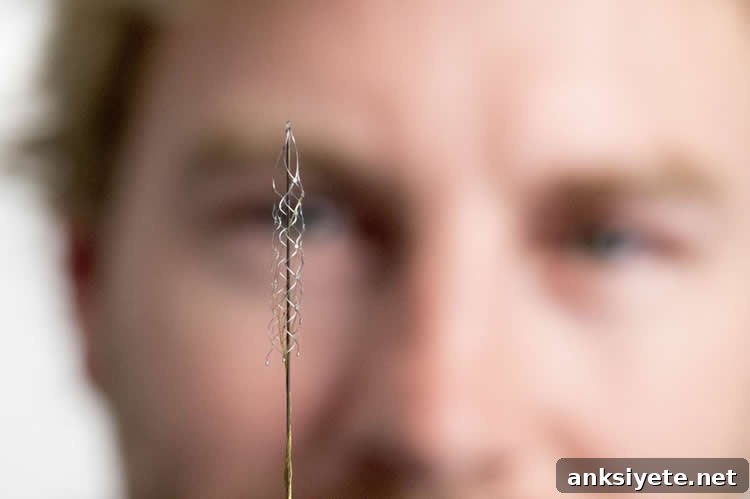
The interface uses a stent-based electrode, called a stentrode, which is implanted into a cortical blood vessel to record neural signals linked to movement. Preclinical studies indicate these signals can be decoded and translated into commands to drive an exoskeleton or bionic limb, offering a potential path to restore mobility for people with paralysis.
The device is roughly the size of a small paperclip and is scheduled to be implanted in the first in-human trial at The Royal Melbourne Hospital. Trial participants are to be selected from the Austin Health Victorian Spinal Cord Unit, with initial human testing anticipated to begin in 2017.
Results published in Nature Biotechnology demonstrate that the stentrode can capture high-quality electrical activity from the brain’s motor cortex without requiring open-brain surgery. By using a blood-vessel approach, clinicians can avoid the higher risks associated with craniotomy-based implants.
Dr Thomas Oxley, principal author and neurologist at The Royal Melbourne Hospital and research fellow at The Florey Institute and the University of Melbourne, described the stentrode as a revolutionary advance in neural interfaces. Dr Oxley is currently based at Mount Sinai Hospital in New York.
“This device brings together experts from The Royal Melbourne Hospital, the University of Melbourne and the Florey Institute,” Dr Oxley said. “In total, 39 scientists from 16 departments collaborated on its development. We have created the world’s only device that can be implanted inside a brain blood vessel through a minimally invasive day procedure, eliminating the need for high-risk open-brain surgery.”
Dr Oxley emphasized the clinical goal: “Our vision is to restore function and mobility to people with complete paralysis. The stentrode records brain activity and converts those signals into electrical commands that can drive mobility aids such as exoskeletons. In effect, it serves as a bionic spinal cord, translating intent into movement.”
Stroke and spinal cord injuries are major causes of long-term disability worldwide. In Australia, about 20,000 people live with spinal cord injuries and roughly 150,000 are left severely disabled after stroke. These conditions highlight the urgent need for technologies that can return independence and mobility to affected individuals.
Co-principal investigator and biomedical engineer Dr Nicholas Opie from the University of Melbourne compared the stentrode’s concept to an implantable cardiac pacemaker: “It’s electrical interaction with tissue via sensors positioned inside the vasculature, but located adjacent to the brain. Using stent technology, the electrode array self-expands and adheres to the inner wall of a vein to pick up local neural activity.”
Once recorded, those neural signals can be decoded and used as direct control commands for wheelchairs, exoskeletons, prosthetic limbs, or computer interfaces. “In our first-in-human trial, which we hoped to begin within two years, our aim is to allow direct brain control of an exoskeleton for several people with paralysis,” Dr Opie said.
Current exoskeleton systems typically require manual control via a joystick or other switches to trigger walking phases like standing, starting, stopping, or turning. The stentrode aims to remove that intermediary by enabling intuitive, thought-driven control of mobility devices.
Professor Clive May, neurophysiologist at The Florey Institute, reported that preclinical data showed the device is safe for long-term implantation. “In our animal studies we recorded stable brain signals for many months, and recording quality often improved as the device integrated with surrounding tissue,” he said.
Professor May added that catheter angiography, the implantation technique used for the stentrode, is minimally invasive and carries significantly lower procedural risk than open surgery. “The brain-computer interface is a game-changing technology with the potential to restore mobility and independence to patients with paralysis and other neurological conditions,” he said.
Professor Terry O’Brien, Head of Medicine at The Royal Melbourne Hospital and the University of Melbourne, called the stentrode the “holy grail” of bionics research. “Developing a device that records brain activity reliably over long periods without damaging tissue is an extraordinary achievement,” he said. “Beyond spinal cord injury, the technology may have applications for epilepsy, Parkinson’s disease and other neurological disorders.”
The development and preclinical testing of the minimally invasive stentrode was supported by major funders, including the US Defense Advanced Research Projects Agency (DARPA) and Australia’s National Health and Medical Research Council. Additional support came from the Office of Naval Research Global, the Australian Defence Health Foundation, The Brain Foundation and The Royal Melbourne Hospital Neuroscience Foundation.
Funding: DARPA; National Health and Medical Research Council; Office of Naval Research Global; Australian Defence Health Foundation; The Brain Foundation; The Royal Melbourne Hospital Neuroscience Foundation.
Source: Jane Gardner, University of Melbourne. Image credit: University of Melbourne.
Abstract
Minimally invasive endovascular stent-electrode array for high-fidelity, chronic recordings of cortical neural activity
High-fidelity intracranial electrode arrays for recording and stimulating brain activity have driven major advances in treating neurological conditions. Traditional arrays require open craniotomy and direct brain implantation, which can provoke inflammatory responses and long-term tissue damage. To address this, researchers developed a passive stent-electrode recording array (stentrode) that can be implanted into a superficial cortical vein via catheter angiography. In freely moving sheep, the device recorded neural activity for up to 190 days, with spectral content and bandwidth comparable to epidural surface arrays. Venous lumen patency was preserved during implantation. Stentrodes could serve as a neural interface for a range of neurological treatments.
Original research: “Minimally invasive endovascular stent-electrode array for high-fidelity, chronic recordings of cortical neural activity,” published in Nature Biotechnology (published online February 8, 2016) by Thomas J. Oxley et al.