
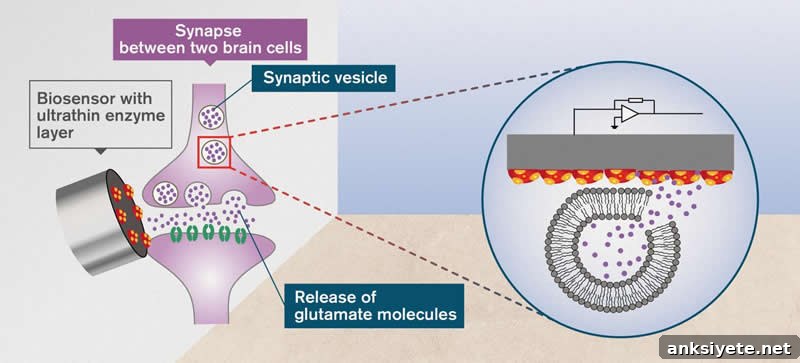
Summary: Researchers have developed an ultra-fast sensor that can count the number of glutamate molecules released from a single synaptic vesicle, revealing new mechanisms by which the brain regulates chemical signaling.
Source: Chalmers University of Technology
Researchers at Chalmers University of Technology and the University of Gothenburg in Sweden have achieved a major breakthrough: they can now quantify the number of glutamate molecules released when a signal passes between two neurons. Using a novel, ultra-fast enzyme-based sensor and a new analytical method, the team demonstrated that glutamate-based neural communication is regulated in more ways than previously understood.
Glutamate is the primary excitatory neurotransmitter in the brain and plays a central role in cognition, memory, learning, appetite and many other physiological processes. Despite its abundance and importance, glutamate has historically been difficult to measure with the temporal resolution needed to capture rapid synaptic events. That limitation has left gaps in our understanding of how glutamate contributes to normal brain function and to neurological and psychiatric disorders.
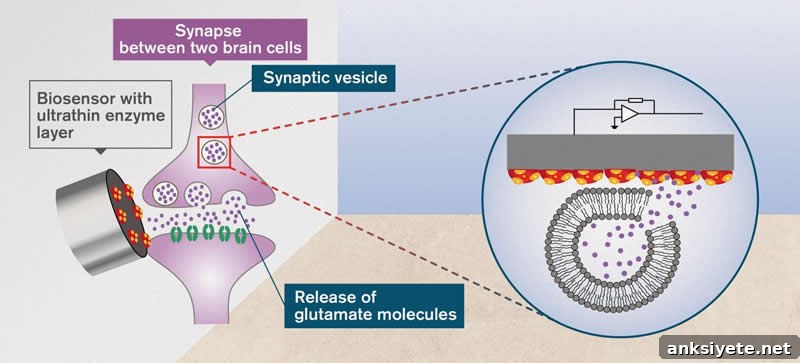
The new technology changes that. Instead of building biosensors with thick enzyme layers that slow response time, the researchers applied an ultra-thin, essentially single-molecule layer of enzyme to a nanostructured sensor surface. By making the enzymatic detection layer just one molecule thick, the team increased sensor speed by roughly a thousand-fold compared to earlier approaches, allowing measurements on the sub-millisecond timescale.
This dramatic improvement in temporal resolution made it possible to detect glutamate release from a single synaptic vesicle—a tiny membrane-bound compartment that discharges neurotransmitter into the synapse. Vesicle release is extremely brief, occurring in less than a thousandth of a second, but the ultra-fast sensor can capture the fleeting amperometric spikes that correspond to individual vesicle fusion events.
“When we focused on improving sensor response time instead of simply aiming for higher concentration sensitivity, the approach began to work,” says Ann-Sofie Cans, Associate Professor of Chemistry at Chalmers and leader of the research group. Their initial breakthrough—demonstrating rapid glutamate detection—was published in 2019. Building on that work, the current study refines the sensor design and introduces a robust method to quantify the tiny glutamate quantities released from single vesicles.
The researchers combined the ultra-fast glutamate sensor with a calibrated analytical protocol. Isolated synaptic vesicles are exposed to the sensor surface where they spontaneously rupture, producing discrete amperometric spikes sampled at high speed (10 kHz). By calibrating sensor response using vesicles pre-filled with known glutamate concentrations, the team could translate individual spike signals into absolute numbers of glutamate molecules.
One surprising outcome is that a single synaptic vesicle contains far more glutamate molecules than previously estimated—on the order of several thousand molecules per vesicle—comparable to the quantities measured for other major neurotransmitters such as dopamine and serotonin. This finding challenges earlier assumptions about how glutamate is loaded and stored in vesicles and suggests shared features across different neurotransmitter systems.
Moreover, the study provides evidence that neurons can regulate the strength of their chemical signaling by varying the number of glutamate molecules released from individual vesicles. That mode of regulation—adjusting vesicular glutamate content—adds a new dimension to how synaptic strength and plasticity may be controlled in healthy brains and how dysregulation might contribute to disease.
“The resolution enabled by this ultra-fast glutamate sensor opens many possibilities,” says Karolina Patrycja Skibicka, Associate Professor in Neuroscience and Physiology at the University of Gothenburg. “It gives neuroscientists a tool to examine glutamate function and dysfunction at a level that was previously inaccessible, with implications for studying epilepsy, neurodegenerative disorders and psychiatric conditions linked to glutamate signaling.”
The ability to quantify glutamate at the single-vesicle level opens new experimental avenues for pharmacology and basic neuroscience. It offers a quantitative platform to test how drugs alter synaptic glutamate release, to study vesicle physiology, and to investigate pathological changes in glutamate regulation in disease models.
More information on glutamate and glutamic acid:
Glutamate (glutamic acid) is a common amino acid found in dietary proteins and occurs naturally in meat, many vegetables, wheat and soy. It is also used as a flavor enhancer in the form of monosodium glutamate (MSG). Beyond its nutritional role, glutamate functions as a key neurotransmitter in the central nervous system, mediating excitatory signaling that underlies learning, memory and other core brain functions. Glutamate also contributes to immune responses and gastrointestinal function.
Source: Swedish Food Agency and Chalmers University of Technology
Source:
Chalmers University of Technology
Media contacts:
Johanna Wilde – Chalmers University of Technology
Image source:
Image credited to Chalmers University of Technology.
Original Research: Closed access
“Counting the Number of Glutamate Molecules in Single Synaptic Vesicles”. Yuanmo Wang, Hoda Fathali, Devesh Mishra, Thomas Olsson, Jacqueline D. Keighron, Karolina P. Skibicka, Ann-Sofie Cans. Journal of the American Chemical Society. DOI: 10.1021/jacs.9b09414.
Abstract
Counting the Number of Glutamate Molecules in Single Synaptic Vesicles
Analytical tools for quantitative measurements of glutamate, the principal excitatory neurotransmitter in the brain, are lacking. Here, we introduce a new enzyme-based amperometric sensor technique for counting glutamate molecules stored inside single synaptic vesicles. In this method, an ultra-fast enzyme-based glutamate sensor is placed into a solution of isolated synaptic vesicles, which stochastically rupture at the sensor surface in a potential-dependent manner at a constant negative potential. Continuous amperometric signals are sampled at high speed (10 kHz) to record sub-millisecond spikes representing glutamate release from single vesicles. Quantification is achieved via a calibration curve based on vesicles filled with known glutamate concentrations. Measurements indicate that an isolated synaptic vesicle encapsulates roughly 8,000 glutamate molecules, comparable to quantal glutamate release measured in mouse brain tissue. This methodology enables quantification of ultra-small glutamate amounts and supports studies of vesicle physiology, pathogenesis, and drug effects in neuronal disorders involving glutamate.