
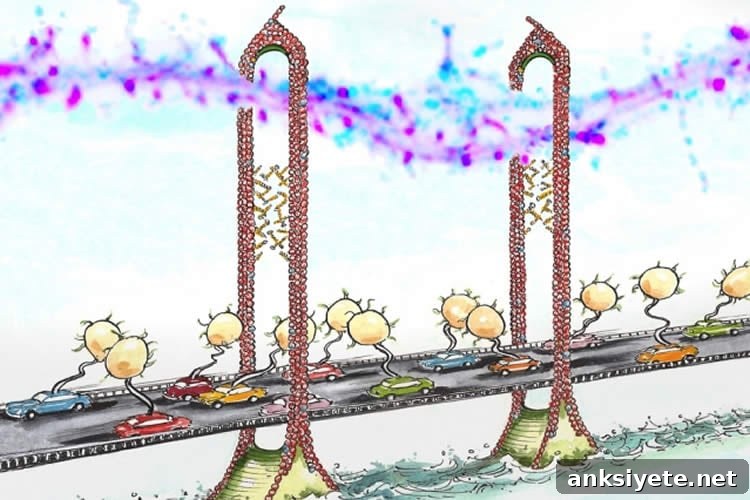
Scientists identify protein that allows brain cells to dampen their sensitivity.
Strengthening and weakening connections between neurons—known as synaptic plasticity—is essential for brain development, learning, and everyday function. One mechanism neurons use to weaken synapses is the internalization of glutamate receptors from their surface, which reduces the cell’s responsiveness to excitatory signals.
In a new study, neuroscientists at MIT describe how neurons remove these receptors, revealing a protein that links the cell’s structural framework to the molecular machinery that carries out receptor internalization. This process helps neurons prune unwanted connections and protect themselves from excessive excitation.
“Putting receptors in and taking them out of the membrane is a highly dynamic process that responds to the neuron’s environment,” says Elly Nedivi, professor of brain and cognitive sciences and a member of MIT’s Picower Institute for Learning and Memory. “Until now, we had limited understanding of how receptor internalization is regulated at the cellular level.”
Nedivi and colleagues identify the protein CPG2 as a central regulator of activity-dependent glutamate receptor internalization. Their findings are especially relevant because mutations in the human form of CPG2, encoded within the SYNE1 gene, have previously been linked to bipolar disorder. These results open the way for testing how specific human mutations affect synaptic function at the cellular level, the authors say.
The paper’s lead author is former Picower Institute postdoctoral researcher Sven Loebrich. Other contributors include Marc Benoit, Jaclyn Konopka, Joanne Gibson, and Jeffrey Cottrell.
Forming a bridge
Neurons communicate at synapses when neurotransmitters—such as glutamate—are released from the presynaptic cell and activate receptors on the postsynaptic membrane. Adjusting the number of receptors available at the postsynaptic site is a fundamental way for the brain to change synaptic strength and encode information like memories.
Long-term depression (LTD) is a form of synaptic weakening in which postsynaptic cells actively internalize surface glutamate receptors. LTD allows neurons to weaken or eliminate ineffective synapses, to reset their level of excitability, and to protect against harmful overactivation.
Internalizing receptors requires two key components: the actin cytoskeleton, which provides mechanical force, and the endocytic machinery, a set of proteins that mediate clathrin-mediated endocytosis (CME). CME captures a patch of membrane and forms a vesicle that carries receptors into the cell. Until now, how the cytoskeleton is physically linked to the endocytic machinery at synapses had not been clear.
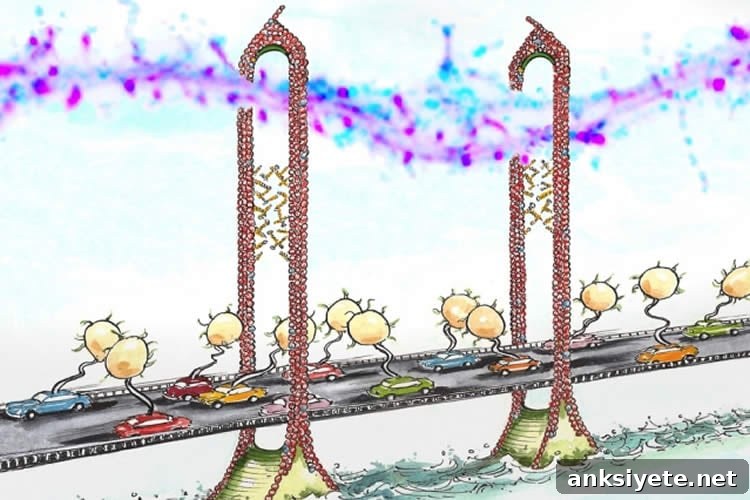
The new study shows that CPG2 connects these two systems. CPG2 functions as a tether that recruits endocytic proteins to F-actin, allowing the cytoskeleton to pull in receptor-containing vesicles. When synapses are stimulated and need to reduce sensitivity, CPG2 helps bring the endocytic apparatus into contact with the actin scaffold so glutamate receptors are pinched off and internalized.
The researchers found that CPG2 binds the endocytic component endophilin B2 (EndoB2). The interaction between CPG2 and EndoB2 is specific to activity-dependent receptor internalization driven by synaptic stimulation and is distinct from the continuous receptor recycling that maintains baseline receptor turnover. Nedivi’s lab previously showed that CPG2 also participates in constitutive receptor recycling, indicating the protein can engage different partners to control different endocytic pathways.
“By engaging different complexes, CPG2 can regulate distinct types of endocytosis,” says Linda Van Aelst, a professor at Cold Spring Harbor Laboratory who was not involved in the study.
The study further indicates that protein kinase A (PKA) regulates CPG2’s association with the cytoskeleton: when synapses are highly active, PKA modifies CPG2 activity and promotes activity-dependent receptor uptake. Because PKA is influenced by hormones and other signaling pathways, CPG2 function may also respond to broader physiological cues.
Link to bipolar disorder
Large-scale human genetic studies previously identified the SYNE1 gene as strongly associated with bipolar disorder; this gene encodes CPG2. That connection drew attention because glutamate receptors and their regulation have been implicated in mood disorders.
In related work, the team isolated human messenger RNA that encodes CPG2 and demonstrated that human CPG2 can substitute for the rat protein in restoring function when the rat gene is knocked out. This functional conservation supports the relevance of studying human CPG2 variants in cellular and animal models.
Picower Institute researchers, including co-lead Mette Rathje, are now examining specific human CPG2 mutations associated with bipolar disorder, testing how those mutations alter synaptic receptor internalization in rodents. The goal is to understand whether and how these genetic changes might disrupt synaptic regulation and contribute to disease risk.
Nedivi emphasizes that CPG2 is likely one contributor among many in a broader network of genes and environmental factors that influence bipolar disorder susceptibility. “There is probably a range of CPG2 function across the population,” she says. “Whether reduced or altered function contributes to disease likely depends on the combination of other genetic and environmental influences.”
Additional information: The related research paper “Genomic mapping and cellular expression of human CPG2 transcripts in the SYNE1 gene” by Loebrich and colleagues was published in Molecular and Cellular Neuroscience in December 2015 (Loebrich et al., 2015).
Funding: The research was supported by the Picower Institute Innovation Fund and the Gail Steel Fund for Bipolar Research.
Source: Anne Trafton – MIT
Image credit: Mark Steele
Original research: Abstract for “CPG2 Recruits Endophilin B2 to the Cytoskeleton for Activity-Dependent Endocytosis of Synaptic Glutamate Receptors” by Sven Loebrich, Marc Robert Benoit, Jaclyn Aleksandra Konopka, Jeffrey Richard Cottrell, Joanne Gibson, and Elly Nedivi, published online January 14, 2016 in Current Biology (doi:10.1016/j.cub.2015.11.071).
Abstract
CPG2 Recruits Endophilin B2 to the Cytoskeleton for Activity-Dependent Endocytosis of Synaptic Glutamate Receptors
Highlights
• CPG2 couples the endocytic machinery to the F-actin cytoskeleton through EndoB2
• CPG2 and EndoB2 interact to facilitate activity-dependent internalization of glutamate receptors
Summary
The internalization of glutamate receptors at the postsynaptic membrane by clathrin-mediated endocytosis (CME) is a core mechanism for tuning synaptic strength. While the role of the F-actin cytoskeleton in CME is established, it was not known how the endocytic machinery is physically linked to actin during activity-dependent receptor removal. This study shows CPG2 directly recruits endophilin B2 (EndoB2) to F-actin, anchoring the endocytic machinery to the spine cytoskeleton and facilitating receptor internalization. Regulation of CPG2’s actin binding by protein kinase A controls the recruitment of EndoB2 and clathrin. Disruption of EndoB2 or the CPG2–EndoB2 interaction specifically impairs activity-dependent—but not constitutive—internalization of both NMDA- and AMPA-type glutamate receptors. These findings demonstrate that CPG2 forms a tripartite complex with F-actin and EndoB2 that is critical for activity-dependent CME of synaptic glutamate receptors.
“CPG2 Recruits Endophilin B2 to the Cytoskeleton for Activity-Dependent Endocytosis of Synaptic Glutamate Receptors” by Sven Loebrich, Marc Robert Benoit, Jaclyn Aleksandra Konopka, Jeffrey Richard Cottrell, Joanne Gibson, and Elly Nedivi, Current Biology, published online January 14, 2016.