
Summary: Researchers highlight the essential role of thyroid hormone transport in cerebellar development.
Source: KU Leuven.
Thyroid hormones play a critical role in brain development. When the proteins that transport these hormones into cells are impaired, the developing cerebellum—often called the “little brain”—suffers significant damage. Researchers from KU Leuven and King’s College London report new findings on how defective thyroid hormone transport affects cerebellar development.
Thyroid hormones regulate metabolism throughout life, but they are especially important before birth. They guide the timing, migration, and connectivity of different neural cell types during embryonic development. Professor Veerle Darras of the Lab of Comparative Endocrinology at KU Leuven explains that until the fetal thyroid becomes fully functional, the fetus depends on maternal thyroid hormones. Insufficient maternal hormone levels can therefore impair fetal brain development very early on.
Clinical assessments typically measure thyroid hormone concentrations in blood, but blood levels do not always reflect hormone action inside cells. This mismatch is particularly evident in Allan–Herndon–Dudley syndrome (AHDS), a rare hereditary neurological disorder that primarily affects boys and causes severe intellectual disability and motor impairment. In AHDS patients, blood thyroid hormone levels can be abnormally high even though the brain is effectively hormone-deficient. The root cause is a defect in a transporter protein—MCT8—caused by mutations in the SLC16A2 gene. When MCT8 is nonfunctional, thyroid hormones cannot enter certain neural cells, preventing normal hormone signaling inside those cells.
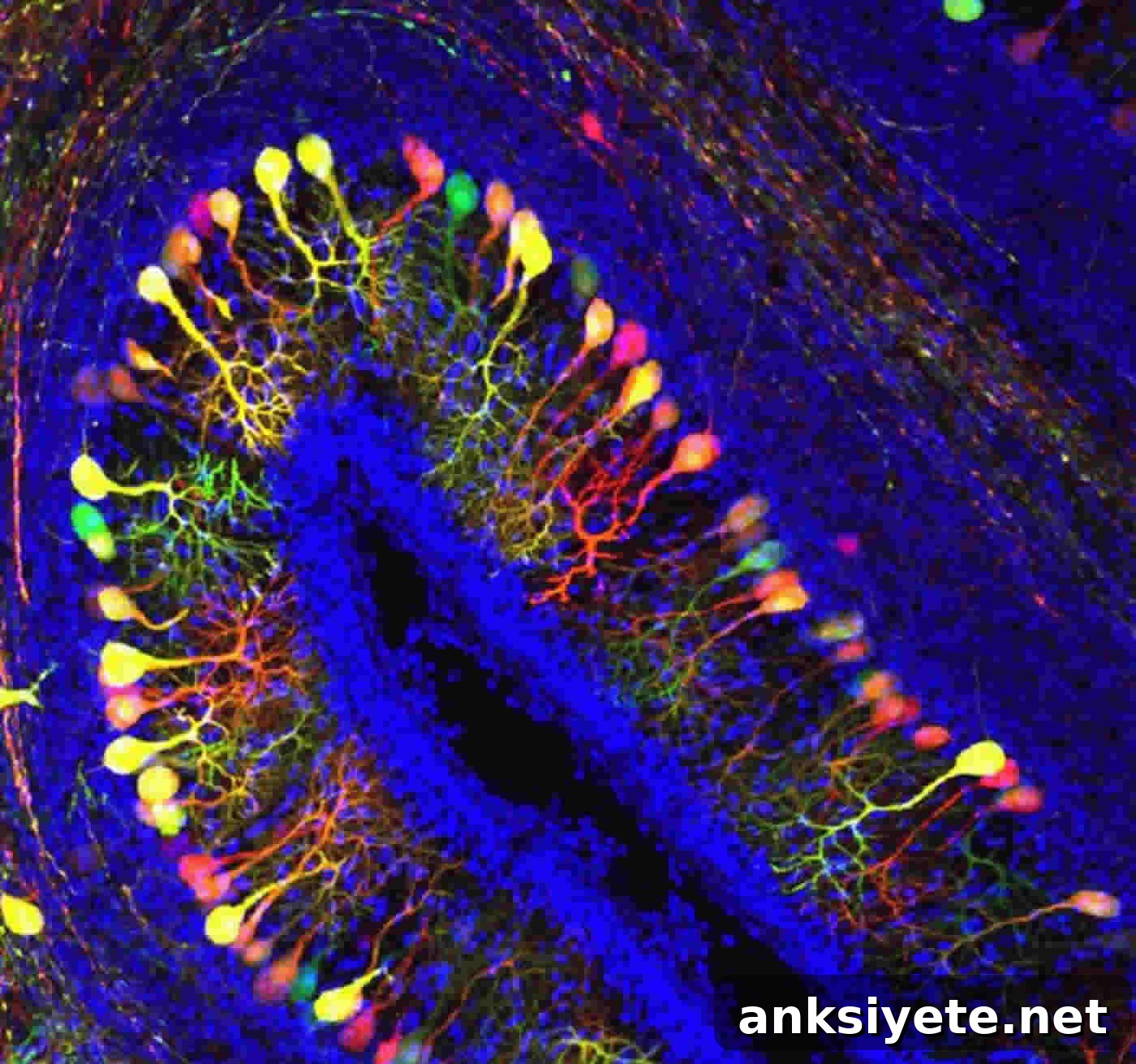
To investigate how MCT8 dysfunction affects cerebellar development, the KU Leuven team studied chicken embryos in which MCT8 was selectively inactivated in parts of the developing cerebellum. PhD student Pieter Vancamp reports that early after transporter knockdown, key proteins required for neuronal development were produced at reduced levels in affected regions. As development proceeded, Purkinje cells—large inhibitory neurons central to cerebellar circuitry—developed fewer and less complex dendritic branches. Since dendrites are essential for receiving and integrating signals, this morphological deficit disrupts neuronal signaling and leads to secondary defects in other cerebellar cell populations.
The study demonstrates that thyroid hormone entry into neural cells via transporters like MCT8 is indispensable from very early stages of embryonic development. The earlier transport is disrupted, the more difficult it becomes to correct the damage after birth. While newborn screening programs typically test infants for thyroid dysfunction using heel-prick blood tests, earlier testing of pregnant women would better protect fetal brain development—yet this practice is not universal. For AHDS, the findings raise important questions about potential prenatal therapies using thyroid hormone analogues that can enter cells without relying on MCT8. Such treatments remain experimental and have so far been explored only after birth.
Source: Veerle Darras, KU Leuven.
Image credit: KU Leuven Lab of Comparative Endocrinology – Joke Delbaere & Pieter Vancamp.
Original research: Delbaere J., Vancamp P., Van Herck S. L. J., Bourgeois N. M. A., Green M. J., Wingate R. J. T., & Darras V. M. (2017). MCT8 deficiency in Purkinje cells disrupts embryonic chicken cerebellar development. Journal of Endocrinology. DOI: 10.1530/JOE-16-0323.
KU Leuven (2017). Transporter of Thyroid Hormones Is Crucial for Embryonic Brain Development. Neuroscience News. Published February 6, 2017.
Abstract
MCT8 deficiency in Purkinje cells disrupts embryonic chicken cerebellar development
Mutations that inactivate the human SLC16A2 gene, which encodes the thyroid hormone transporter MCT8, cause Allan–Herndon–Dudley syndrome and severe motor deficits. Using the chicken embryo as a model, researchers electroporated an MCT8-RNAi vector into the cerebellar primordium at embryonic day 3 to knock down MCT8 specifically in Purkinje cell precursors. By day 6, thyroid hormone–responsive genes such as RORα and the Purkinje cell differentiation marker LHX1/5 were downregulated. By embryonic day 18, Purkinje cells showed reduced dendritic complexity, indicating that MCT8 is crucial for cell-autonomous maturation of these neurons. Early treatment with the thyroid hormone analogue 3,5,3′-triiodothyroacetic acid partially rescued early Purkinje cell differentiation. MCT8-deficient Purkinje cells also produced non–cell-autonomous effects: granule cell precursor proliferation decreased, the external germinal layer became thinner with loss of PAX6 expression at early stages, and later showed an apparent accumulation of migrating granule cells in the molecular layer, suggesting stalled inward radial migration. The findings indicate that early MCT8 expression in Purkinje cells is essential for both autonomous and nonautonomous aspects of cerebellar development and offer new insights into the developmental origin of Allan–Herndon–Dudley syndrome.
Delbaere J., Vancamp P., Van Herck S. L. J., Bourgeois N. M. A., Green M. J., Wingate R. J. T., & Darras V. M. (2017). “MCT8 deficiency in Purkinje cells disrupts embryonic chicken cerebellar development.” Journal of Endocrinology. Published online February 1, 2017. DOI: 10.1530/JOE-16-0323.