
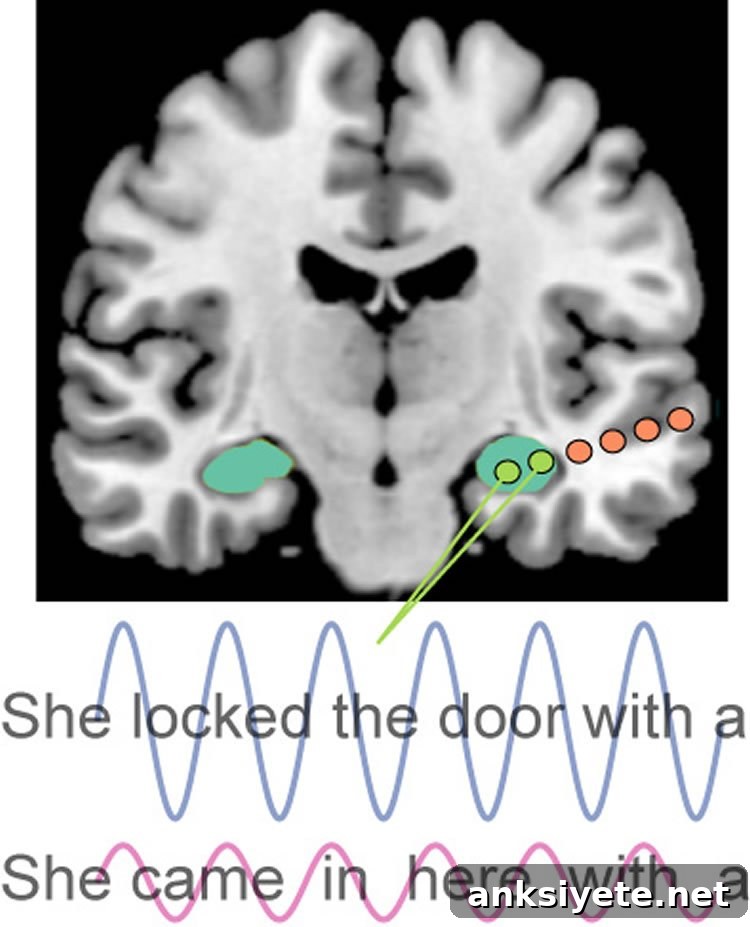
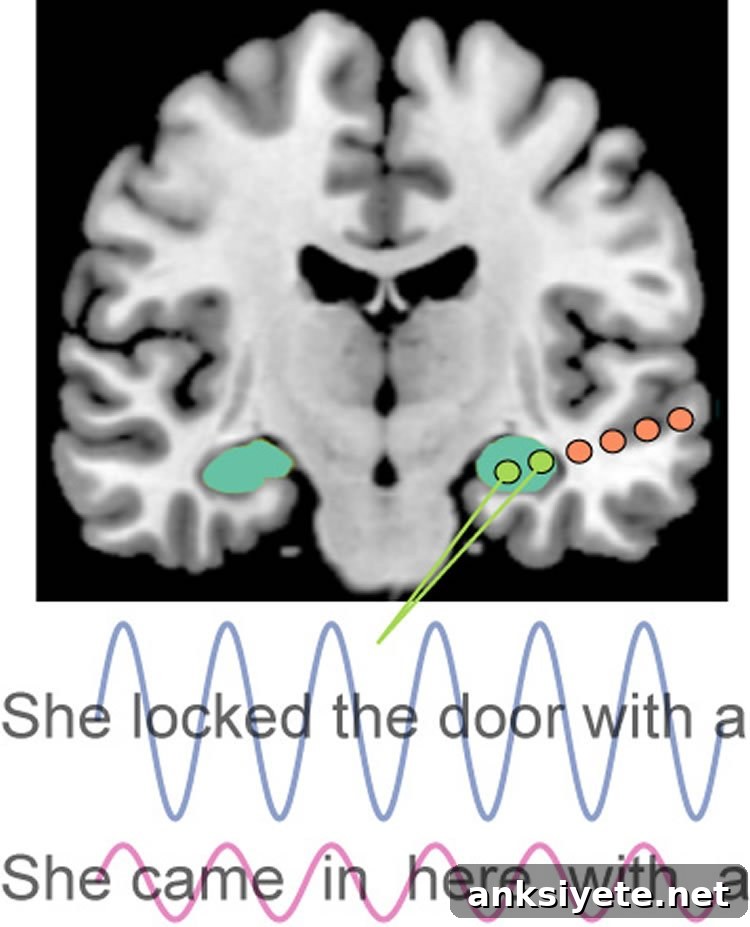
Summary: Researchers report that memory and language are closely connected through the hippocampus.
Source: UC Berkeley
New research finds that completing someone’s sentence or answering a fill-in-the-blank task engages the hippocampus, a brain region long associated with memory but often overlooked in studies of language.
It may seem obvious that language depends on memory—words, context, past conversations and knowledge inform how we speak and understand—but psychological research has frequently treated language and memory as separate brain functions. A team of psychologists at the University of California, Berkeley, has produced evidence that the two are tightly integrated through hippocampal activity.
The hippocampus, located deep within the medial temporal lobe, acts like a hub that links related memories: for example, the color, texture, smell and taste of an orange are bound together so they can be recalled as a single, meaningful concept. The new study demonstrates that the hippocampus also links incoming words to this stored semantic knowledge, a process essential for interpreting and producing sentence meaning.
Clinical observations had already hinted at this connection. Patients with hippocampal damage sometimes show difficulties that are precisely the sort of deficits expected if the hippocampus supports language associations—trouble relating word meanings to one another and extracting contextual information from sentences or extended discourse.
“The link between language and the hippocampus may explain some language deficits seen in patients who do not have damage to classical language areas,” said Vitória Piai, a former UC Berkeley postdoctoral fellow and now a senior researcher at Radboud University. “Studying language as it occurs in real life should reveal a larger role for the hippocampus in language than previously appreciated.”
Intracranial recordings reveal real-time activity
To investigate, researchers recorded neuronal activity directly from the hippocampus in 12 people undergoing clinical electrophysiological monitoring. Participants listened to sentences that either constrained the final word strongly—“He swept the floor with a ________”—or allowed many possible completions. After a brief pause, a picture representing the final word appeared and participants named it.
In most subjects the hippocampus showed pronounced, synchronized activity while listeners homed in on the correct word but before the picture appeared. This pattern indicates the hippocampus was actively making associations across brain networks to retrieve the expected word (for example, broom for the sentence above).
These deep-brain recordings capture neural activity on the scale of milliseconds, revealing rapid dynamics that cannot be resolved by functional MRI, which measures slower blood-oxygen changes. Electrophysiology therefore offers a direct window into how neural circuits assemble meaning in real time.
“fMRI can indicate where regions might interact, but it cannot reveal how the brain brings components together moment by moment,” Piai explained. “Electrophysiology lets us observe the timing of neural events that underlie language processing and memory retrieval.”
The study, co-authored by Robert Knight, professor of psychology at UC Berkeley, was published online in the journal Proceedings of the National Academy of Sciences.
Language and memory are coordinated
“Language has traditionally been viewed as a cortical function, which is why it has been considered a distinguishing feature of humans,” Knight said. “Although the hippocampus is well known for its role in spatial and verbal memory, the fields studying language and memory have largely operated independently—like ships passing in the fog. This work shows they are more connected than assumed.”
The experiment took advantage of a robust behavioral effect: people more quickly and accurately supply a missing word when sentence context strongly constrains a single answer than when multiple answers are plausible. In the intracranial recordings, constrained sentences produced a burst of synchronized theta-band oscillations (about 4–8 Hz) in the hippocampus in 10 of the 12 participants—an electrophysiological signature associated with memory-related associations.
Previous electrophysiological studies have shown that memory-related neurons can fire across a wide frequency range, but associations among related memories often appear in the theta band. One model proposes that when one associated representation is activated, other neurons oscillating at the same theta frequency synchronize and fire together, enabling recall of linked features—sensory details, semantic attributes, and emotional associations—of a concept.
By this account, hearing words like “swept” and “floor” activates overlapping groups of neurons that gradually synchronize and converge on the one word tightly related to both—“broom.” In contrast, unconstrained sentences fail to produce such coordinated hippocampal activity because they do not evoke common, overlapping associations.
These results suggest memory processes contribute continuously as sentences unfold, not merely as a separate, downstream function. The hippocampus appears to participate actively in generating sentence meaning by mapping incoming linguistic input onto stored semantic knowledge.
Other co-authors include Kristopher Anderson and Callum Dewar (UC Berkeley); neurologists Jack Lin (UC Irvine Medical Center) and Josef Parvizi (Stanford University Medical Center); and neuropsychologist Nina Dronkers (UC Davis and the Veterans Administration hospital in Martinez).
Funding: The work was supported by the Netherlands Organization for Scientific Research, the National Institutes of Health, the U.S. Department of Veterans Affairs Clinical Sciences Research and Development Program, Stanford NeuroVentures Program, the National Institute of Neurological Disorders and Stroke, the National Science Foundation and the Nielsen Corporation.
Source: Robert Sanders, UC Berkeley
Original research: Piai V., Anderson K. L., Lin J. J., Dewar C., Parvizi J., Dronkers N. F., Knight R. T. — “Direct brain recordings reveal hippocampal rhythm underpinnings of language processing,” Proceedings of the National Academy of Sciences, published online September 19, 2016. doi:10.1073/pnas.1603312113
Abstract
Direct brain recordings reveal hippocampal rhythm underpinnings of language processing
Language has typically been associated with cortical perisylvian regions. Here, intracranial recordings from hippocampal structures demonstrate that theta oscillations—important for memory—track the amount of contextual linguistic information in sentences. Twelve participants heard either constrained sentences (e.g., “She locked the door with the”) or unconstrained sentences (e.g., “She walked in here with the”) before being shown a picture of the final word to name. Hippocampal theta power increased for constrained relative to unconstrained contexts during sentence processing, and this increase occurred prior to picture presentation. The findings indicate that the hippocampal complex actively contributes to language by relating incoming words to stored semantic knowledge, a necessary process for constructing sentence meaning.