
Summary: Researchers have developed a new dry EEG sensor design capable of measuring brain activity through hair and across curved scalp surfaces, a step toward controlling robots and other devices with the mind.
Source: American Chemical Society
What once sounded like science fiction — wearing an electronic headband to control a robot using only your thoughts — is now closer to reality. A team reported in ACS Applied Nano Materials the development of a novel dry sensor that records brain electrical activity without sticky gels, potentially expanding noninvasive brain–machine interfaces (BMIs).
Traditional electroencephalography (EEG) records brain signals with electrodes placed on the scalp or implanted in the brain. EEG is essential for diagnosing neurological conditions and is increasingly used to create BMIs that translate neural activity into commands for prosthetics, robots, or computers. Most noninvasive EEG systems use wet electrodes with conductive gels that provide low impedance contact but can irritate skin and are inconvenient for everyday use.
Efforts to replace gels have produced various dry sensors, yet many still underperform compared with standard silver/silver-chloride (Ag/AgCl) wet electrodes—especially over hairy, curved regions of the head. Flat nanomaterials such as graphene offer promising electrical properties, but their planar, flaky forms struggle to make reliable contact on irregular scalp surfaces for extended wear.
To overcome these challenges, Francesca Iacopi and colleagues designed three-dimensional, micropatterned sensors made from epitaxial polycrystalline graphene. The microstructured graphene coatings were formed on small 3D scaffolds about 10 µm thick and patterned in different geometries to test contact, comfort, and signal fidelity on the occipital scalp region, which overlies the visual cortex.
Among the tested layouts, a hexagonal micropattern provided the most reliable skin contact and electrical performance on the curved, hairy occipital area. The researchers embedded eight of these sensors into a flexible headband that maintained gentle, even pressure against the back of the head without gels or adhesives.
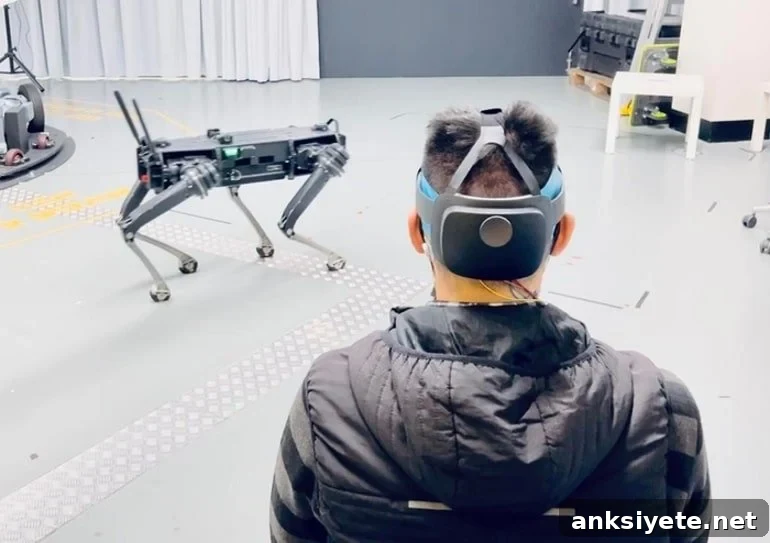
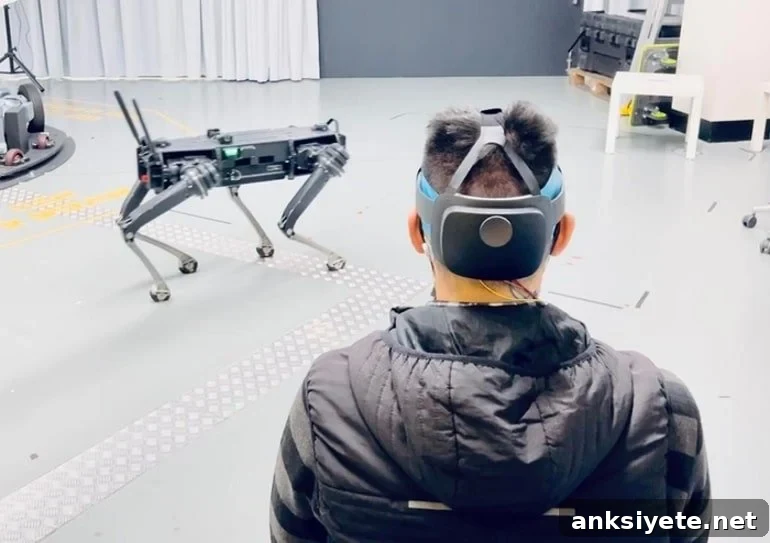
In experiments combining the headband with an augmented reality display that presented visual stimuli, the dry sensor array detected steady-state visually evoked potentials (SSVEPs) associated with particular cues. Signal processing translated these EEG patterns into commands that successfully controlled the movement of a four-legged robot, demonstrating a hands-free BMI application based on noninvasive dry electrodes.
Although the patterned graphene dry electrodes did not yet fully match the signal quality of traditional wet Ag/AgCl sensors, they achieved low skin–electrode impedance and competitive signal-to-noise ratios in many tests. The authors emphasize this work as an important advance toward comfortable, easy-to-use dry EEG sensors that could broaden BMI use outside clinical settings.
Funding: The study acknowledges support from the Defence Innovation Hub of the Australian Government, the Australian National Fabrication Facility at the University of Technology Sydney, and the Research & Prototype Foundry at the University of Sydney Nano Institute.
About this robotics research news
Author: Katie Cottingham
Source: American Chemical Society
Contact: Katie Cottingham – American Chemical Society
Image: Adapted from ACS Applied Nano Materials, 2023, DOI: 10.1021/acsanm.2c05546
Original Research: Open access.
“Noninvasive Sensors for Brain–Machine Interfaces Based on Micropatterned Epitaxial Graphene” by Shaikh Nayeem Faisal et al. ACS Applied Nano Materials
Abstract
Noninvasive Sensors for Brain–Machine Interfaces Based on Micropatterned Epitaxial Graphene
Reliable, high-performance dry EEG sensors are essential for scaling brain–machine interfaces beyond laboratory and clinical environments. Historically, dry sensors exhibit lower performance than Ag/AgCl wet electrodes, particularly when recording from hairy, curved parts of the scalp. Bulky or sharp dry probes can improve contact but sacrifice comfort and wearability.
This study presents three-dimensional micropatterned sensors based on a subnanometer-thick epitaxial graphene layer that conform to the occipital scalp, a region important for visual paradigms such as steady-state visually evoked potentials (SSVEPs). The patterned graphene sensors provide effective on-skin contact with low impedance and can deliver signal-to-noise ratios comparable to wet sensors in many conditions.
Using these dry, conformal electrodes integrated into a simple elastic headband, the researchers demonstrated hands-free communication with a quadruped robot driven by decoded brain activity, illustrating the potential of micropatterned graphene for comfortable, noninvasive BMI applications.