
A new study examining fruit fly brains reveals a previously unrecognized stem cell mechanism that may illuminate how diverse neurons form in humans. The research by scientists at the University of Oregon was published online in Nature ahead of the June 27 issue.
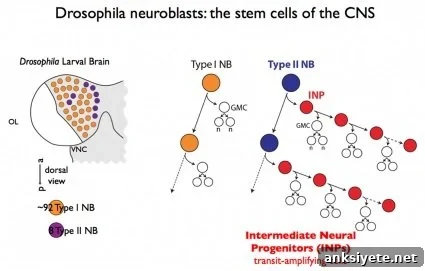
“The question we confronted was, ‘How does a single kind of stem cell, like a neural stem cell, make all different kinds of neurons?’” said Chris Doe, professor of biology and co-author of the paper, “Combinatorial temporal patterning in progenitors expands neural diversity.”
Stem cells’ ability to produce new cells is well known, but this study clarifies how a specific class of stem cells creates intermediate progenitors that then generate many distinct neuronal subtypes. Rather than simply amplifying one cell type, these progenitors produce a sequence of different neurons, increasing both cell number and variety.
Lead author Omar Bayraktar, a doctoral student in developmental neurobiology who recently defended his dissertation, explained that prior work showed stem cells and progenitors could change over time to produce different cell types. What had not been described in detail was the full extent of temporal patterning across large stem cell lineages that include multiple kinds of progenitors. This study maps out how those patterns operate over time to expand neural diversity.
The team focused on type II neuroblasts in Drosophila (fruit flies). These neuroblasts give rise to intermediate neural progenitors (INPs), which were previously known to proliferate into many cells. Bayraktar and Doe discovered that INPs do more than multiply: they generate distinct neural subtypes in a precise temporal order. In effect, the system uses two complementary axes of patterning — the neuroblast-level program and the INP-level program — to dramatically expand the number and variety of neurons produced from a single stem cell lineage.
Instead of simply making repeated copies of the same neuron, a single stem cell lineage can therefore produce hundreds of diverse neurons by combining sequential programs of specification. Where older estimates suggested a single stem cell might produce on the order of a hundred similar neurons, the combinatorial temporal patterning the authors describe can boost that output to several times more neurons and many more subtypes.
These Drosophila cell types have analogous counterparts in the developing human brain, and the authors emphasize the broader relevance for mammalian neurobiology. Understanding the pathways that direct the formation of specific neuronal types could enable researchers to reprogram or redirect stem cells to produce particular neurons, a long-term goal that could inform cell-based therapies for neurological disease.
The two-tiered mechanism is elegant but finite: the patterning programs eventually stop and the lineage ceases producing new cells. Identifying how and why this termination occurs is one of the next questions for the research team, as understanding the shutdown signal could be as important as understanding the activation program.
Funding for the study came from the Howard Hughes Medical Institute and the National Institute of Child Health and Human Development at the NIH, along with additional NIH training grants that supported Bayraktar. The new paper builds on earlier research from the Doe laboratory published in 2008 that first characterized intermediate neural progenitors and quantified their proliferative expansion.
Kimberly Andrews Espy, vice president for research and innovation and dean of the Graduate School at the University of Oregon, highlighted the study’s significance: “This vital research will no doubt capture the attention of human biologists. Researchers at the University of Oregon continue to advance our understanding of developmental processes that influence health and well-being around the world.”
Notes about this neural stem cell and neuroscience research
NIH grants to Chris Doe (R01HD27056) and to Omar Bayraktar (T32HD216345 and T32GM007413) supported the work, together with Howard Hughes Medical Institute support to Doe. The Nature article appears alongside a related study from New York University; together, these papers shed new light on how a broad array of neuronal cell types is produced during development.
Contact: Lewis Taylor – University of Oregon
Source: University of Oregon press release
Image source: Drosophila neuroblast diagram credited to Chris Doe and adapted from the University of Oregon press release.
Original research: Abstract for “Combinatorial temporal patterning in progenitors expands neural diversity” by Omer Ali Bayraktar and Chris Q. Doe in Nature. Published online in advance of the June 27 issue.