
Summary: Preclinical PET imaging can create a visual map of inflammation and may help evaluate new therapies for autoimmune and other inflammatory diseases.
Source: Society of Nuclear Medicine.
Preclinical PET imaging maps neuroinflammation and could accelerate development of therapies for multiple sclerosis
Researchers presented findings showing that preclinical positron emission tomography (PET) imaging can visualize inflammatory activity in models of multiple sclerosis (MS) and may serve as a valuable tool for testing novel therapies targeting immune signaling pathways.
Multiple sclerosis affects more than 2.3 million people worldwide. MS is an autoimmune disorder characterized by inflammation and progressive damage to neuronal fibers and their myelin insulating layer. Loss of myelin disrupts neuronal signaling and leads to disability. Similar inflammatory mechanisms are involved in other neurodegenerative disorders such as Parkinson’s and Alzheimer’s diseases, in inflammatory bowel diseases such as Crohn’s and ulcerative colitis, and in vascular inflammation that contributes to atherosclerosis.
“Inflammation is a fundamental defense mechanism, but when it becomes chronic it contributes to many diseases,” said Zhude Tu, PhD, professor of PET radiochemistry at Washington University School of Medicine. The study highlights how imaging tools can illuminate the molecular drivers of inflammation and support the development of targeted treatments.
The investigators focused on sphingolipid signaling—a pathway increasingly implicated in inflammatory disease. The sphingosine-1-phosphate receptor 1 (S1P1) is central to immune cell trafficking and inflammatory responses. The therapeutic success of fingolimod (FTY-720), approved for relapsing MS, reflects the importance of modulating S1P1 activity to reduce autoimmune attacks.
Adam J. Rosenberg, PhD, and colleagues synthesized a series of small molecules designed to bind selectively to S1P1 and labeled several candidates with the positron-emitting isotope fluorine-18. These radiotracers directly target S1P1 and enable noninvasive PET imaging to measure receptor expression in living animals. The team used rodent models of experimental autoimmune encephalomyelitis (EAE), a widely used preclinical model of MS, and also assessed tracer behavior in healthy nonhuman primates.
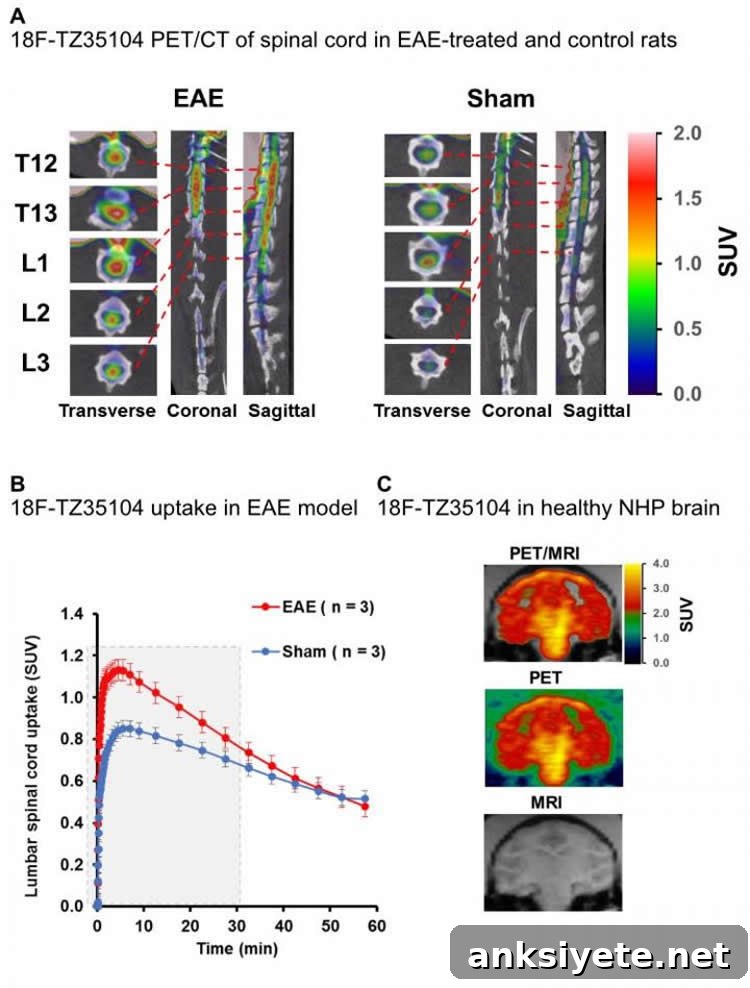
Key findings included clear detection of increased S1P1 expression in animals with induced neuroinflammation compared with healthy controls, and demonstration that the compounds can cross the blood–brain barrier—an important requirement for imaging and for drug delivery to the central nervous system. One tracer, [18F]TZ43113, showed a 31% higher uptake in the lumbar spinal cord of EAE rats versus sham-treated controls, consistent with local inflammatory changes confirmed by immunohistochemistry.
“These tracers show promise for imaging S1P1 in MS and other inflammatory disorders,” said Tu. “They offer a way to quantify receptor expression in vivo, which could help monitor disease activity and evaluate the effects of novel S1P1-targeted therapies.”
Source: Laurie Callahan, Society of Nuclear Medicine. Image credit: Mallinckrodt Institute of Radiology, Washington University School of Medicine, St. Louis, MO. Original research: “Development and in vivo evaluation of three F-18 labeled S1P1 ligands as PET tracers for MS” by Adam Rosenberg, Hui Liu, Xuyi Yue, Hongjun Jin and Zhude Tu, Journal of Nuclear Medicine (published online May 1, 2016).
The study was presented at the 2016 Annual Meeting of the Society of Nuclear Medicine and Molecular Imaging (SNMMI).
Abstract
Development and in vivo evaluation of three F-18 labeled S1P1 ligands as PET tracers for MS
Objectives Many neurological disorders, including multiple sclerosis, involve neuroinflammation. S1P1 expression increases under these conditions and is a validated therapeutic target. The study evaluated second-generation, S1P1-selective fluorine-18 tracers for in vivo imaging in control and inflammatory animal models.
Methods A focused library of fluorine-containing S1P1-selective compounds was synthesized and screened in vitro. Three high-affinity ligands were advanced, converted to tosylate precursors, and radiolabeled with fluorine-18 by nucleophilic displacement. After deprotection, the radiotracers were evaluated using autoradiography, biodistribution studies, and microPET imaging in rodent EAE models and in normal nonhuman primates.
Results Seventeen candidates showed sub-50 nM affinity for S1P1 and low affinity for S1P2/3. Three lead compounds with IC50 values below 10 nM—[18F]TZ35110 (2.6 nM), [18F]TZ43113 (9.8 nM) and [18F]TZ35104 (6.7 nM)—were produced with high specific activity. Rodent biodistribution revealed measurable brain uptake with peak levels at about 1 hour post-injection. In the EAE rat model, microPET imaging with [18F]TZ43113 revealed a 31% increase in lumbar spinal cord uptake in EAE animals versus sham controls, corroborated by post-imaging immunohistochemistry. Nonhuman primate imaging of [18F]TZ35104 demonstrated robust brain entry and favorable kinetics.
Conclusions A set of fluorinated, S1P1-selective ligands were designed, radiolabeled, and validated in vivo. These agents cross the blood–brain barrier and can detect elevated S1P1 expression in a preclinical model of MS. They represent promising PET tracers for imaging neuroinflammation and could support the development and assessment of S1P1-targeted therapies.
Research support: DOE #DESC0008432; NIH/NIMH #MH092797; NIH/NINDS #NS075527 and #NS061025.