
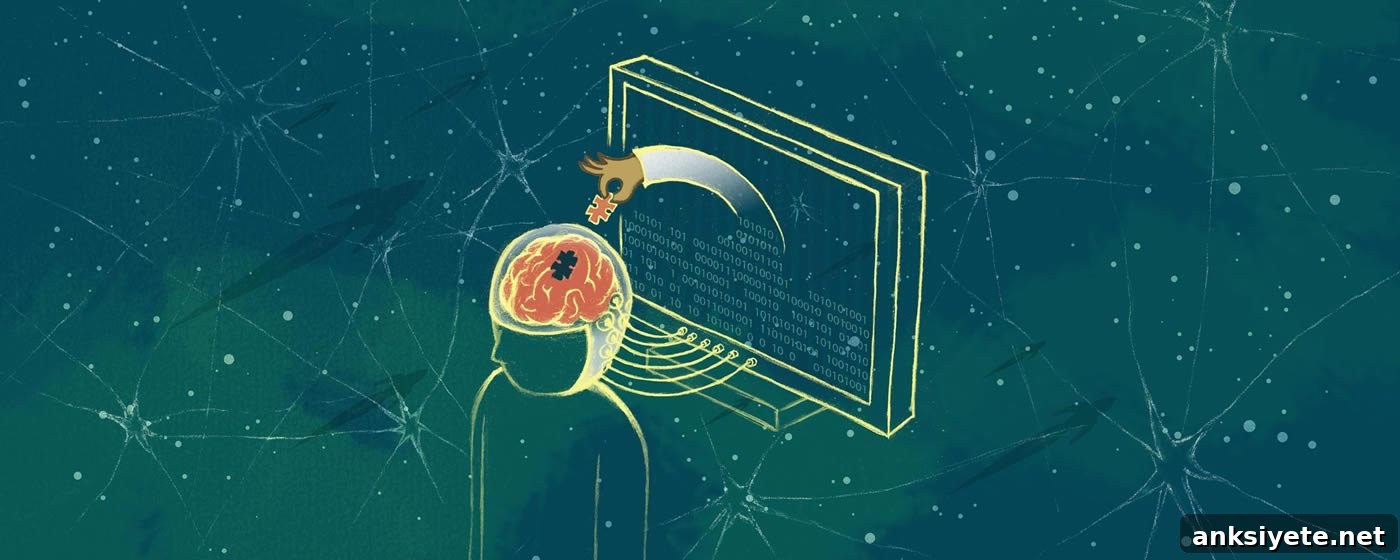
Summary: Decoding brain activity can advance brain–computer interfaces, improving treatments and enabling people with neurological conditions to interact more effectively with their environment.
Source: Stanford.
For more than a century, people have imagined linking the human brain—remarkably adaptable but vulnerable—to precise, reliable machines. Early science fiction speculated on clockwork enhancements and transplanted brains piloting starships. Today, practical brain–machine interfaces are already transforming medicine: they can restore basic vision, ease symptoms of Parkinson’s disease, and prevent some epileptic seizures. The next step is improving how we interpret and respond to the brain’s signals.
The primary obstacle isn’t always the implant or sensor hardware. Often the greater challenge is understanding what the brain is communicating and how to reply effectively. Researchers must identify patterns that signal an imminent seizure, a desire to move a cursor, or other intentions, and then translate those patterns into timely actions. Progress in decoding that “language” will accelerate advances in clinical care and emerging neurotechnology applications.
Listening to the language of the brain
The modern field of brain–computer interfaces began in the early 1970s with Jacques Vidal’s Brain Computer Interface project, which combined EEG recordings and computer processing to translate neural signals into simple actions. Vidal imagined interfaces that could one day control prosthetic devices or other machines. While piloting starships remains fiction, neural prosthetics are a clinical reality getting closer to widespread use.
At Stanford, researchers such as Krishna Shenoy (electrical engineering) and Jaimie Henderson (neurosurgery) have advanced neural prosthetic technology. Over nearly two decades they helped develop implants and algorithms that allowed people with paralysis to move on-screen cursors and type messages, and in other studies to control robotic arms with brain signals. Achieving these milestones required progress in sensors, surgical methods, and—critically—the software that decodes neural activity in real time.
Translating neural activity is an immense challenge. The brain’s messages are encoded across billions of neurons firing in complex patterns. Paul Nuyujukian, trained in Shenoy’s lab and later a faculty member in bioengineering and neurosurgery, worked on the decoder algorithms that map neural signals to cursor movements. He compares the task to hearing a hundred people speaking different languages simultaneously and trying to isolate a single person’s intent.
Despite the difficulty, the team found elegant practical solutions. Experiments with monkeys showed that focusing on task context—like where the monkey was instructed to move a cursor—helped the decoder isolate relevant neural signals. These design choices substantially improved decoder performance, more than doubling effectiveness in some cases. Adapting those innovations for clinical studies led to record typing speeds for people with paralysis, demonstrating the potential for real-world benefit.
Nuyujukian emphasizes that neural interfaces can address many pressing medical needs beyond prosthetic control, including treatments for epilepsy and stroke—conditions where interpreting the brain’s emergent signals could guide timely interventions.
Listening for signs something’s wrong
Some brain–computer interfaces are designed not to enact voluntary commands, but to detect when the brain signals distress or dysfunction. NeuroPace, developed with contributions from Stanford, is an implantable system that monitors brain activity for patterns that precede epileptic seizures. When such patterns are detected, the device delivers brief electrical pulses to interrupt seizure activity.
Similarly, improving deep brain stimulation for Parkinson’s disease can benefit from smarter sensing. Traditional stimulators run continuously and can cause side effects like tingling or speech difficulties. The cardiac pacemaker evolved by sensing heart rhythms and delivering therapy only when needed; a parallel approach is emerging for the brain. Researchers, including Helen Bronte-Stewart, are developing responsive “brain pacemakers” that sense neural signals and adjust stimulation in real time to reduce side effects and increase efficacy.
Bronte-Stewart’s lab has applied analytical methods from physics and information theory to study a particularly disabling Parkinson’s symptom called freezing of gait, in which patients temporarily cannot lift their feet. Their work found that low-frequency brain waves become less predictable during freezing episodes and that this increased randomness differentiates people who experience freezing from those who do not. Detecting such markers could enable well-timed stimulation to prevent freezing episodes with fewer side effects, and similar adaptive systems might one day address cognitive or psychiatric symptoms as well.
Do we need to speak the brain’s language?
Some effective interfaces operate without a deep understanding of the brain’s internal code. Decoders can exploit statistical patterns and task context to translate intent into action, which may be sufficient for many clinical applications like prosthetic control or seizure prevention. However, other goals—especially restoring complex senses—may require greater fidelity to the brain’s native signals.
E.J. Chichilnisky, who studies visual prosthetics, argues that restoring sight will demand more precise, neuron-level communication. The retina is not a uniform grid of identical sensors; it contains multiple specialized neuron types that each convey distinct features of visual information. A successful prosthetic retina must identify which neuron types an electrode interfaces with and convert images into patterns those specific neurons expect.
That means a prosthetic system should both read individual neurons’ activity and produce stimulation that the neurons interpret correctly. With that two-way interaction, a prosthetic retina could adapt to the brain and improve the resulting perception. In short, for sensory restoration, speaking the brain’s language—at least at the level of specific cell types—may be essential.
Whether by advanced decoders that infer intent from patterns or by devices that directly converse with targeted neurons, the future of brain–machine interfaces rests on better listening and more nuanced responses. As hardware improves, so will the algorithms and adaptive strategies that translate neural activity into meaningful, timely action—expanding therapeutic options for epilepsy, Parkinson’s, paralysis, blindness, and other conditions.
Bronte-Stewart, Chichilnisky, Henderson, and Shenoy are affiliated with Stanford Bio-X and the Stanford Neurosciences Institute.
Source: Nathan Collins — Stanford
Publisher: Organized by NeuroscienceNews.com.
Image Source: Image adapted from a Stanford video. Top image credited to Guo Mong.
Video Source: Video credited to Stanford.
Stanford. “Improving Brain–Machine Interfaces to Help People With Paralysis Interact With the World.” NeuroscienceNews, October 20, 2017.