
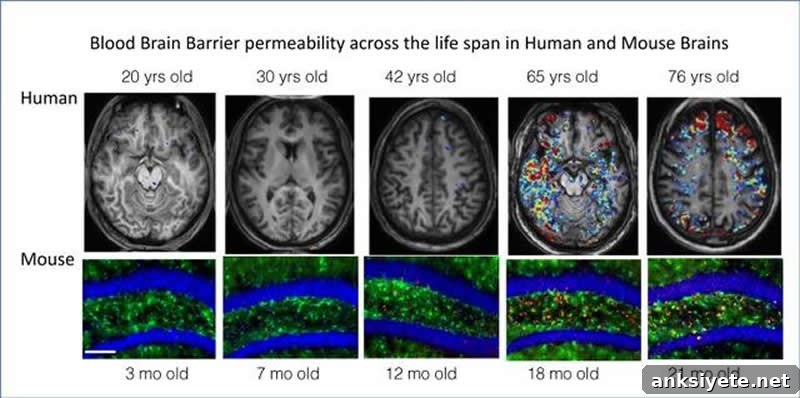
Summary: A synthesized small-molecule drug that crosses the blood-brain barrier blocks the TGF‑β receptor in astrocytes. In aged mice this treatment reduced receptor activity to levels seen in younger animals, decreased neuroinflammation, and restored learning and spatial navigation abilities.
Source: UC Berkeley
Drugs that reduce brain inflammation may slow or reverse age-related cognitive decline
Researchers from the University of California, Berkeley, and Ben‑Gurion University report in Science Translational Medicine that a targeted drug therapy reduced brain inflammation and restored cognitive performance in aged mice. The treatment reduced molecular signs of aging in the brain and allowed older animals to perform learning and maze tasks at levels similar to much younger mice.
“We often equate brain aging with irreversible cell loss and degeneration. Our findings point to a different mechanism: an inflammatory ‘fog’ driven by blood-brain barrier dysfunction that suppresses normal brain function,” said Daniela Kaufer, a UC Berkeley professor of integrative biology and co-senior author. “When that inflammation is removed, the aged brain rapidly regains youthful plasticity. The result is a hopeful sign that aspects of brain aging can be reversed.”
The study supports a shift in how researchers understand cognitive decline in aging. Evidence has been mounting that the blood-brain barrier (BBB)—the brain’s filtration system that prevents potentially harmful blood-borne molecules and pathogens from entering neural tissue—becomes more permeable with age. That increased permeability allows blood proteins and other factors to enter the brain and trigger inflammation and neuronal damage. MRI studies led by Alon Friedman indicate that BBB leakiness is common in older adults, with a substantial proportion showing measurable leakage after age 70.
An accompanying paper by Kaufer, Friedman and colleagues links this BBB-driven inflammation to abnormal brain rhythms. They identified transient episodes of slowed cortical activity—called paroxysmal slow wave events (PSWEs)—in both mice and humans. These events resemble microseizure-like disturbances in hippocampal rhythm and were detected by electroencephalogram (EEG) recordings in people with epilepsy, Alzheimer’s disease and mild cognitive impairment.
Together, the two studies provide clinicians with two practical biomarkers—MRI-detectable BBB leakage and EEG-detectable abnormal rhythms—that can identify patients with BBB dysfunction and guide treatment decisions. “With these biomarkers, clinicians can select patients for therapy, monitor response, and stop treatment once the barrier has healed,” Kaufer said.
Blood-brain barrier, albumin, and the TGF‑β pathway
Previous work from Friedman and Kaufer connected BBB leakage to the blood protein albumin. When albumin escapes the circulation and enters the brain, it binds to the TGF‑β receptor on astrocytes, triggering a cascade of inflammatory responses that disrupt neural circuits, reduce inhibitory signaling, increase excitation, and raise seizure susceptibility.
Earlier studies showed that blocking the TGF‑β receptor with certain drugs prevented epilepsy after brain trauma. Building on that work, the new experiments demonstrate that albumin infusion into the brains of young mice rapidly produces the hallmarks of an aged brain—hyperexcitability, inflammatory gene expression, susceptibility to seizures, and impaired maze performance. Electrophysiological recordings from these animals revealed PSWEs localized to the site of albumin exposure, mirroring findings in aged animals and patients with cognitive dysfunction.
“Infusing albumin was sufficient to induce an aged brain phenotype in very young mice—at the molecular, electrophysiological and behavioral levels,” Kaufer said.
Genetic experiments further confirmed the central role of astrocytic TGF‑β signaling. When researchers engineered aged mice to allow conditional knockdown of the TGF‑β receptor in astrocytes, the treated animals regained resistance to experimentally induced seizures and recovered youthful maze-learning performance.
In a translational advance, medicinal chemistry produced a brain-penetrant small molecule, dubbed IPW, that selectively blocks astrocytic TGF‑β signaling. When administered to aged mice at doses that reduced receptor activity to young-adult levels, IPW reduced neuroinflammation, normalized gene expression, decreased PSWEs, lowered seizure susceptibility, and restored learning and spatial navigation to near-young performance.
Human tissue analysis reinforced the animal findings. Kaufer and colleagues detected albumin and elevated TGF‑β signaling in aged human brain samples, along with increased markers of neuroinflammation. Friedman’s development of dynamic contrast-enhanced (DCE) MRI made it possible to map regional BBB leakage in people and showed greater leakage in individuals with worse cognitive performance.
Collectively, these results indicate that early dysfunction of the brain’s filtration system can initiate inflammatory cascades and network disruptions that underlie cognitive aging. By preventing or reversing BBB-driven TGF‑β activation in astrocytes, it may be possible to reduce inflammation and restore function after stroke, concussion, traumatic brain injury or in age-related cognitive impairment.
Kaufer, Friedman and collaborators, together with the medicinal chemist who synthesized IPW, have founded a company to develop therapies that heal the blood-brain barrier and modulate astrocytic TGF‑β signaling. Their goal is to translate these findings into clinical treatments that reduce brain inflammation and limit long-term damage after injury, and ultimately to help older adults with dementia who show MRI evidence of BBB leakage.
“We arrived at this insight by studying plasticity, traumatic brain injury and epilepsy,” Kaufer said. “The mechanism we uncovered—BBB leakage leading to astrocyte-driven inflammation and network dysfunction—offers a new perspective on why neurological function declines with age.”
Funding: National Institutes of Health (R01NS066005, R56NS066005), European Union’s Seventh Framework Program, Israel Science Foundation, United States–Israel Binational Science Foundation.
Source:
UC Berkeley
Media Contacts:
Robert Sanders – UC Berkeley
Image Source:
The image is credited to Alon Friedman and Daniela Kaufer.
Original Research: Closed access. “Paroxysmal slow cortical activity in Alzheimer’s disease and epilepsy is associated with blood-brain barrier dysfunction,” Alon Friedman et al., Science Translational Medicine, DOI: 10.1126/scitranslmed.aaw8954.
Abstract
Paroxysmal slow cortical activity in Alzheimer’s disease and epilepsy is associated with blood-brain barrier dysfunction
Analysis of EEG data from patients with Alzheimer’s disease revealed transient slowing events (PSWEs) whose frequency correlated with cognitive impairment. Similar PSWEs localized to regions with BBB dysfunction in patients with epilepsy and appeared in rodent models with BBB pathology: aged mice, a young familial Alzheimer’s model, and status‑epilepticus–induced epilepsy. Direct infusion of the serum protein albumin into young rodent brains produced high incidence of PSWEs, implicating BBB leakage and albumin-driven TGF‑β signaling as mechanisms that alter network dynamics. These findings identify PSWEs as an EEG signature of subclinical seizure-like network disturbances in Alzheimer’s disease and suggest BBB repair and TGF‑β modulation as therapeutic targets.