
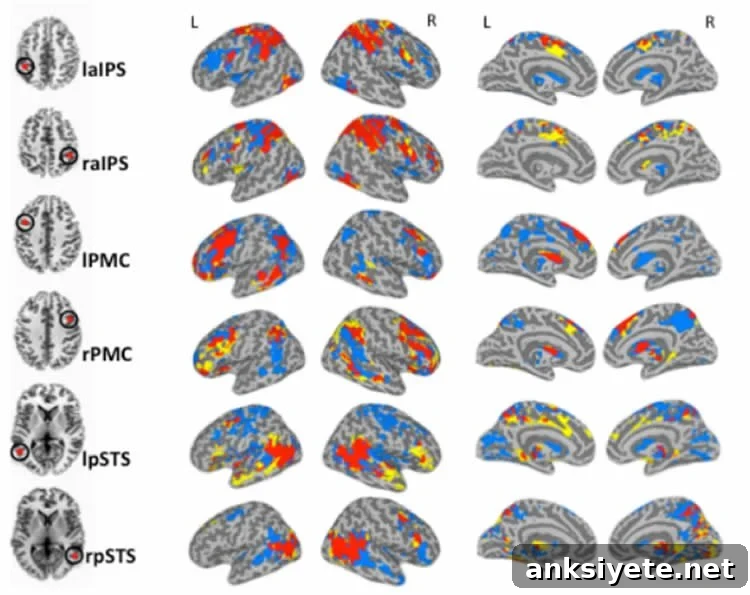
New NIH grants will enable SDSU psychologist Ralph-Axel Müller to study the autistic brain using fMRI, EEG, and MEG imaging technologies together.
Recent brain imaging research increasingly shows that neural connections in children with autism differ from those in typically developing children. Early work emphasized reduced connectivity between key brain regions, but more recent studies suggest the opposite in many cases: some brains on the autism spectrum show patterns of overconnectivity or atypical communication between regions.
Most prior studies have relied on a single imaging method, which limits how completely researchers can characterize atypical brain organization. Combining complementary methods promises a fuller, more reliable picture of the neural differences associated with autism spectrum disorder (ASD).
Two new grants from the National Institute of Mental Health (NIMH) will allow San Diego State University psychology professor Ralph-Axel Müller to do just that. Using funds totaling $4.2 million, Müller and collaborators will integrate three major neuroimaging approaches—functional magnetic resonance imaging (fMRI), electroencephalography (EEG), and magnetoencephalography (MEG)—to study connectivity and dynamics in the autistic brain.
Techniques working in tandem
“Brain imaging” refers to many distinct methods that each reveal different aspects of brain structure and function. fMRI, a widely used technique, maps blood flow changes across the brain. Because increased blood flow correlates with increased neural activity, fMRI is powerful for identifying where activity occurs, especially across large-scale networks. However, its temporal resolution is limited: fMRI captures activity on the scale of seconds, and it cannot resolve the millisecond-by-millisecond dynamics of neural signaling.
EEG, by contrast, measures electrical activity at the scalp with millisecond precision, making it well suited to track fast, transient processes. EEG’s spatial resolution is limited, so it is harder to localize the precise brain sources of those electrical signals. MEG measures the brain’s magnetic fields and combines excellent temporal resolution with improved source localization compared with EEG. Each method has distinct strengths and constraints, and combining them allows researchers to use the best features of each technique.
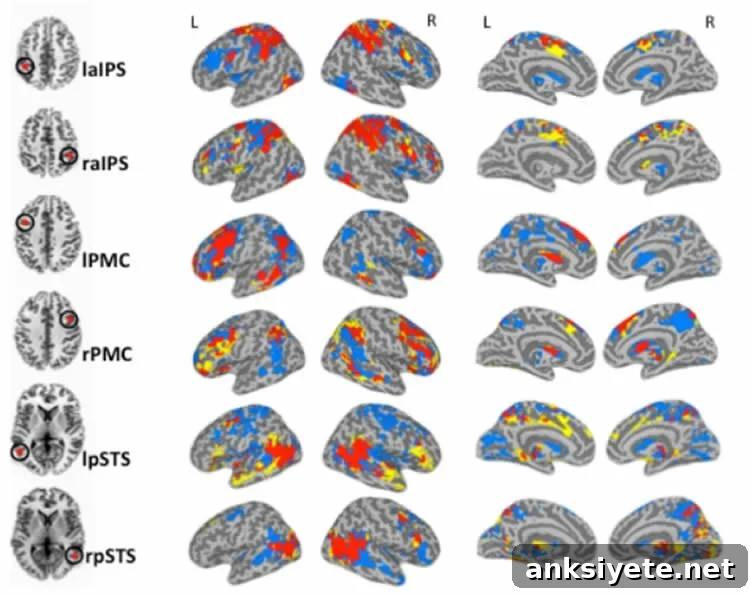
Müller’s team will search for disorganized patterns of activity—aberrant timing, atypical synchrony, or unexpected directional influences—that could underlie core symptoms of autism such as reduced attention to social cues, restricted interests, or repetitive behaviors. In earlier work, Müller and colleagues reported impaired connectivity between the cerebral cortex and the thalamus in children with autism. The thalamus plays a central role in sensorimotor integration and attention, so disruptions in cortico-thalamic communication could help explain several ASD-related differences in perception and behavior.
Together with collaborators Ksenija Marinkovic at SDSU and Thomas Liu at the University of California, San Diego, Müller will recruit children and adolescents with and without autism. Participants will complete a series of tasks designed to engage language, sensory processing, and higher-level cognitive systems while researchers record simultaneous and complementary fMRI, EEG, and MEG data. These tasks include language and semantic decision tests that isolate activity in distributed networks while revealing timing and coordination across regions.
Defining the differences
Part of the project focuses on the visual system. Prior studies suggest that people on the autism spectrum may rely more heavily on visual cortical processing during tasks that typically developing individuals solve using distributed, multimodal networks. For instance, when asked to make semantic judgments—such as deciding whether a truck qualifies as a vehicle—individuals with ASD sometimes show greater activation of visual cortex relative to control participants. By combining fMRI’s spatial mapping with MEG’s millisecond timing, Müller’s team can trace how visual and language-related regions interact in real time and how those interactions differ in autism.
The research will also examine intrinsic brain activity during rest to characterize large-scale network organization. Resting-state measures reveal how brain regions correlate their activity when no explicit task is present, and deviations in resting-state organization have been repeatedly linked to ASD. Integrating EEG and MEG with fMRI-based anatomical and functional maps will yield a more comprehensive and convergent description of atypical network architecture and rapid neural dynamics in autism than any single method could provide.
Ultimately, the researchers aim to identify reliable neural biomarkers that indicate whether an individual falls on the autism spectrum. Objective, brain-based markers could complement behavioral assessment and potentially distinguish biological subtypes within the broad diagnostic category of autism spectrum disorder.
“Autism is a brain-based disorder, but its diagnosis is still based entirely on behavioral observation,” Müller said. “This is inadequate. We need to find brain biomarkers for autism.” The team also hopes that imaging-based markers might eventually be linked with genetic and environmental data to clarify different causes of ASD and guide more targeted interventions.
“For decades, research teams studying autism have specialized in one or another scientific technique, often without fully appreciating what other methods can reveal,” Müller added. “Our study, which combines several major imaging techniques, will be a step toward a more complete understanding of how the autistic brain differs from the typically developing brain—and what might be done about it.”
Contact: Michael Price – SDSU
Source: SDSU press release
Image Source: The image is adapted from the SDSU press release
Original Research: We will report on the research when it is completed.