
Summary: After injury, insulin is essential for the maturation and survival of newly generated olfactory sensory neurons, supporting recovery of the sense of smell.
Source: Monell Chemical Senses Center
Researchers have long recognized insulin’s role in the growth and repair of certain sensory neurons that convey environmental information to the brain, such as those involved in vision. Until now, its role in olfaction—the sense of smell—has been less clear.
A research team at the Monell Chemical Senses Center now reports that insulin critically supports the maturation of immature olfactory sensory neurons (OSNs) following injury. Their findings, published in eNeuro, identify a specific window during recovery when insulin signaling is required for newly generated OSNs to survive, mature, and re-establish functional connections.
“Our results suggest that delivering insulin intranasally could be developed into a treatment to restore smell after injury,” said first author Akihito Kuboki, MD, a postdoctoral fellow in Johannes Reisert, PhD’s lab. The work builds on prior knowledge that insulin plays a role in neuronal survival and that insulin receptors are abundant in olfactory tissues.
To test insulin’s role in olfactory regeneration, the investigators reduced circulating insulin in mice by inducing type 1 diabetes through pancreatic beta-cell ablation. They then selectively ablated existing OSNs using an olfactotoxic agent and tracked regeneration of the olfactory epithelium (OE), the sheet of tissue in the nasal cavity where OSNs reside. Early stages of OE regeneration proceeded similarly in diabetic and non-diabetic mice, but differences emerged after two weeks.
After day 14, diabetic mice showed fewer mature OSNs and more apoptotic cells in the OE than controls, indicating impaired maturation and increased cell death. Electrophysiological recordings confirmed reduced odor-evoked responses in the nasal epithelium, and analysis of the olfactory bulb showed fewer odor-activated cells. Behaviorally, diabetic mice performed worse on an odor-guided task designed to assess their ability to locate a scent-rewarded cookie, demonstrating a functional deficit in smell.
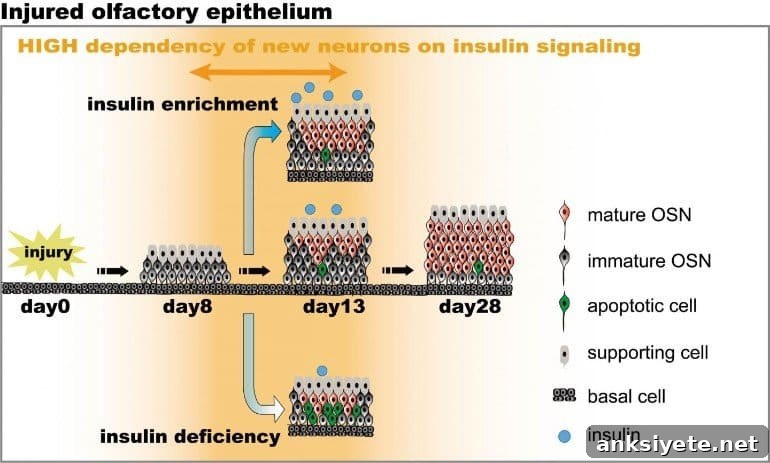
By systematically varying the timing of insulin treatment, the team identified a critical period between days 8 and 13 after injury during which insulin availability is essential. Intranasal insulin applied in this window fully rescued OSN recovery in diabetic mice, restoring cellular and functional measures to near-control levels. In contrast, insulin given during days 1–6 after injury did not produce the same benefit.
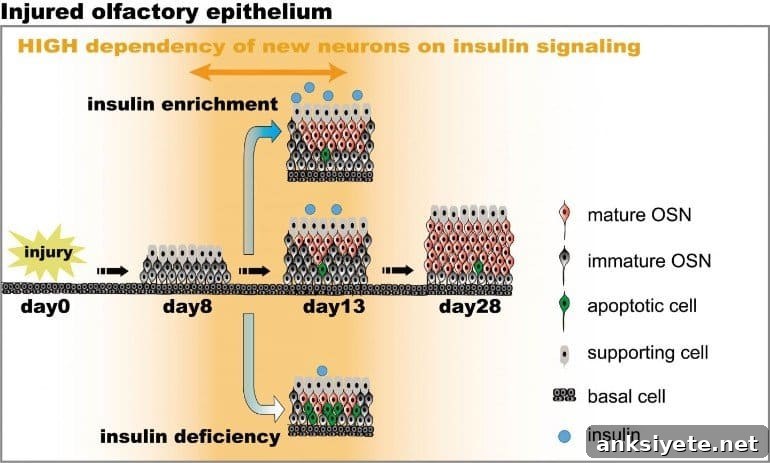
Molecular analysis showed that insulin receptor expression on regenerating OSNs is elevated during this critical window, and blocking insulin receptors in the nose inhibits regeneration. Importantly, creating an insulin-enriched environment enhanced OSN regeneration even in non-diabetic mice, indicating that intranasal insulin may have broader therapeutic potential beyond diabetic olfactory loss.
These results suggest a model in which newly formed OSNs are especially vulnerable to apoptosis during a defined maturation period and require insulin receptor signaling to survive, extend axons, and form connections in the olfactory bulb. The dependency on insulin during days 8–13 after injury pinpoints when supportive interventions are likely to be most effective.
Kuboki notes that these findings may help explain why people with diabetes are prone to smell loss (anosmia) and points to intranasal insulin as a promising strategy to accelerate recovery after diverse causes of olfactory injury, including head trauma and viral infections. The current study focused on a type 1 diabetes model; the authors plan to investigate type 2 diabetes and other clinical contexts in future work.
Other contributors to this research include Ichiro Matsumoto, PhD (Monell); Nobuyoshi Otori, MD, PhD and Hiromi Kojima, MD, PhD (Jikei University School of Medicine); and Shu Kikuta, MD, PhD and Tatsuya Yamasoba, MD, PhD (University of Tokyo).
About this neuroscience research news
Source: Monell Chemical Senses Center
Contact: Karen Kreeger – Monell Chemical Senses Center
Image: The image is credited to Monell Chemical Senses Center, eNeuro
Original Research: Closed access. “Insulin-dependent maturation of newly generated olfactory sensory neurons after injury” by Akihito Kuboki, Shu Kikuta, Nobuyoshi Otori, Hiromi Kojima, Ichiro Matsumoto, Johannes Reisert and Tatsuya Yamasoba. eNeuro
Abstract
Insulin-dependent maturation of newly generated olfactory sensory neurons after injury
Injuries to the olfactory epithelium (OE) cause loss of olfactory sensory neurons (OSNs) and trigger regeneration of new OSNs that must mature and integrate into olfactory circuits to restore smell. This study examined how insulin receptor signaling influences the functional recovery of OSNs after OE injury.
The researchers reduced systemic insulin in mice by ablating pancreatic beta cells with streptozotocin, then selectively removed OSNs with an olfactotoxic agent. Early OE regeneration up to day 14 proceeded similarly in diabetic and control mice, but thereafter diabetic OE showed fewer mature OSNs and increased apoptosis. Diabetic mice had diminished electro-olfactogram responses, reduced odor-evoked activity in the olfactory bulb, and poorer performance in an odor-guided behavioral task.
Crucially, intranasal insulin delivered between days 8 and 13 after injury rescued OSN recovery in diabetic mice, while insulin given during days 1–6 did not. During this critical interval, insulin receptors are highly expressed on regenerating OSNs, and blocking these receptors inhibits regeneration. An insulin-rich nasal environment also enhanced regeneration in non-diabetic mice.
These findings indicate that the maturation of newly generated OSNs depends on insulin signaling during a defined recovery period (days 8–13 post-injury) and that intranasal insulin can facilitate regeneration and functional recovery of the olfactory system.
Significance Statement
Insulin receptor signaling affects proliferation and apoptosis, but its role in post-injury regeneration of olfactory sensory neurons has been unclear. By comparing regeneration after chemically induced OSN loss in diabetic and control mice, this study demonstrates a temporal window when sufficient insulin is required for new OSNs to mature. Enhancing insulin levels in the nasal cavity during this critical period promotes recovery even in non-diabetic animals.
These results support the potential of intranasal insulin as a therapeutic approach to improve olfactory neuron regeneration and restore smell after injury.