
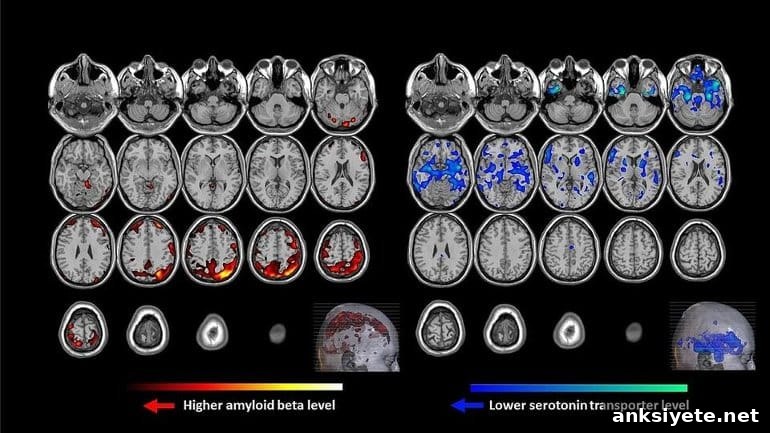
Summary: Greater accumulation of amyloid beta alongside reduced serotonin transporter availability in older adults’ brains was linked to an increased risk of developing depression and to more severe depressive symptoms.
Source: Johns Hopkins Medicine
Researchers at Johns Hopkins Medicine have identified a brain imaging pattern that connects higher amyloid beta (Aβ) deposition with lower serotonin transporter (5-HTT) availability in older adults. Using positron emission tomography (PET) and a mathematical algorithm to combine two radiotracer signals, the team found that this Aβ-high/5-HTT-low pattern was more pronounced in people with late-life depression and correlated with greater depressive symptom severity. The findings may help predict who is at higher risk for depression and potentially cognitive decline as they age.
The study, published in Translational Psychiatry, used PET imaging to measure both Aβ—a protein linked to memory loss and Alzheimer’s disease—and the serotonin transporter, a protein that controls serotonin levels in nerve cells. According to the researchers, the ability of PET to visualize and quantify chemical changes in living human brains was essential for testing hypotheses that originated from preclinical mouse models showing early monoamine system degeneration in the presence of amyloid pathology.
Late-life depression (LLD) is a common psychiatric condition in older adults and may present as a first major depressive episode during later years. Estimates vary, but the American Geriatrics Society notes that diagnosed major depression affects a portion of adults over 65, and that prevalence may be underestimated because older adults are less likely to report depressive symptoms. Importantly, LLD is associated with an elevated risk of subsequent cognitive decline and dementia.
For the imaging study, the research team enrolled 40 adults aged 60 and older, balanced by sex. Twenty participants were unmedicated patients meeting DSM-V criteria for major depression without bipolar or psychotic features; 20 were healthy control subjects with no depression. All participants underwent comprehensive medical, neurological and psychiatric evaluations, neuropsychological testing, laboratory screening, toxicology testing, and the Mini-Mental State Exam to assess cognition.
Each participant received PET scans using two radiotracers: one that binds to Aβ ([11C]-PiB) and another that measures serotonin transporter availability ([11C]-DASB). The resulting parametric images were analyzed with a voxel-based multi-modal partial least squares (mmPLS) algorithm. This approach identifies spatial covariance patterns across the two imaging measures—essentially mapping how regional increases in one tracer relate to decreases in the other.
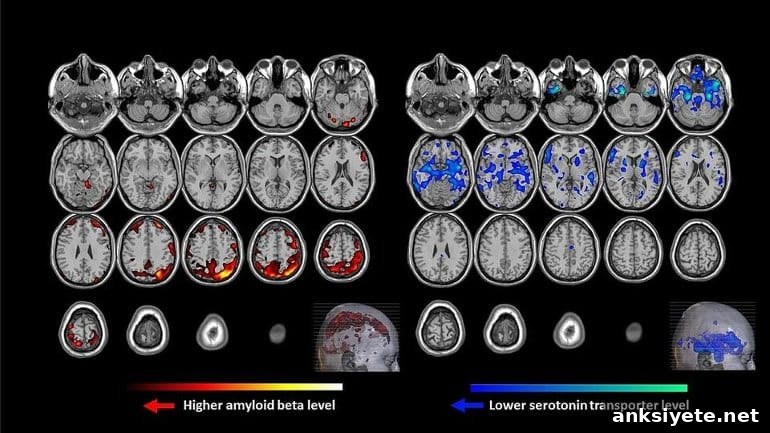
The mmPLS analysis revealed a reproducible spatial covariance pattern: increased Aβ in temporal, parietal and occipital cortical regions paired with decreased 5-HTT in subcortical and limbic structures including the putamen, thalamus, amygdala, hippocampus and raphe nuclei. This Aβ-high/5-HTT-low pattern distinguished the late-life depression group from healthy controls. Moreover, participants who exhibited greater expression of this combined pattern also showed more severe depressive symptoms, suggesting a dose–response relationship between the imaging signature and clinical severity.
These results reinforce the role of serotonin dysfunction in late-life depression and link it mechanistically to brain changes commonly associated with memory impairment. Prior clinical practice already uses selective serotonin reuptake inhibitors (SSRIs) to increase serotonin availability for treating major depression and certain anxiety disorders. The current imaging findings provide a biological context for serotonin-targeted treatment in older patients and raise the possibility that combined PET markers could inform prognosis and treatment selection.
The investigators emphasize that additional research is needed to determine how this multimodal PET pattern can be applied clinically. Future studies should evaluate whether the spatial covariance signature can predict who will respond best to specific antidepressant treatments and whether it signals an increased risk of subsequent cognitive decline or dementia in patients with late-life depression.
About this depression and aging research news
Author: Press Office
Source: Johns Hopkins Medicine
Contact: Press Office – Johns Hopkins Medicine
Image: Image credited to Smith et al
Original Research: Open access.
Title: Positron emission tomography imaging of serotonin degeneration and beta-amyloid deposition in late-life depression evaluated with multi-modal partial least squares — Gwenn S. Smith et al. Translational Psychiatry
Abstract
Positron emission tomography imaging of serotonin degeneration and beta-amyloid deposition in late-life depression evaluated with multi-modal partial least squares
Late-life depression is linked to an increased risk of cognitive decline and dementia. The neurobiology of LLD may involve overlapping neurochemical and neurodegenerative mechanisms. Preclinical transgenic amyloid models indicate early degeneration of monoamine systems, motivating an investigation in humans of whether a spatial covariance pattern of higher beta-amyloid and lower serotonin transporter availability in cortical regions would separate LLD patients from controls and relate to depressive symptom severity.
Twenty unmedicated patients meeting DSM-V criteria for major depression and 20 healthy control subjects underwent PET imaging with radiotracers for Aβ ([11C]-PiB) and 5-HTT ([11C]-DASB). A voxel-based multi-modal partial least squares algorithm was applied to identify the spatial covariance between the two tracers. The analysis revealed a pattern of increased Aβ in temporal, parietal and occipital cortices associated with reduced 5-HTT in putamen, thalamus, amygdala, hippocampus and dorsal/medial/pontine raphe nuclei. This pattern distinguished LLD patients from controls, and higher expression of the pattern correlated with greater depressive symptoms.
The mmPLS approach offers a powerful means to evaluate synaptic and molecular changes associated with Alzheimer’s pathology in vivo. Further evaluation is warranted to determine whether this spatial covariance pattern can serve as a biological marker for antidepressant treatment response or a predictor of cognitive decline in late-life depression.