
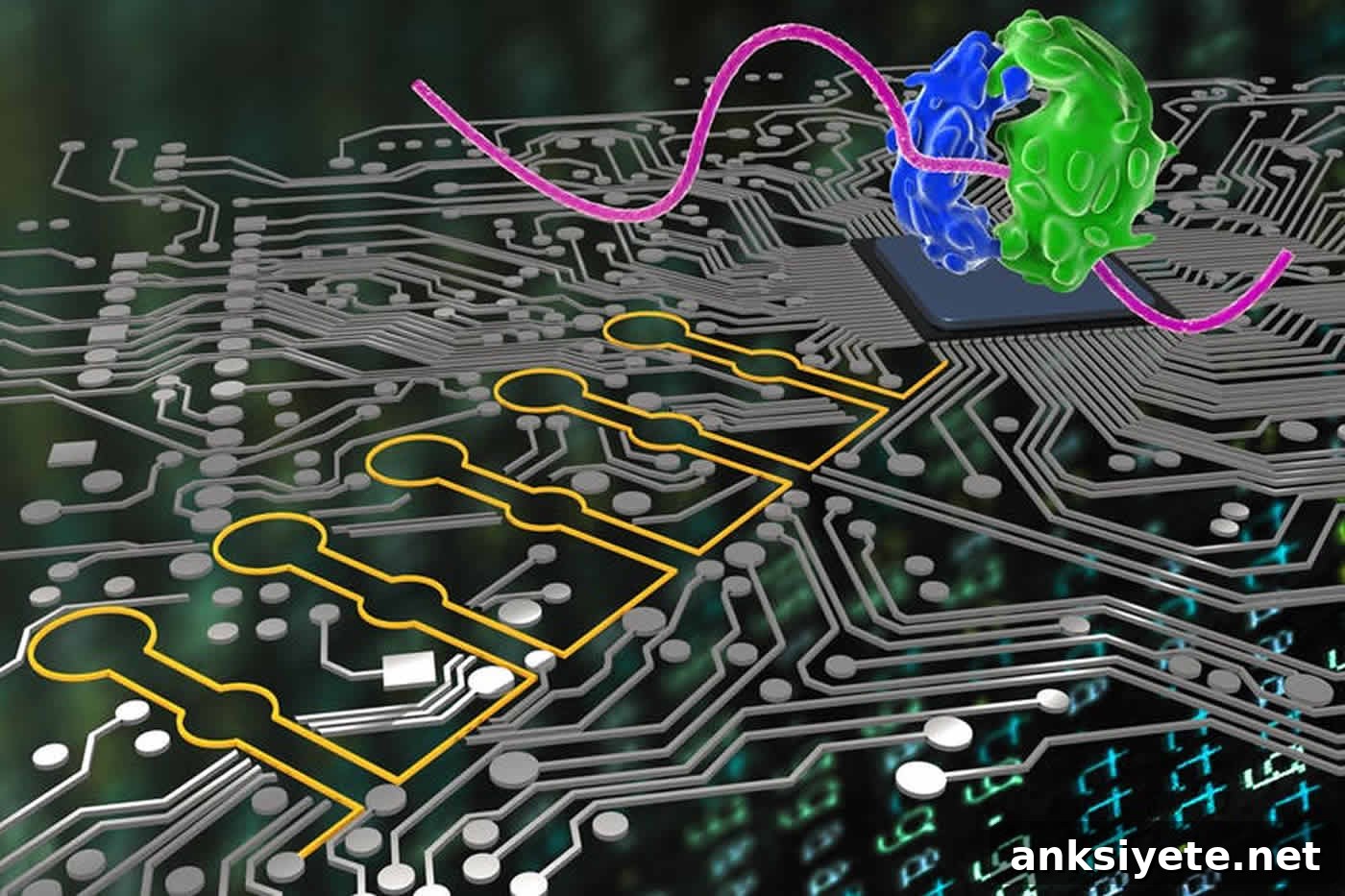
Summary: Researchers engineered an RNA molecule into a programmable, logically operating ribocomputing device. The advance could enable the construction of more sophisticated synthetic biological circuits for diagnostics and therapeutics.
Source: Wyss Institute
Novel RNA nanodevices in living cells can sense and evaluate multiple signals, offering a path to advanced synthetic diagnostics and targeted therapeutics.
Synthetic biologists are increasingly turning microbes into programmable, living devices capable of useful tasks such as producing drugs, fine chemicals, and biofuels, detecting pathogens, and releasing therapeutic molecules inside the body. To achieve these functions, researchers install synthetic molecular machinery into cells so they can sense environmental toxins, metabolic states, or inflammatory cues. Like electronic circuits, these biological systems must process information and make logic-guided decisions, but they must do so using only the molecular parts a cell can produce and within the crowded, changing environment of the cell.
Existing synthetic biological circuits typically detect only a limited number of signals and rely on a mix of molecular components—DNA, RNA, and proteins—that must find one another and interact reliably. This multi-component requirement makes design slow and unpredictable because finding combinations that function well together is time-consuming and often empirical.
In a study published in Nature, a team at Harvard’s Wyss Institute for Biologically Inspired Engineering reports a compact, RNA-only solution that brings programmability and logical computation into a single molecule. The researchers designed a genetically encodable RNA nanodevice capable of sensing and integrating multiple intracellular RNA inputs and executing complex logic to control protein synthesis with high precision. In Escherichia coli, these ribocomputing devices were programmed to perform a 12-input logical expression and regulate production of a fluorescent reporter only when a specified pattern of RNA signals was present, demonstrating how programmable RNA devices can expand the decision-making power of living cells.
“We show that an RNA molecule can be engineered into a programmable, logically acting ‘Ribocomputing Device,’” said Peng Yin, Ph.D., Wyss Core Faculty and Professor of Systems Biology at Harvard Medical School, who led the study. “This innovation at the intersection of nanotechnology and synthetic biology paves the way for more reliable circuits that are aware of complex cellular contexts relevant to specific goals.”
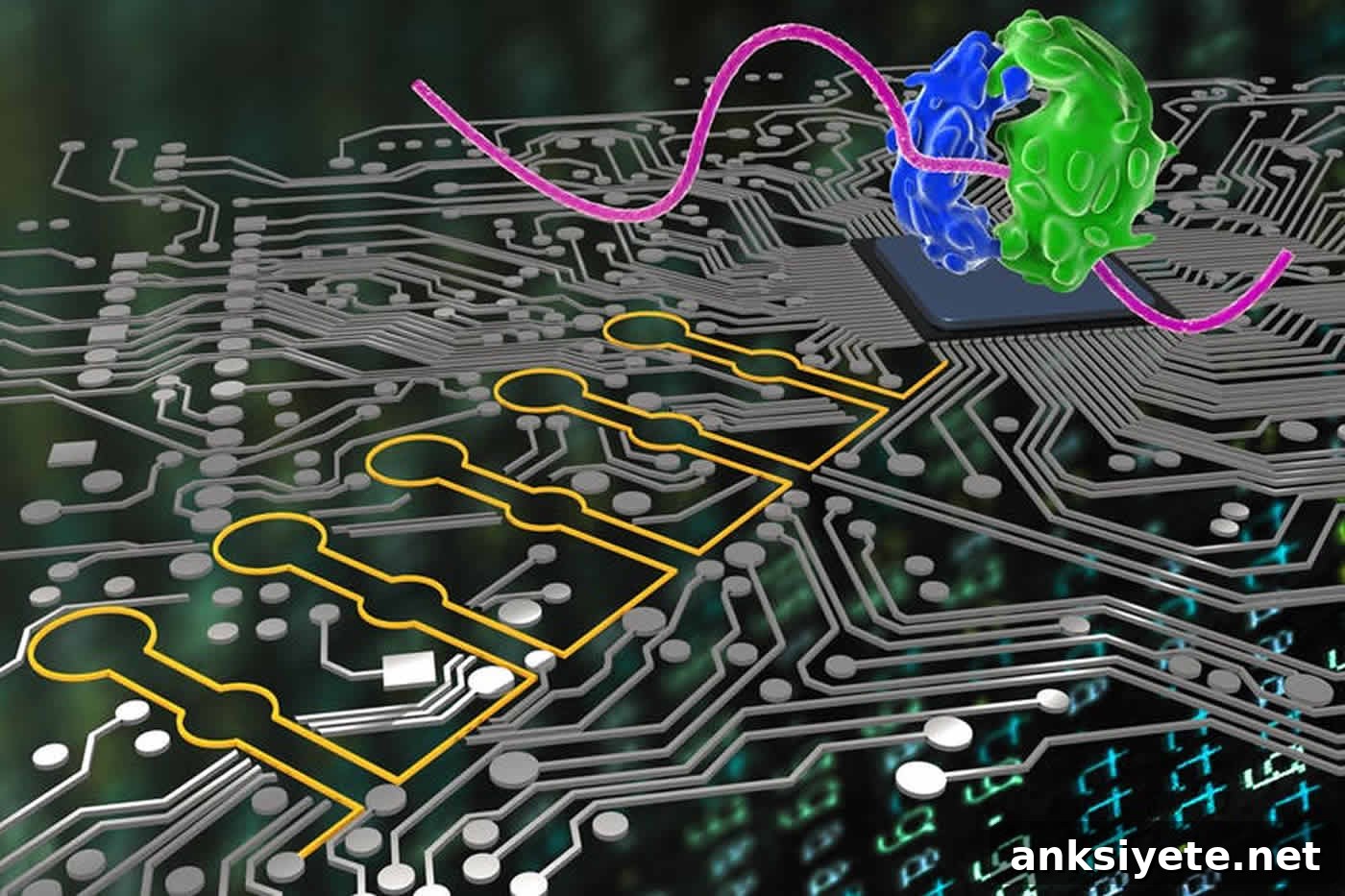
Yin’s team collaborated with Wyss Core Faculty colleagues James Collins, Ph.D., and Pam Silver, Ph.D. Collins is also a professor at MIT and Silver is a professor at Harvard Medical School’s Department of Systems Biology. Together the group built on prior work with Toehold Switches—programmable RNA hairpin structures first introduced in 2014 that control translation by exposing a ribosome binding site only when a complementary trigger RNA binds and unfolds the hairpin.
Toehold Switches are inherently programmable, and the new study leverages that programmability to create gate RNAs that perform logical operations—AND, OR and NOT—within a single extended RNA transcript. These gate RNAs co-localize sensing, computation, signal transduction, and output control in the same molecule, reducing diffusion losses, lowering metabolic cost, and improving reliability compared with multi-component circuits assembled from separate molecules.
“By encoding basic logical operations in RNA and integrating them into a single gate RNA, we made Ribocomputing Devices both compact and scalable,” said Alexander Green, Ph.D., co-first and co-corresponding author. “This design allows protein production to be tightly coupled to specific combinations of input RNAs, activating expression only when the prescribed cellular conditions are met.”
The researchers demonstrated a range of devices in E. coli: two-input logic with dynamic ranges up to 900-fold, four-input AND gates, six-input OR gates, and a complex 12-input expression that combines multiple AND, OR and NOT terms. They also expressed two independent gate RNAs in the same cell that produced different fluorescent proteins, showing it is possible to deploy multiple ribocomputing circuits within a single organism to generate richer, multi-output behaviors.
Beyond living cells, these logic-based RNA systems are compatible with cell-free formats. Ribocomputing Devices could be freeze-dried onto paper, enabling inexpensive, field-deployable diagnostics that sense and integrate multiple disease-relevant signals in a clinical sample. Such paper-based, RNA-driven diagnostics would benefit from the programmability, compactness, and predictable design rules of RNA base-pairing.
“Ribocomputing expands what synthetic biology can do by using designed RNA parts that obey predictable base-pairing rules,” said James Collins. “The technology offers a route to programmable biological circuits that are easier to design, scale, and transfer between hosts or into cell-free systems.”
Wyss Founding Director Donald Ingber, M.D., Ph.D., noted that the development of computational RNA nanodevices marks a significant advance for synthetic biology because it introduces compact, genetically encoded logic capable of operating in living cells and in extracellular settings.
Funding: The study was supported by the Wyss Institute’s Molecular Robotics Initiative; a DARPA Living Foundries grant; and grants from the National Institutes of Health (NIH), the Office of Naval Research (ONR), the National Science Foundation (NSF), and the Defense Threat Reduction Agency (DTRA).
Source: Wyss Institute at Harvard University
Image credit: Wyss Institute at Harvard University
Original research: Nature. Article: “Complex cellular logic computation using ribocomputing devices” by Alexander A. Green, Jongmin Kim, Duo Ma, Pamela A. Silver, James J. Collins & Peng Yin. Published online July 26, 2017. DOI: 10.1038/nature23271
Complex cellular logic computation using ribocomputing devices
Synthetic biology seeks engineering-driven approaches to program cellular functions and produce transformative technologies. Traditional synthetic gene circuits combining DNA, RNA, and protein parts can exhibit behaviors such as bistability, oscillation, feedback, and logic; however, scaling these systems is limited by the finite set of well-performing, orthogonal parts, empirical composition rules, and resource costs. Here we present RNA-only nanodevices that evaluate complex logic in living cells by relying on de-novo-designed parts and predictable base-pairing rules. These ribocomputing systems operate post-transcriptionally using extended RNA transcripts that co-localize sensing, computation, signaling, and output elements in a single molecular complex. Co-localization reduces diffusion-mediated signal loss, decreases metabolic burden, and improves reliability. In E. coli, ribocomputing devices achieved two-input logic with up to 900-fold dynamic range and were scaled to four-input AND and six-input OR gates, as well as a complex 12-input expression combining AND, OR, and NOT terms. The successful operation of these programmable RNA interactions suggests the design approach could be adapted for other hosts or extracellular applications, including cell-free diagnostics and environmental sensors.
Please share and cite this article as needed when referencing the underlying research and funding sources.