
Summary: Researchers report new molecular details about memory formation, showing how CaMKII binding sites organize actin filaments into rigid bundles that form the structural backbone of dendritic spines.
Source: Rice University
New insight into a longstanding puzzle — how memory can be encoded and maintained — comes from a multidisciplinary team that characterized how neuronal structure changes when cells learn.
The study connects three moving parts — a multi-domain binding protein, the structural protein actin, and calcium — to explain how electrical and chemical signals trigger changes in neuronal architecture that underlie cognition and memory storage.
Scientists from Rice University, the University of Houston (UH) and The University of Texas Health Science Center at Houston (UTHealth) combined theory, computer simulation and laboratory experiments to map how calcium-calmodulin-dependent kinase II (CaMKII) attaches to and detaches from the neuronal cytoskeleton.
Their report in the Proceedings of the National Academy of Sciences provides detailed evidence that CaMKII’s binding sites align actin filaments into long, rigid bundles. Those bundles become the scaffolding of dendritic spines — the tiny, actin-rich protrusions on neurons that receive synaptic input and are central to synaptic plasticity and memory.
Peter Wolynes, a theoretical physicist at Rice, joined UH physicist Margaret Cheung and UTHealth neurobiologist Neal Waxham to explore how synaptic signals propagate through dendrites, the branched extensions of neurons that carry information between cells.
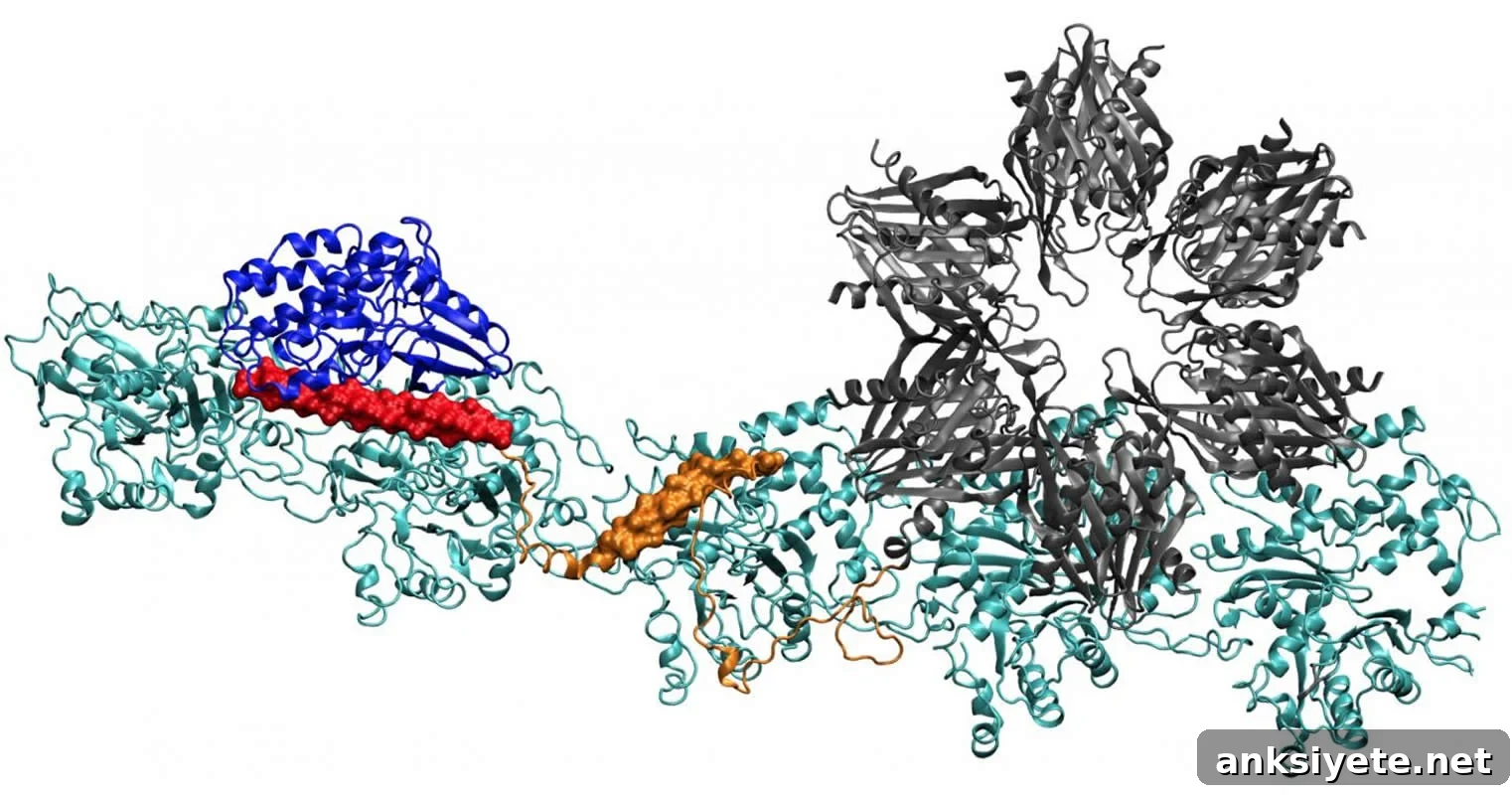
Because the full CaMKII assembly resists conventional structural methods such as X-ray crystallography, the team used a computational protein-structure prediction program called AWSEM to model the complex when bound to actin. The predicted architecture closely matched two-dimensional electron microscope images produced by Waxham’s group, which show ladder-like rungs of CaMKII holding parallel actin filaments together.
“There are preliminary chemical steps involving CaMKII’s enzymatic activity that precede this structural stage, so the entire sequence is not yet fully mapped,” Wolynes said. “Still, it is clear that assembly of the complex is the crucial step where molecular chemistry becomes a larger-scale structure capable of supporting a memory.”
Actin, the most abundant protein in eukaryotic cells, has special roles in neurons: it provides the resting architecture of thousands of dendritic protrusions and also enables the plasticity needed to respond to continual incoming signals. Actin monomers naturally polymerize into long, helical filaments with hydrophobic pockets between subunits. Those pockets create ideal binding sites for CaMKII.
CaMKII is a large protein composed of multiple domains. In the model, discrete CaMKII domains dock into three successive binding sites along an actin filament; the helical twist of actin places these docking sites at regular intervals, preventing CaMKII molecules from stacking indiscriminately. The kinase’s association domain, arranged as a six-fold assembly, also links across neighboring filaments and thereby bundles them into the rigid backbones that shape dendritic spines.
When calcium levels in the dendrite are low, these actin-CaMKII bundles remain stable. Calcium influx through synapses, however, binds to calmodulin and that calcium-calmodulin complex interacts with CaMKII’s flexible regulatory domain. This interaction leads to dissociation of parts of CaMKII from the filament and then the remainder of the protein, briefly opening a window during which the actin bundles can reconfigure.
“When enough calcium enters the spine, activated calmodulin disrupts the bundles, but only transiently,” Wolynes said. “As the cytoskeleton reforms, the spine can adopt a different shape — sometimes a larger one — which is consistent with structural changes observed during learning.”
“Calcium is the carrier of information into the cell,” Cheung added. “How neurons interpret that signal depends on how proteins like CaMKII encode it. Our work links molecular binding rules to the way those rules scale up into microscale structural changes.”
Quantitative analysis of the model indicates that the association domain supplies roughly 40% of CaMKII’s binding strength to actin, a flexible linker domain contributes another 40%, and the regulatory domain provides the remaining 20%. That arrangement is functionally sensible because the regulatory domain is the site where calcium-calmodulin binding can rapidly unzip the protein from the filament.
The collaboration was coordinated through Rice’s Center for Theoretical Biological Physics (CTBP), where Wolynes is co-director and Cheung is a senior scientist. Their partnership traces back to earlier academic connections at the University of California, San Diego. The project also built on prior proposals that actin can stabilize protein assemblies with prion-like properties that may encode long-term memory, linking initiation, remodeling and preservation phases into a broader view of memory formation.
“Earlier studies looked at the initiation of memory-related events and others addressed preservation at the end of learning,” Wolynes said. “Actin appears to operate in the middle, transforming short-lived biochemical signals into longer-lived structural changes. There are likely additional molecular players in this intermediate stage, but this work identifies a key element of the process.”
Funding: The research received support from the National Science Foundation, the D.R. Bullard Chair at Rice, the William Wheless III Professorship at UTHealth and the NSF-supported CTBP.
Rice postdoctoral researcher Qian Wang and alumnus Mingchen Chen are lead authors. Co-authors include Rice postdoctoral researcher Nicholas Schafer and graduate student Carlos Bueno, UTHealth research assistant Sarah Song and UTHealth alumnus Andy Hudmon, now at Purdue University. Waxham holds the William M. Wheless III Professorship in Biomedical Sciences at UTHealth. Cheung is the Moores Professor of Physics, Chemistry and Computer Science at UH. Wolynes is Rice’s D.R. Bullard-Welch Foundation Professor of Science and holds appointments in chemistry, biochemistry and cell biology, physics and astronomy, and materials science and nanoengineering.
Source:
Rice University
Media Contacts:
Mike Williams – Rice University
Image Source:
Image credit: Wolynes Research Lab / Rice University.
Original Research: The study will appear in PNAS.