
Innovative ultrasound method uses acoustic pressure to control which molecules cross the blood-brain barrier—potentially improving treatments for central nervous system disorders such as Parkinson’s and Alzheimer’s.
A research team led by Elisa Konofagou, professor of biomedical engineering and radiology at Columbia Engineering, has demonstrated for the first time that the size of molecules that penetrate the blood-brain barrier (BBB) can be controlled by adjusting acoustic pressure from a focused ultrasound beam. The peer-reviewed study was published in the July issue of the Journal of Cerebral Blood Flow & Metabolism.
“This is an important breakthrough in delivering drugs to specific brain regions precisely, non-invasively, and safely, and it may improve treatments for central nervous system diseases like Parkinson’s and Alzheimer’s,” says Konofagou. Her National Institutes of Health Research Project Grant (R01) funding was recently renewed for an additional four years, providing $2.22 million to investigate how microbubbles affect both the efficacy and safety of drug delivery across the BBB, with a specific focus on Parkinson’s disease.
The blood-brain barrier protects brain tissue by preventing most small molecules and nearly all large-molecule therapeutics from entering the brain from circulation. Because of this barrier, many central nervous system disorders remain undertreated. For example, Parkinson’s disease could benefit from targeted delivery of therapeutic molecules to vulnerable neurons to slow their degeneration. Traditionally, options to bypass the BBB have required invasive procedures—direct injections into the brain that need anesthesia, skull drilling, and carry higher infection risk and limited coverage. Even transcranial injection yields low success rates in many cases.
Focused ultrasound combined with microbubbles—gas-filled bubbles coated with protein or lipid shells—remains the only non-invasive technique that can transiently and safely permeabilize the BBB. When ultrasound strikes microbubbles in the bloodstream, the bubbles oscillate; depending on the magnitude of the acoustic pressure, they persistently oscillate or collapse. These microbubble dynamics create a temporary opening in the BBB that allows therapeutic agents to enter targeted brain regions.
Previous research using focused ultrasound and microbubbles typically evaluated delivery of a single, commercially available agent size, often those used clinically as ultrasound contrast agents. Konofagou’s team aimed to determine whether the BBB opening could be tuned to allow molecules of different sizes to pass through by adjusting the acoustic pressure. The researchers targeted the hippocampus, a brain area essential to memory, and administered sugar molecules (Dextran) of varying sizes. Using fluorescence imaging, they found that higher acoustic pressures permitted larger molecules to accumulate in the hippocampus, while lower pressures allowed only smaller molecules through.
These results demonstrate that the pressure of the ultrasound beam can be tailored to the size of the therapeutic molecule intended for delivery: varying pressure thresholds produce distinct BBB opening sizes so that small molecules pass at lower pressures, and progressively larger molecules require higher pressures. The study also improved understanding of the physical mechanisms underlying trans-BBB delivery for differently sized agents, which will support development of agent size–specific focused ultrasound treatment protocols.
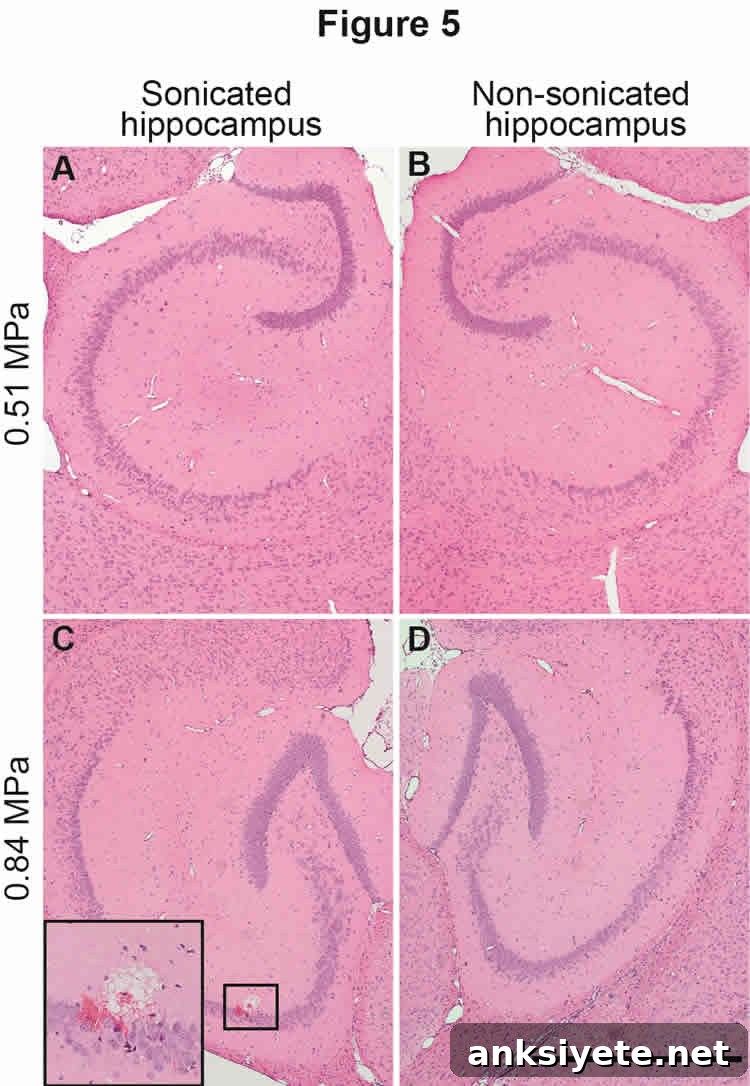
Konofagou emphasizes both the promise and the importance of safety monitoring: histological analysis in the study showed no microscopic tissue damage at moderate pressure levels, while a minor localized microhemorrhage was observed at a higher pressure in one instance. This underscores the need to balance delivery efficacy with safety when choosing acoustic pressure settings for specific drugs and target sites.
Her Ultrasound Elasticity Imaging Laboratory plans to continue developing this technology for applications in Alzheimer’s and Parkinson’s disease across a variety of preclinical models, with the goal of advancing to human clinical trials within the next five years.
“It is alarming that so many brain diseases still lack effective treatments,” Konofagou adds. “We are encouraged because this tool could potentially change the outlook for patients diagnosed with neurological disorders.”
Source: Holly Evarts – Columbia University School of Engineering and Applied Science
Contact: Columbia University School of Engineering and Applied Science press release
Image credit: Elisa Konofagou, adapted from the Columbia University School of Engineering and Applied Science press release
Original Research: Abstract for “The size of blood–brain barrier opening induced by focused ultrasound is dictated by the acoustic pressure” by Hong Chen and Elisa E. Konofagou in Journal of Cerebral Blood Flow & Metabolism. Published online July 2014, doi:10.1038/jcbfm.2014.71