
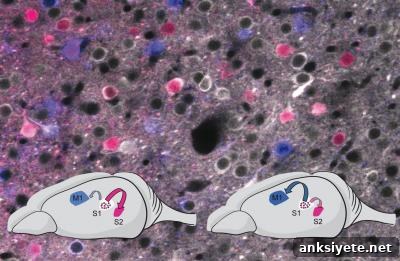
Different regions of the brain specialize in processing distinct aspects of our sensory experiences. How those cortical areas communicate and route sensory signals to support perception and behavior has been a longstanding question in neuroscience. By studying touch in mice, researchers at the University of Zurich demonstrate that the flow of sensory information from one cortical area to others depends strongly on the behavioral goal and the task the animal is performing. These findings offer insight into how targeted cortical communication supports flexible behavior and may inform approaches to cognitive disorders.
In mammals, the cerebral cortex is organized into multiple interconnected areas, each of which contributes to sensation, decision-making or action. The somatosensory cortex is a cortical region specialized for processing touch and haptic information. Although cortical areas are densely linked, it has remained unclear how information is routed between them so that the brain can transform raw sensory inputs into goal-appropriate responses. A research team led by Professor Fritjof Helmchen at the University of Zurich’s Brain Research Institute has now shown that the pattern of information transfer across cortical areas is not fixed but depends on which sensory features are relevant for the task at hand. In other words, task demands shape which projection neurons within sensory cortex become engaged and which downstream regions they target.
Goal-directed processing of sensory information
In a study published in Nature, the team examined how mice use their facial whiskers to explore surfaces and locate objects, a tactile strategy comparable to how humans use their hands to feel in low light. Two groups of mice were trained on different tasks that required distinct sensory computations. One group learned to distinguish coarse from fine sandpaper textures with their whiskers in order to receive a reward. The other group learned to determine the angle or position of a metal rod relative to their snout. During task performance the investigators recorded activity in neurons of the primary somatosensory cortex using a specialized microscopy approach and, with anatomical staining, identified which of those neurons project to more distant cortical targets such as the secondary somatosensory area (S2) or the motor cortex (M1).
The recordings revealed a striking, task-dependent routing of information. Neurons in primary somatosensory cortex that send projections to S2 were preferentially active when mice discriminated surface texture, whereas neurons projecting to motor cortex were more strongly engaged when animals performed the localization task. Crucially, these distinct activation patterns were not observed when mice passively encountered sandpaper or rods without a task or reward; in passive conditions the sensory input alone did not produce the same selective recruitment of projection-specific neurons. This demonstrates that the behavioral context—what the animal is trying to achieve—gates which cortical outputs are recruited to solve a particular sensory problem.
Impaired communication in the brain
Professor Helmchen and colleagues interpret these results as evidence that the cortex can selectively route information to different downstream areas when specific features must be extracted from the environment to guide goal-directed behavior. This targeted, long-range communication between cortical areas is likely a fundamental mechanism by which the brain implements flexible, context-dependent perception and action. Importantly, disruptions in such communication have been implicated in a range of cognitive disorders, including Alzheimer’s disease, autism spectrum conditions and schizophrenia. A deeper mechanistic understanding of how long-range, projection-specific networks are recruited according to behavioral goals could therefore inform strategies to restore or compensate for impaired cortical interactions in these conditions and improve cognitive function.
Contact: Fritjof Helmchen – University of Zurich
Source: University of Zurich press release
Image source: The S1 region image is credited to Jerry Chen, University of Zurich.
Original research: Chen JL, Carta S, Soldado-Magraner J, Schneider BL, Helmchen F. “Behaviour-dependent recruitment of long-range projection neurons in somatosensory cortex.” Nature. Published online June 23, 2013. doi:10.1038/nature12236