
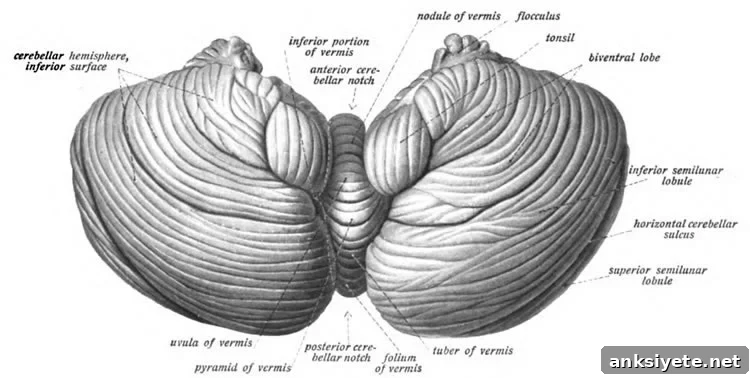
Summary: New research reveals that the cerebellum contributes not only to movement control but also to cognitive processes such as short-term memory and motor planning.
Source: Baylor College of Medicine.
Background
For decades neuroscientists have assigned different brain regions to specific functions: the cerebellum was primarily linked to motor control and coordination, while the frontal cortex was associated with higher cognitive functions such as working memory and decision making. Recent work, however, shows these boundaries are more fluid. Interactions between brain areas are essential for planning and executing behavior, and the cerebellum appears to play a broader role than previously recognized.
New findings from Baylor College of Medicine
Dr. Nuo Li, an assistant professor of neuroscience and McNair Scholar at Baylor College of Medicine, and his collaborators provide the first direct evidence that the cerebellum contributes to cognitive processes involved in motor planning. Their experiments demonstrate that the cerebellum and frontal cortex form a functional loop in which each region supports persistent neural activity that underlies short-term memory and the planning of future movement.
“We knew anatomically that the frontal cortex and cerebellum were connected, and clinical observations had linked cerebellar damage to memory and planning deficits,” said Dr. Li. “Our results show how these two regions work together to sustain the neural signals that guide future actions.”
How the experiment worked
The research team trained mice on a sensory-discrimination task that required short-term memory to plan a directional response. Each mouse saw a single object placed in a specific location, then experienced a delay period with no movement, followed by a cue to indicate the remembered location. The correct response required the animal to use memory during the delay and then lick left or right to report the remembered position. This delay period isolated the neural correlates of short-term memory and motor planning from the execution of movement.
Key observations and causal tests
Neural recordings revealed persistent, preparatory activity during the delay in both the frontal cortex and deep cerebellar nuclei. To test causality, researchers transiently silenced regions of the cerebellum during the delay. Silencing disrupted the animals’ subsequent choices—indicating impaired memory or planning—without affecting the animals’ ability to perform the motor action itself. Simultaneously, frontal cortex activity that normally reflected memory and impending choice was reduced when cerebellar output was suppressed, showing that frontal preparatory signals depend on cerebellar input.
Conversely, silencing frontal cortex activity abolished preparatory signals in the cerebellum, demonstrating bidirectional dependence. Together, these manipulations show that a cortico‑cerebellar loop is necessary to sustain the neural dynamics that bridge memory and planned movement.
Interpretation
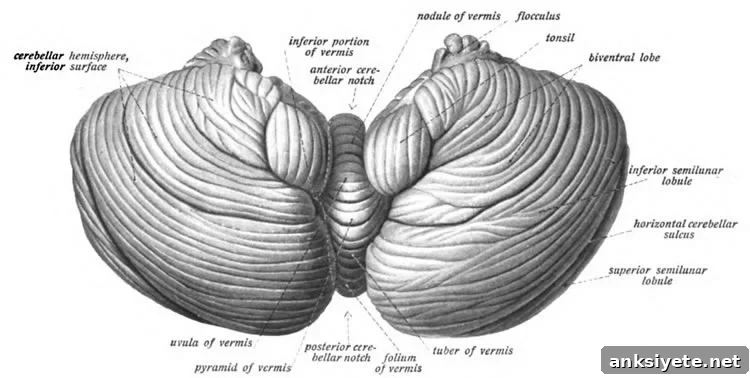
The cerebellum is well known for guiding movement through error-driven learning: when a shot is missed, cerebellar circuits compare intended and actual outcomes and adjust future motor commands. Dr. Li and colleagues propose that similar error-correction or predictive computations performed by the cerebellum could apply to the neural activity that underlies thought and planning. In other words, the cerebellum may help refine and maintain the internal signals that represent intended actions, not just the physical execution of those actions.
“Activity that coordinates a single behavior is distributed across multiple brain regions,” Li explained. “Disrupting communication between frontal cortex and cerebellum breaks the persistent activity that supports planning, so both regions are essential parts of the same functional circuit.”
Next steps
The research team is continuing to test the hypothesis that cerebellar computations analogous to motor error correction also operate on the neural processes underlying cognition—examples include complex decision-making tasks such as playing chess, where maintaining and refining internal plans is critical for success.
Contributors to the study include Courtney Davis, Alyse M. Thomas and Amada M. Abrego (Baylor College of Medicine); Michael N. Economo and Karel Svoboda (Janelia Research Campus); and Zhenyu Gao and Chris I. De Zeeuw (Erasmus MC, Rotterdam). The lead corresponding investigator is Nuo Li from Baylor College of Medicine.
Funding: This work was supported by the Robert and Janice McNair Foundation, the Whitehall Foundation, the Alfred P. Sloan Foundation, the Searle Scholars Program, National Institutes of Health (NS104781), the Simons Collaboration on the Global Brain, the Dutch Organization for Medical Sciences, Life Sciences, an Erasmus MC fellowship, ERC Advanced and ERC-PoC awards, and the Howard Hughes Medical Institute.
Source: Graciela Gutierrez, Baylor College of Medicine. Publisher: Organized by NeuroscienceNews.com. Image source: public domain.
A cortico‑cerebellar loop for motor planning
Persistent and ramping neural activity in the frontal cortex often anticipates specific upcoming movements. Preparatory activity is distributed across multiple brain regions, but the sources and interactions required to maintain this activity are not fully understood. Although the cerebellum has been primarily associated with short-timescale motor control, clinical evidence suggests it can influence planning and working memory in humans. In mice trained to use short-term memory to plan a directional movement, the authors observed preparatory activity in both frontal cortex and cerebellar nuclei during the delay before movement. Transient perturbation of the medial deep cerebellar nucleus (fastigial nucleus) disrupted correct subsequent responses without impairing movement execution. Silencing frontal cortex abolished cerebellar preparatory activity, and cerebellar output was necessary to sustain frontal preparatory activity. Fastigial output targeted behaviorally relevant frontal regions via thalamic relays, forming a closed cortico‑cerebellar loop. These results indicate that persistent neural dynamics supporting motor planning are maintained by multi‑regional circuits and that cerebellar computations extend beyond online motor control.