
Brain Structure Predicts Whether People Represent Numbers Spatially or Non‑Spatially
A new study from the Donders Institute in Nijmegen demonstrates that the way individuals mentally represent numbers—either along a spatial line or via non‑spatial magnitudes—has a measurable structural basis in the brain.
Many people mentally organize numbers along an imaginary horizontal line, with smaller numbers on the left and larger numbers on the right. This “mental number line” is a spatial representation. Others represent numerical magnitude in a non‑spatial way, linking numbers to different kinds of magnitudes such as force, size or brightness. Florian Krause and colleagues used MRI to show that these individual tendencies correspond to differences in grey matter volume in specific brain regions.
Distinct differences in grey matter volume
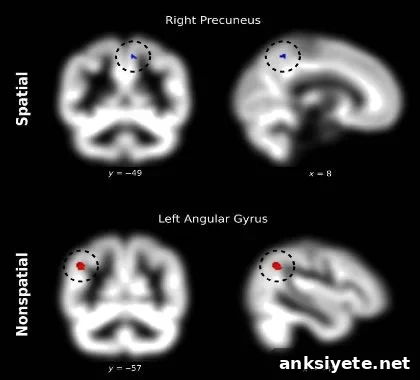
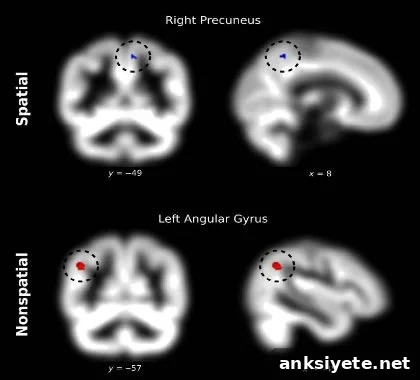
The study found reliable anatomical differences between people who habitually use spatial representations and those who favor non‑spatial representations. Participants who processed numbers spatially had greater grey matter volume in the right precuneus, a region implicated in visual‑spatial processing and scene imagery. Those who relied on non‑spatial representations showed greater grey matter volume in the left angular gyrus, a region often associated with semantic processing, conceptual integration and number knowledge. Grey matter contains neuronal cell bodies and the local volume can reflect long‑term differences in how a region is used.
How the researchers identified spatial and non‑spatial processors
Thirty participants took part in the experiment. Each person was placed in an MRI scanner and completed two successive digit‑classification tasks using the digits 1–9 with the exception of 5. In both tasks participants judged whether a digit was odd or even, but the response mode differed between tasks. In the spatial response task participants pressed a left or right button with their index or middle finger, creating a spatial mapping of smaller to larger numbers. In the non‑spatial task participants used a pressure sensor with their thumb to apply either a small or a large force, creating a magnitude mapping that was not tied to left/right space. Both response sets were executed with the right hand.
Across subjects the researchers observed consistent couplings between number magnitude and response type: small numbers were associated with leftward responses or softer presses, while larger numbers were associated with rightward responses or harder presses. These individual response patterns were quantified for each participant and statistically compared with the structural MRI measurements to identify brain regions where grey matter volume predicted the preferred representation style.
Educational implications and future directions
Contemporary mathematics instruction often assumes a spatial number line as the default representation. The current findings suggest that people differ in their preferred internal representation of number, and that those differences are supported by brain structure. If some learners represent numbers non‑spatially, they might benefit from alternative teaching approaches that emphasize magnitude experience rather than only spatial layouts.
For example, non‑spatial strategies could include physically experiencing magnitude through graded force, body movements that encode size, or tasks that compare numerical size to other perceptual magnitudes. Krause notes that these approaches merit systematic testing: future studies are planned to examine whether non‑spatial, body‑based or magnitude‑based teaching techniques improve numerical understanding for learners who are less inclined to use a spatial number line.
Notes on this research
Research team: Florian Krause, Oliver Lindemann, Ivan Toni, Harold Bekkering. The work was carried out at Radboud University Donders Institute in Nijmegen.
Source: Press release from Radboud University, Donders Institute (summary of the published study).
Original article: “Different Brains Process Numbers Differently: Structural Bases of Individual Differences in Spatial and Nonspatial Number Representations,” Journal of Cognitive Neuroscience. Published online November 4, 2013. DOI: 10.1162/jocn_a_00518.
Image: MRI image adapted from the institutional press release; shown here for illustrative purposes to indicate relative grey matter differences discussed in the study.