
Summary: A sensitive, high-resolution analysis finds many more DNA copy number variations in people with schizophrenia than in controls, and suggests that genomic instability may contribute to the disorder.
Source: Nagoya University
International researchers led by Nagoya University applied a highly sensitive method to detect DNA copy number changes and found a greater burden of clinically important sequence repeats in patients with schizophrenia than in control individuals, highlighting possible links between genome instability and disease processes.
Differences in the number of repeated DNA sequences—known as copy number variations (CNVs)—occur naturally between people. Some CNVs are linked to disease; prior studies have found rare CNVs on chromosomes such as 1, 15, 16 and 22 to be more frequent in people with schizophrenia than in unaffected controls. However, earlier work has not thoroughly explored the full impact of specific CNVs, particularly those on the X chromosome, nor systematically investigated which biological pathways and genes are disrupted by CNVs in schizophrenia.
An international team centered at Nagoya University addressed these gaps by using array comparative genomic hybridization with fluorescently labeled DNA fragments, a technique that offers higher sensitivity and finer resolution than many previous methods. This approach enabled robust detection of many more CNVs overall and identified a large proportion of small CNVs (under 100 kb), which comprised about 70% of the rare CNVs found in the study.
The study examined DNA from 1,699 individuals diagnosed with schizophrenia and 824 control participants. Clinically significant CNVs were substantially more frequent in patients than in controls (odds ratio = 3.04), with roughly 9% of cases carrying such CNVs. The analysis also confirmed a link between X-chromosome aneuploidies and schizophrenia, and identified 11 de novo CNVs in affected individuals. High genetic heterogeneity emerged: clinically important CNVs were found across 67 distinct genomic regions and were present in about 9% of patients. Some CNVs appeared in control individuals without causing symptoms, illustrating variable expressivity.
Clinically, patients who carried pathogenic CNVs showed a range of additional problems, including developmental abnormalities and higher rates of treatment resistance. Individuals with two clinically significant CNVs tended to have more severe clinical manifestations than those with a single CNV.
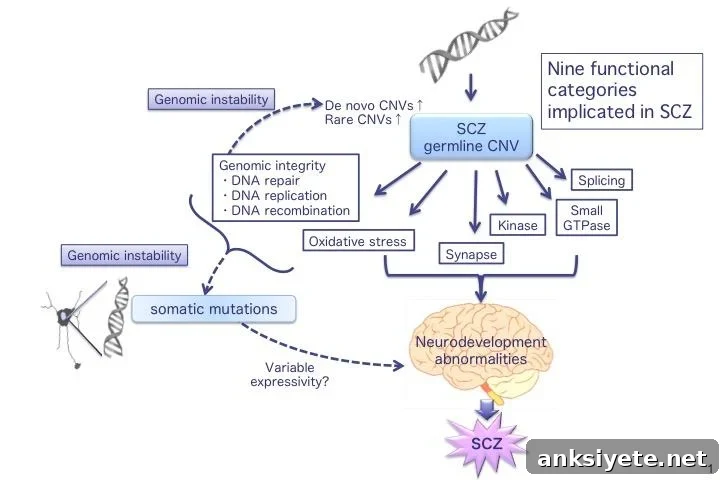
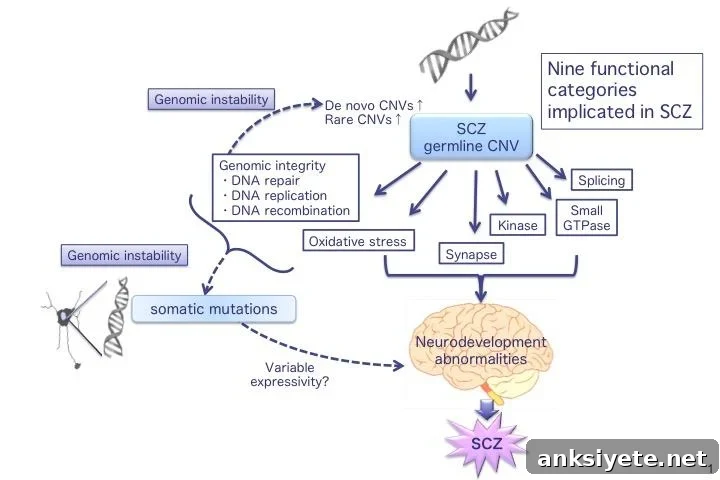
To understand how CNVs might contribute to schizophrenia risk and clinical variation, the researchers analyzed affected gene sets and biological pathways. Consistent with earlier work, pathways related to synaptic function and calcium signaling were implicated. Importantly, the study highlighted several additional pathways that were significantly affected by CNVs in cases, including oxidative stress response, DNA repair and replication (genomic integrity), kinase signaling, and small GTPase signaling.
Based on these findings, the authors propose a model in which CNVs that disturb oxidative stress defenses and genomic integrity create or exacerbate genomic instability. This instability could lead to an increased frequency of de novo CNVs and to the emergence of somatic CNVs in neurons, which in turn may account for both the higher burden of rare CNVs in schizophrenia and the variable clinical presentation among carriers.
Funding: Supported by the Japan Agency for Medical Research and Development and the Ministry of Education, Culture, Sports, Science & Technology (MEXT), Japan.
Source: Koomi Sung, Nagoya University. Image credit: Itaru Kushima and Norio Ozaki.
Original research: The findings are reported in the journal Molecular Psychiatry under the title “High-resolution copy number variation analysis of schizophrenia in Japan.”
High-resolution copy number variation analysis of schizophrenia in Japan
Recent schizophrenia (SCZ) research has reported an increased burden of de novo CNVs and identified specific high-risk loci, although phenotype expressivity varies. Using array comparative genomic hybridization, this study performed a high-resolution, genome-wide CNV analysis in a predominantly (92%) Japanese sample of 1,699 schizophrenia cases and 824 controls, identifying 7,066 rare CNVs—about 70% of which were smaller than 100 kb. Clinically significant CNVs were significantly more frequent in cases than in controls (odds ratio = 3.04; P = 9.3 × 10⁻⁹), affecting 9.0% of cases. The analysis confirmed association of X-chromosome aneuploidies with SCZ and detected 11 de novo CNVs in cases. Among patients with clinically significant CNVs, 41.7% had congenital or developmental phenotypes, and treatment resistance was more common (odds ratio = 2.79; P = 0.0036). Patients carrying two clinically significant CNVs exhibited more severe clinical features. Gene set analysis replicated previously reported pathways (for example, synapse and calcium signaling) and identified novel pathways including oxidative stress response, genomic integrity, kinase activity, and small GTPase signaling. The results suggest that multiple candidate genes and biological pathways contribute to SCZ pathogenesis within known CNV-associated loci, reveal extensive genetic heterogeneity, and raise the possibility that genomic instability plays a role in the disorder by increasing de novo CNV burden and contributing to variable expressivity.
The study authors include I. Kushima and N. Ozaki, among many collaborators. The research was published online May 31, 2016 in Molecular Psychiatry (doi:10.1038/mp.2016.88).