

 Can’t cope? Overwhelmed? Stressed?
Everyone struggles to cope at times—missed promotions, relationship breakups, looming deadlines. Whether we manage stress well depends largely on how we interpret events. Stress is an emotional and physical response shaped by our thoughts, and adapting how we think can change how we cope.
Our brains evolved to solve problems in very different environments from modern life, and that mismatch can make contemporary stressors especially challenging. Still, decades of psychological research in sport, business, and clinical settings have identified practical strategies and tools that help people manage stress, grow through difficulty, and build lasting resilience.
This Article Contains:
- A Look at the Coping Wheel
- Five Strategies for Coping With Stress
- A Real-Life Example
- Teaching Coping to Children: Three Ideas
- Two Ways to Cope With Anxiety
- How to Cope With Anger
- Seven Recommended Books
- Practical Tools and Training
- Take-Home Message
- References
A Look at the Coping Wheel
Coping strategies are the methods people use to manage stress. They influence thoughts, feelings, and behavior before, during, and after difficult situations. Research has cataloged hundreds of coping techniques and multiple ways to classify them.
- Problem-focused strategies: directly addressing the source of stress.
- Emotion-focused strategies: reducing emotional distress through regulation.
- Approach strategies: engaging with a stressor to resolve it.
- Avoidance strategies: distancing yourself from the stressor to reduce immediate distress.
Researchers have grouped coping techniques into broader “coping families” that share similar action tendencies—such as problem solving, seeking social support, negotiation, surrender, and emotion regulation. The coping wheel framework helps visualize these families and choose approaches suited to the situation.
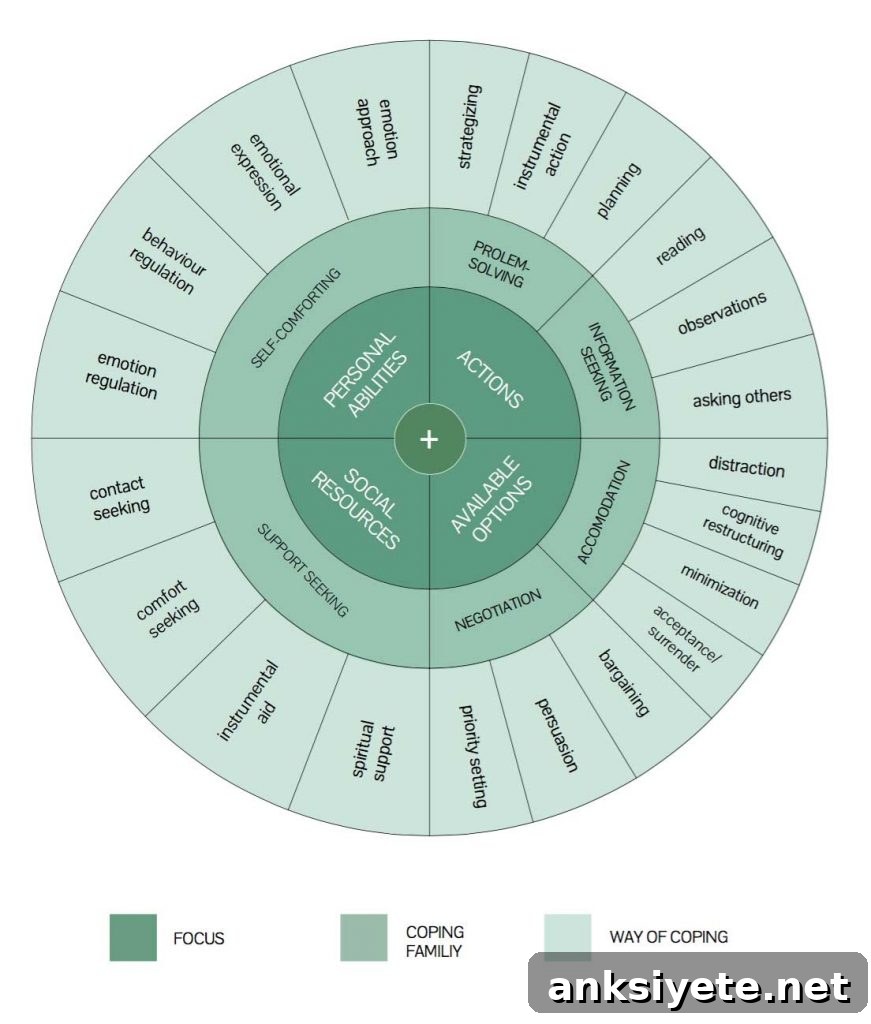
Source: The Positive Psychology Toolkit (The Coping Strategy Wheels)
5 Strategies for Coping With Stress
Stress arises from both social and physical environments and can range from minor irritations to life-threatening crises. Effective coping tools help reframe situations, reduce negative thinking, and strengthen positive responses. Below are five evidence-informed strategies you can adopt.
1. ABCDE model
Developed by Albert Ellis, the ABCDE model provides a simple structure to identify and challenge irrational beliefs that drive unhelpful emotions and behaviors. The process encourages replacing distorted thoughts with rational alternatives.
| ABCDE model | |
|---|---|
| A – Adversity or Activating event | I didn’t do well in my math test today. |
| B – Belief (identify irrational thinking) | I’m useless. I can’t do anything right. |
| C – Consequence (emotional or behavioral) | I give up and stop studying for the exam next week. |
| D – Dispute irrational belief | I did well on last week’s test. I’ve been studying, but I hadn’t covered this topic yet. The result shows where to focus my efforts. |
| E – Effect of a new rational belief | I meet my teacher to review the material and adjust my study plan. |
Challenging unhelpful beliefs can reduce distress and improve decision-making. You may not control every situation, but you can change how you respond.
2. Positive thinking and self-talk
Our internal conversations shape feelings and actions. Positive affirmations—short, supportive statements—can shift mindset and build confidence. Athletes and performers often use affirmations and structured self-talk to prepare for high-pressure moments.
| Situation | Short, supportive statements |
|---|---|
| Job interview | I have prepared thoroughly. I can share relevant examples from my experience. |
| Public presentation | I am calm, clear, and capable. I enjoy sharing my ideas with others. |
At the end of each day, write down three achievements—big or small. This routine reinforces progress, reduces rumination, and primes a positive start the next day.
3. Visualization
Mental imagery helps rehearse performance and manage anxiety. Athletes visualize successful execution of skills and strategies; you can use the same technique for presentations, interviews, or difficult conversations. Rehearsing success in your mind increases self-efficacy and calms defensive inner voices.
4. Control the controllable
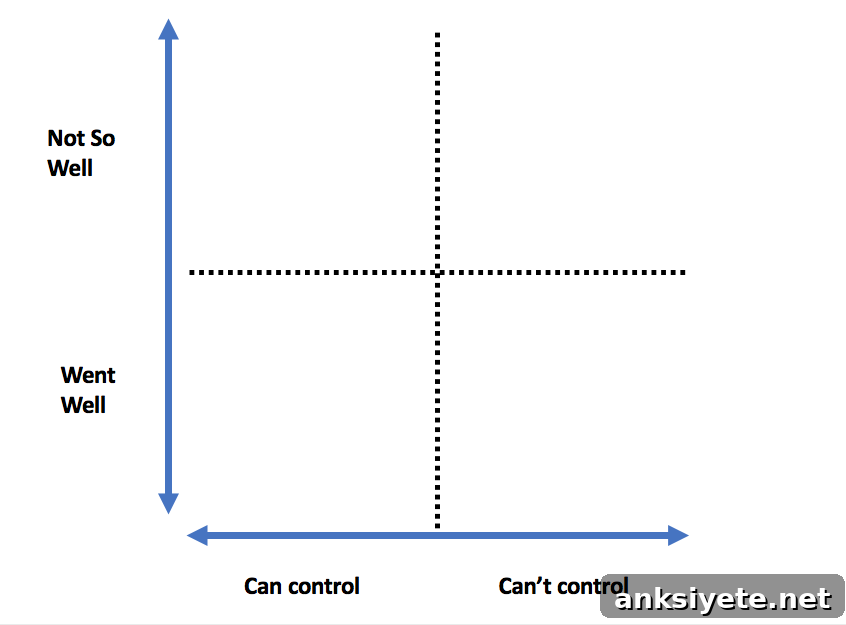
Focus energy on factors you can influence. Preparation increases perceived control, which supports motivation and performance. After a challenging meeting, list what went well and what didn’t, and map those items into four categories: went well / within my control; went well / outside my control; didn’t go well / within my control; didn’t go well / outside my control. Learn from items you can change, accept those you cannot, and move on.
5. Three steps to handle stress
Viewing stress as a potential enhancer rather than purely harmful can improve performance and reduce negative health effects. A three-step approach can harness stress constructively:
Step one – See your stress
Label the feeling: “I am stressed because I have not finished the report.” Naming stress reduces avoidance and helps you address it.
Step two – Own it
Acknowledge how stress relates to your goals or responsibilities: “This stress comes with my new role; it’s part of the job.”
Step three – Use it
Channel the physiological energy and focus that stress brings. Use heightened alertness and motivation to tackle the task rather than letting it debilitate you.
A Real-Life Example
People vary dramatically in how they respond to the same event. One person might be devastated by a traumatic incident, while another transforms hardship into purpose. The story below illustrates extraordinary resilience.
Against all odds
After a brutal assault left her in a coma for months and with devastating injuries, Carmen faced a long, painful recovery. Despite blindness and multiple surgeries, she made a conscious choice to help others. She became a speaker and advocate, later undergoing a face transplant and forming a close friendship with the donor’s family. Carmen’s response shows how meaning, connection, and purpose can turn trauma into a path for growth.
Teaching Coping to Children: Three Ideas
 Steve Peters’ “Chimp Model” offers a simple way to explain emotions to kids. The model describes three parts: the human (rational thinking), the chimp (emotional, impulsive reactions), and the computer (automatic habits and memory).
Using this framework, children learn to recognize when emotions (the chimp) take over and practice habits that support the rational human. Simple exercises include:
- Recognizing the chimp’s urges (e.g., choosing cake over healthy food).
- Choosing words to describe the calm, rational self versus the emotional chimp.
- Offering encouraging phrases to the chimp to try new activities, such as: “If you try it, you might enjoy it,” or “Trying new things builds confidence.”
These short, playful exercises help children build emotional awareness and coping routines they can use throughout life.
Two Ways to Cope With Anxiety
Relaxation and attention control are effective methods for reducing anxiety. Physically calming the body often leads to clearer thinking.
1. Controlled distraction
Redirect attention from anxious thoughts to neutral, grounding tasks: count ceiling tiles, listen to music, or visualize a pleasant scene. Controlled distraction is especially useful when you need a quick reduction in nervousness before a performance.
2. Progressive muscle relaxation (Mitchell method)
Progressive muscle relaxation asks you to tense and then release muscle groups while maintaining awareness of breathing and body position. This mindful tightening and releasing reduces physiological tension and promotes calm.
How to Cope With Anger
Anger management begins with noticing early physical signals—fast heartbeat, tense muscles, shallow breathing. Simple techniques buy time and reduce escalation: take a short walk, count to ten, or speak with a trusted friend for perspective.
Breathing exercises like box breathing (inhale, hold, exhale, hold—each for about four seconds) slow heart rate and calm the nervous system. Regular exercise, healthy distractions, and mindfulness practices also help process and dissipate anger constructively.
Seven Recommended Books on Coping and Resilience
- On Mental Toughness (Harvard Business Review)
- Mindset: Changing the Way You Think to Fulfill Your Potential — Carol Dweck
- Positivity: Groundbreaking Research to Release Your Inner Optimist and Thrive — Barbara Fredrickson
- Evolutionary Psychology: The New Science of the Mind — David Buss
- The Chimp Paradox: The Mind Management Program to Help You Achieve Success, Confidence, and Happiness — Dr. Steve Peters
- Self-Determination Theory: Basic Psychological Needs in Motivation, Development, and Wellness — Richard Ryan & Edward Deci
- Developing Mental Toughness: Coaching Strategies to Improve Performance, Resilience, and Wellbeing — Doug Strycharczyk & Peter Clough
Practical Tools and Training
Practitioners and individuals can benefit from structured programs and curated toolkits that collect validated exercises and interventions for resilience and coping. Look for resources that emphasize science-based techniques, practical worksheets, and training modules to support clients, students, or teams.
A Take-Home Message
The human mind is capable of remarkable adaptation. Coping depends less on external events and more on how we interpret them. By learning to reframe stress, regulate emotion, and focus on what we can control, we increase our capacity to grow through hardship.
Stress is not inherently bad—when reframed, it can motivate learning, build resilience, and deepen authenticity. But if stress becomes overwhelming or harmful, adopting targeted coping tools and seeking professional support are essential steps toward recovery and flourishing.
While we cannot always control our environment, we can choose how we respond. Practicing these strategies consistently will strengthen coping skills and improve long-term wellbeing.
Thank you for reading.
References
- Buss, D. (2014). Evolutionary Psychology: The New Science of the Mind (5th ed.). Psychology Press.
- Cosmides, L., & Tooby, J. (2013). Evolutionary psychology: New perspectives on cognition and motivation. Annual Review of Psychology, 64, 201–229.
- Crum, A., & Crum, T. (2018). Stress can be a good thing if you know how to use it. In HBR’s 10 Must-Reads: On Mental Toughness. Harvard Business Review Press.
- Csikszentmihalyi, M. (2009). Flow: The Psychology of Optimal Experience. Harper Row.
- Dweck, C. S. (2017). Mindset: Changing the Way You Think to Fulfill Your Potential (6th ed.). Robinson.
- Fredrickson, B. (2010). Positivity: Groundbreaking Research to Release Your Inner Optimist and Thrive. Oneworld Publications.
- Hooper, R. (2019). Superhuman: Life at the Extremes of Mental and Physical Ability. Abacus.
- Li, N. P., van Vugt, M., & Colarelli, S. M. (2017). The evolutionary mismatch hypothesis: Implications for psychological science. Current Directions in Psychological Science, 27(1), 38–44.
- Machado, A. V., et al. (2020). Association between habitual use of coping strategies and posttraumatic stress symptoms in a non-clinical sample of college students. PLOS ONE, 15(2).
- McCormick, A., Meijen, C., & Marcora, S. (2018). Effects of a motivational self-talk intervention for endurance athletes. The Sport Psychologist, 32(1), 42–50.
- Meijen, C. (2019). Endurance Performance in Sport: Psychological Theory and Interventions. Routledge.
- Mitchell, L. (1990). Simple Relaxation: The Mitchell Method of Physiological Relaxation for Easing Tension. Murray.
- Monroe, S. M., & Slavich, G. M. (2016). Psychological stressors: Overview. In G. Fink (Ed.), Stress: Concepts, Cognition, Emotion, and Behavior. Academic Press.
- Peters, S. (2016). The Chimp Paradox: The Mind Management Program to Help You Achieve Success, Confidence, and Happiness. Vermilion.
- Peters, S., & Battista, J. (2018). My Hidden Chimp: Helping Children to Understand and Manage Their Emotions, Thinking, and Behaviour with Ten Helpful Habits. Studio Press Books.
- Ryan, R. M., & Deci, E. L. (2018). Self-Determination Theory: Basic Psychological Needs in Motivation, Development, and Wellness. Guilford Press.
- Skinner, E. A., & Zimmer-Gembeck, M. J. (2007). The development of coping. Annual Review of Psychology, 58, 119–144.
- Strycharczyk, D., & Clough, P. (2015). Developing Mental Toughness: Coaching Strategies to Improve Performance, Resilience, and Wellbeing. Kogan Page.