
Summary: A new mouse study identifies the Necdin (Ndn) gene as a causal driver in autism associated with 15q11–q13 chromosomal duplication.
Source: Kobe University
A research team led by Professor Toru Takumi and Assistant Professor Kota Tamada in the Physiology Division of Kobe University’s Graduate School of Medicine (with Professor Takumi also a Senior Visiting Scientist at RIKEN Center for Biosystems Dynamics Research) has identified Necdin (NDN) as a causal gene in an autism mouse model carrying a copy number variation (CNV) of the 15q11–q13 chromosomal region.
The investigators aim to clarify how NDN influences neural development at the molecular level and to use that knowledge to guide the development of new therapeutic strategies for developmental disorders, including autism spectrum disorder (ASD).
These findings were published in Nature Communications on July 1, 2021.
Main points
- The team used synapse-focused screening in a 15q duplication mouse model to identify Ndn as a driver gene for autism-like phenotypes.
- NDN controls synapse development and dendritic spine formation and maturation during postnatal development.
Background
Autism spectrum disorder (ASD) is increasing in diagnosis worldwide, yet many aspects of its biology remain unclear. Causes include both genetic and environmental factors. Among genetic contributors, specific copy number variations (CNVs) have been linked to ASD; one well-documented example is duplication of the 15q11–q13 chromosomal region.
Duplications in the 15q11–q13 region can be inherited maternally or paternally. Prior work identified Ube3a as a key driver for maternally derived duplications, but the causal factor for paternally derived duplications remained unknown.
The Kobe University group previously developed a mouse model that carries a duplication of the 15q11–q13 region (the 15q dup mouse). That model reproduces a number of features relevant to autism, such as atypical social behaviors, elevated anxiety in novel environments, perseverative behaviors, and alterations in dendritic spine development. Because the duplicated region contains multiple noncoding RNAs and many protein-coding genes, determining the specific gene responsible required further genetic dissection.
Methods
The original duplication spans roughly 6 megabases and includes many genes. Prior observations indicated that maternally derived duplication did not produce the specific behavioral abnormalities under study, allowing the researchers to exclude a ~2 Mb subregion. To narrow candidates within the remaining ~4 Mb, the team engineered a new mouse line with a 1.5 Mb duplication and assessed behavior. The 1.5 Mb duplication mice showed no autism-like behavioral abnormalities, enabling the researchers to exclude that interval as causal and focus on the remaining three protein-coding genes.
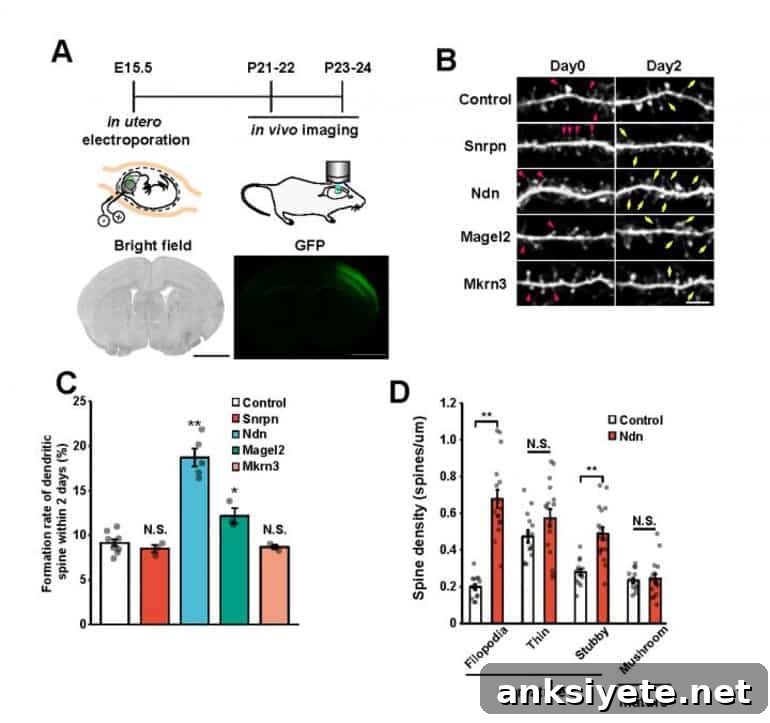
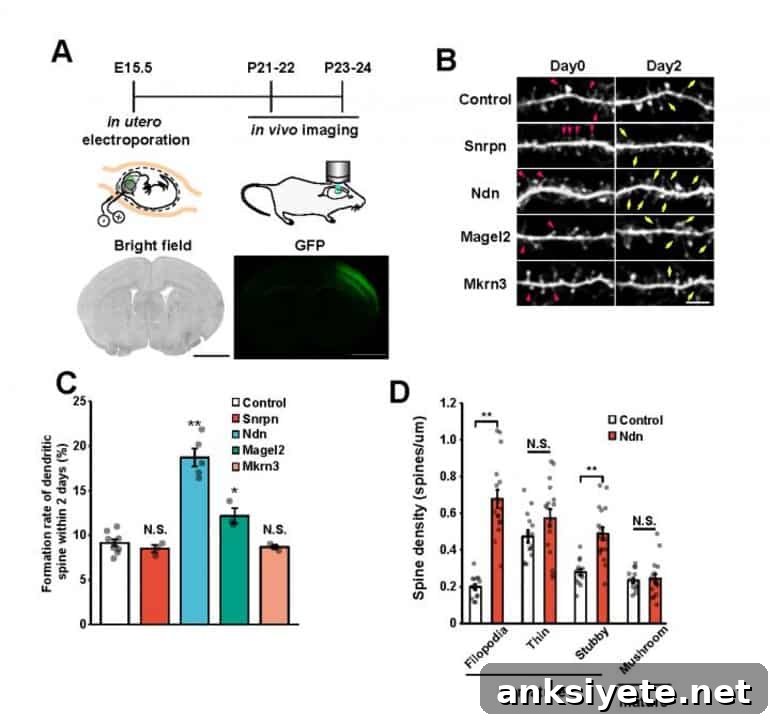
Each of these three candidate genes was then overexpressed individually in the developing cerebral cortex using in utero electroporation. The team used in vivo two-photon microscopy to measure dendritic spine turnover—the rate of spine formation and elimination—over a two-day period. Overexpression of Ndn caused a marked increase in spine formation, and morphological classification showed that most of these new spines were immature, indicating that Ndn promotes excessive spine formation and interferes with normal spine maturation during development.
To test causality within the full 15q duplication context, the researchers used CRISPR-Cas9 genome editing to remove one copy of Ndn from 15q dup mice, producing mice with a normalized copy number of Ndn (15q dupΔNdn). Restoration of Ndn copy number in this way normalized spine turnover and rescued deficits in inhibitory synaptic input that had been observed in 15q dup mice.
Behaviorally, the team tested whether normalizing Ndn copy number could rescue autism-like phenotypes in 15q dup mice, such as reduced sociability and increased perseveration. In most behavioral assays, 15q dupΔNdn mice showed substantial improvement compared with 15q dup mice, indicating that excess Ndn contributes to both synaptic changes and behavioral abnormalities in this model.
Implications and future directions
This study demonstrates that Ndn plays a pivotal role in the consequences of paternal 15q duplication in mice: it drives excessive dendritic spine formation, perturbs excitation/inhibition balance in cortical circuits, and contributes to ASD-like behaviors. The research team now plans to dissect the molecular pathways downstream of NDN and to explore whether modulating NDN function or its effectors can prevent or reverse developmental neuronal and behavioral abnormalities. Such work aims to inform new therapeutic approaches for developmental disorders linked to CNVs.
Glossary
1. Chromosomal abnormality: Structural changes in chromosomes, such as duplications or deletions, which can alter gene dosage and are observed in some individuals with autism.
2. Copy number variation (CNV): A genomic alteration in which sections of DNA are duplicated or deleted, leading to an abnormal number of copies of specific genes. Normal cells typically contain two copies (diploid).
3. Synapse: The junction between two neurons where signals are transmitted.
4. Dendritic spine: Small protrusions on a neuron’s dendrites that receive synaptic input and are important for synaptic strength and plasticity.
5. In utero electroporation: A technique for delivering DNA into embryonic brain cells by injecting DNA into the uterus and applying brief electrical pulses to promote cellular uptake.
6. Two-photon microscopy: A laser-based imaging approach that enables live imaging of neuronal structures, allowing researchers to track dendritic spine dynamics in living mice.
7. CRISPR-Cas9: A precise genome-editing technology used to cut and modify specific genomic regions; here it was used to excise one copy of Ndn from the 15q duplication mouse.
Funding: This research received support from KAKENHI grants of the Japan Society for the Promotion of Science (JSPS), including the innovative area “Dynamic regulation of brain function by Scrap & Build system,” and from the Takeda Science Foundation, among others.
About this ASD and genetics research news
Source: Kobe University
Contact: Verity Townsend – Kobe University
Image: Credit to Takumi et al., Nature Communications, 2021
Original research (open access): “Genetic dissection identifies Necdin as a driver gene in a mouse model of paternal 15q duplications” by Kota Tamada, Keita Fukumoto, Tsuyoshi Toya, Nobuhiro Nakai, Janak R. Awasthi, Shinji Tanaka, Shigeo Okabe, François Spitz, Fumihito Saitow, Hidenori Suzuki & Toru Takumi. Nature Communications
Abstract
Genetic dissection identifies Necdin as a driver gene in a mouse model of paternal 15q duplications
Maternally inherited duplication of chromosome 15q11–q13 (Dup15q) is a pathogenic CNV associated with ASD. Paternally derived duplications have also been linked to ASD, but the underlying molecular drivers were not well understood.
Using genetic screening and targeted overexpression, the authors identify Necdin (Ndn) as a driver gene for paternal 15q duplications that produces ASD-like phenotypes in mice. Excess Ndn enhances dendritic spine formation and density and increases excitability of cortical pyramidal neurons.
The authors generated 15q dupΔNdn mice by excising one copy of Ndn from Dup15q mice via CRISPR-Cas9. These mice lacked ASD-like phenotypes and showed dendritic spine dynamics and cortical excitatory–inhibitory balance similar to wild-type animals.
This work clarifies the role of Ndn in paternal 15q duplication and provides a mouse model for studying paternal Dup15q syndrome.