
Summary: New research shows that, over the course of a few hours of practice, the brain reorganizes activity in more limited ways than scientists previously believed.
Source: Carnegie Mellon University
Researchers at Carnegie Mellon University and the University of Pittsburgh report that, when people learn a new task, the brain reorganizes neural activity using constrained strategies. The study, published in Nature Neuroscience, shows that short-term learning relies on reusing existing neural activity patterns rather than creating optimal new patterns, which limits the speed and extent of improvement over hours of practice.
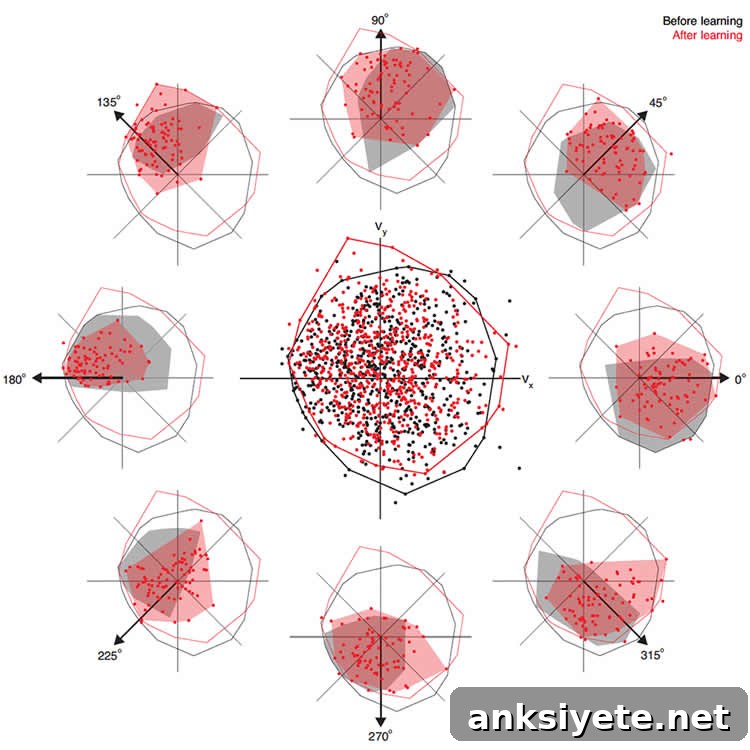
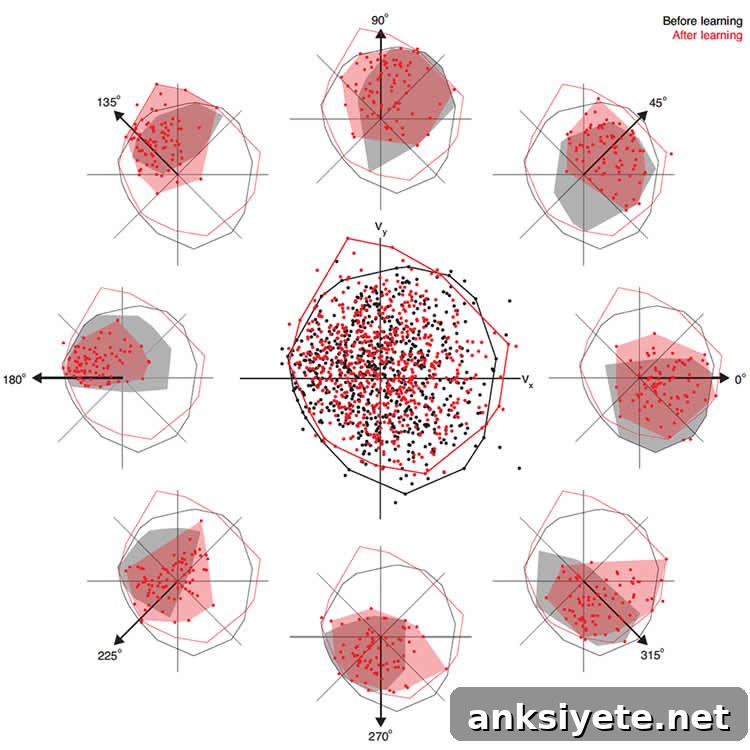
To understand how neural activity changes during learning, the team recorded activity from populations of neurons rather than from single cells. They used a brain-computer interface (BCI) in which subjects controlled a computer cursor solely through neural activity. As expected, subjects improved cursor control with practice, just as athletes improve with repeated training. But by examining how many neurons changed their coordinated activity during learning, the researchers discovered that changes were surprisingly limited and did not always produce the most efficient or accurate control possible.
“In this experimental setup, we can record the entire set of neurons that can directly influence behavior and examine how those neurons change together,” said Steve Chase, associate professor of biomedical engineering at Carnegie Mellon and a member of the Center for the Neural Basis of Cognition. “What we see is a tightly constrained set of adjustments. These limited changes lead to measurable improvement, but not to the best possible performance. That suggests there are real limits on how flexibly the brain can reorganize on short time scales.”
The results indicate that short-term learning largely repurposes activity patterns the brain can already generate. Some neural mechanisms adapt quickly, while others require longer periods of training. On the timescale of a few hours, the brain tends to map existing population activity to new actions rather than produce wholly new activity patterns optimized for the task. That “quick and dirty” solution improves performance but remains suboptimal compared with what would be achievable if the brain could reorganize more freely.
To illustrate this constraint, the authors offer a sports analogy. A tennis player trying squash will adjust quickly enough to hit the ball because of shared motor skills, but she will initially swing the squash racket like a tennis racket. Only with extended practice will her technique become fully appropriate for squash. Similarly, neurons initially apply familiar activity patterns to a novel task and only slowly reshape those patterns toward ideal activity for the new skill.
“It takes time to train neurons to generate the ideal activity patterns,” said Byron Yu, associate professor of biomedical engineering and electrical and computer engineering at Carnegie Mellon. “When faced with a new task, the brain relies on patterns it already produces and uses them as effectively as possible for the moment.”
“When learning begins, the brain tends to reuse existing activity patterns rather than produce entirely new ones,” said Aaron Batista, associate professor in the Department of Bioengineering at the University of Pittsburgh. “Over a few hours, learning follows a suboptimal path: it remaps known patterns to new movements rather than creating the best possible pattern for the new task.”
Those findings help explain a common experience: initial gains in learning are often rapid but plateau before reaching high proficiency. Short-term learning gives the brain a way to cope quickly by reallocating known neural patterns, but achieving expert-level performance demands longer-term changes in circuit connectivity and activity that are harder and slower to produce.
“None of us predicted how limited learning would be on the scale of just a few hours,” said Matthew Golub, a postdoctoral researcher in electrical and computer engineering at Carnegie Mellon. “We were surprised that, when first adapting to a novel mapping, the brain does not choose the globally best strategy. Instead, it relies on a restricted repertoire of activity patterns and reassigns those patterns to new actions.”
The study was conducted in collaboration with the Center for Neural Basis of Cognition, a cross-university research and education program between Carnegie Mellon University and the University of Pittsburgh that combines expertise to study the neural and cognitive mechanisms underlying behavior and intelligence.
Source: Emily Durham – Carnegie Mellon University
Publisher: Organized by NeuroscienceNews.com
Image credit: Researchers / Nature Neuroscience
Original research: Abstract in Nature Neuroscience (doi: 10.1038/s41593-018-0095-3)
Carnegie Mellon University (2018, March 13). The Learning Brain Is Less Flexible Than We Thought. NeuroscienceNews.
Abstract
Learning by neural reassociation
Behavior arises from coordinated activity across populations of neurons. Learning requires those populations to produce different activity for a desired behavior. To examine how population activity reorganizes during learning, the authors recorded intracortical population activity in primary motor cortex of rhesus macaques during short-term learning with a brain–computer interface. Because the mapping from neural activity to cursor movement was known exactly, the experiments allowed precise tests of neural reorganization hypotheses. The results show that short-term changes in population activity follow a suboptimal strategy of reassociation: animals relied on a fixed set of activity patterns and reassigned those patterns to new movements after learning. These findings suggest the repertoire of activity patterns a neural population can generate is more constrained than previously thought and help explain why rapid acquisition of high proficiency is often difficult.