
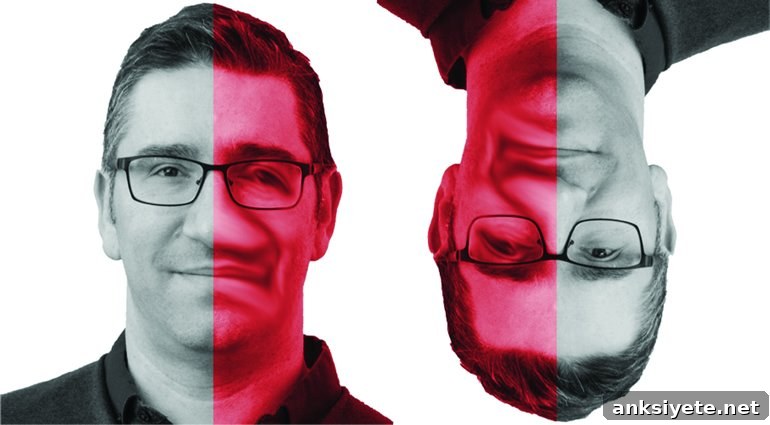
Summary: Some people with a rare condition called hemi-prosopometamorphosia (hemi-PMO) perceive distortions on the same half of every face they view, regardless of angle or orientation. New findings suggest the human visual system aligns every face to a common internal template so faces can be compared more easily to those stored in memory.
Source: Dartmouth College
Imagine that whenever you look at a person, one side of their face always appears to be melting or drooping, as if from a surreal painting. That is the experience reported by people with a rare perceptual disorder called hemi-prosopometamorphosia (hemi-PMO). A new study, reported in Current Biology, documents a case in which the distorted half of every face remains the same no matter how the face is presented. The results support the idea that the visual system aligns perceived faces to a single, orientation- and viewpoint-independent template so they can be matched against faces stored in memory.
“Each time we see a face, the brain reformats our representation of that face — adjusting size, viewpoint, and orientation — so it aligns with faces we already remember, similar to how automated face recognition systems operate,” explains Brad Duchaine, a professor of psychological and brain sciences and principal investigator of the Social Perception Lab at Dartmouth College. “By aligning a new face with stored templates, the brain simplifies the job of recognizing whether this is someone we’ve seen before.”
Hemi-PMO is an uncommon condition that can follow brain injury. When it occurs, facial features on one side appear distorted while the other side appears normal. The condition implies that the two halves of a face may be processed independently in the brain. Because hemi-PMO often fades with time, researchers have found it difficult to study, and many questions remain about the normal mechanisms of human face perception.
This study centers on a right-handed man in his early 60s, referred to as Patient A.D., whose hemi-PMO symptoms have persisted for years. Like many people with the disorder, A.D.’s symptoms followed damage to the splenium, a fiber bundle that links visual regions across the left and right hemispheres. Five years prior to the study, A.D. noticed while watching television that the right halves of faces looked as if they had melted, while the left halves appeared normal. When he looked in a mirror, the right side of his own reflected face appeared distorted as well. He reported no comparable distortions for other body parts or inanimate objects.
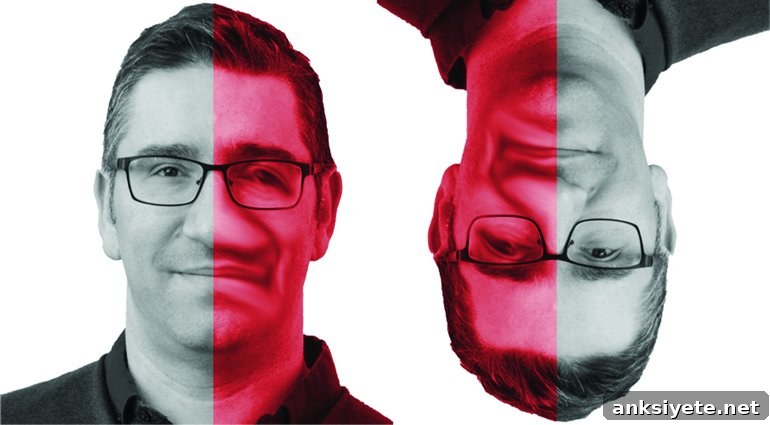
The researchers conducted two experiments with A.D. In the first, they showed him photographs of human faces alongside non-face images, including houses, cars, and other objects, and asked whether he perceived distortions. He reported distortions in 17 of 20 face photographs. The perceived distortions always affected the right side of the face and typically made features appear to sag or droop. In one example, A.D. described the right eye as much larger than the left, with the right eyebrow, right side of the nose, and right corner of the mouth appearing to hang downward. Two face photographs did not trigger distortions because they were right-profile shots where the right side of the face was not visible. Consistent with his everyday experience, A.D. reported no distortions for any non-face images, indicating the effect is specific to face-processing mechanisms.
In the second experiment, the team tested A.D. with 15 faces displayed across different visual fields, at varying in-depth rotations, and at four picture-plane rotations: 0° (upright), 90°, 180° (upside-down), and 270°. Across every condition, A.D. reported distortions affecting the same facial features. Notably, when a face was shown upside down, A.D. still perceived distortions corresponding to the face-centered right side, even though, on the rotated image, this appeared on the left side of the picture. This pattern indicates that the visual system internally reorients faces to a consistent, face-centered reference frame before applying higher-level processing.
The consistency of A.D.’s distortions across changes in viewpoint and orientation supports the existence of an orientation- and view-invariant face template encoded in a face-centered reference frame. The findings further suggest that both hemispheres maintain these face-centered representations and that the left and right halves of a face can be processed separately. In A.D.’s case, signals from one hemisphere appear to be altered as they cross the damaged splenium, producing the persistent, side-specific perceptual distortion.
About this research
Source:
Dartmouth College
Contacts:
Press Office – Dartmouth College
Image source:
Image credited to the study authors.
Original research: Open access. Article: “Face-Specific Perceptual Distortions Reveal a View- and Orientation-Independent Face Template” by Brad Duchaine et al., Current Biology.
Abstract
Face-Specific Perceptual Distortions Reveal a View- and Orientation-Independent Face Template
A stimulus’s spatial coordinate system is its reference frame, and visual representations rely on multiple reference frames to encode information efficiently. Early face representations depend on retinotopic (eye-centered) coordinates, but the reference frames underlying high-level face judgments are less well understood. To probe these representations, the authors examined hemi-prosopometamorphosia, a striking disorder of face perception. Following a left splenium lesion, Patient A.D. perceived features on the right side of faces as if they had melted. The same features were distorted regardless of which visual field the face was presented in, the in-depth rotation of the face, and the picture-plane orientation, including upside-down presentations. These results indicate that faces are aligned to a view- and orientation-independent face template encoded in a face-centered reference frame, that such face-centered representations exist in both hemispheres, and that the representations of the left and right halves of a face can be dissociated.