
Advanced brain imaging links specific schizophrenia symptoms to distinct anatomical features, a study at Washington University School of Medicine in St. Louis reports. The results could help refine diagnosis and lead to more targeted treatments for schizophrenia.
The study, published online in the journal NeuroImage, used high-resolution magnetic resonance imaging (MRI) and diffusion tensor imaging (DTI) to examine how variations in white matter structure relate to clinical symptoms in people diagnosed with schizophrenia.
“By examining brain anatomy in detail, we identified distinct subgroups of patients whose structural brain differences correspond with specific symptom profiles,” said senior investigator C. Robert Cloninger, MD, PhD. “This supports the idea that schizophrenia is not a single uniform illness, and it points to new ways of thinking about diagnosis and personalized care.”
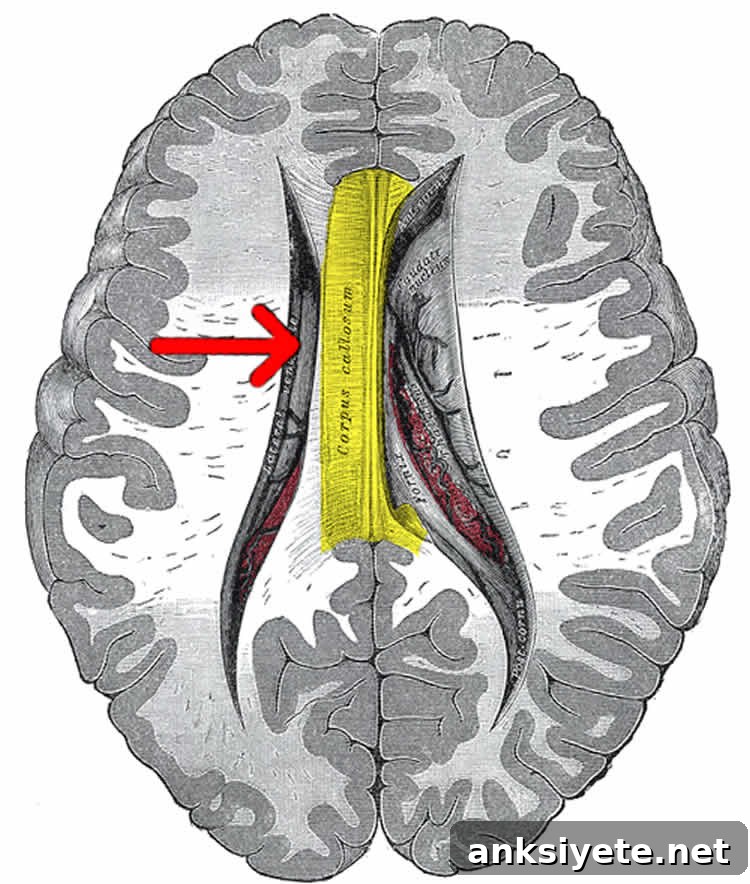
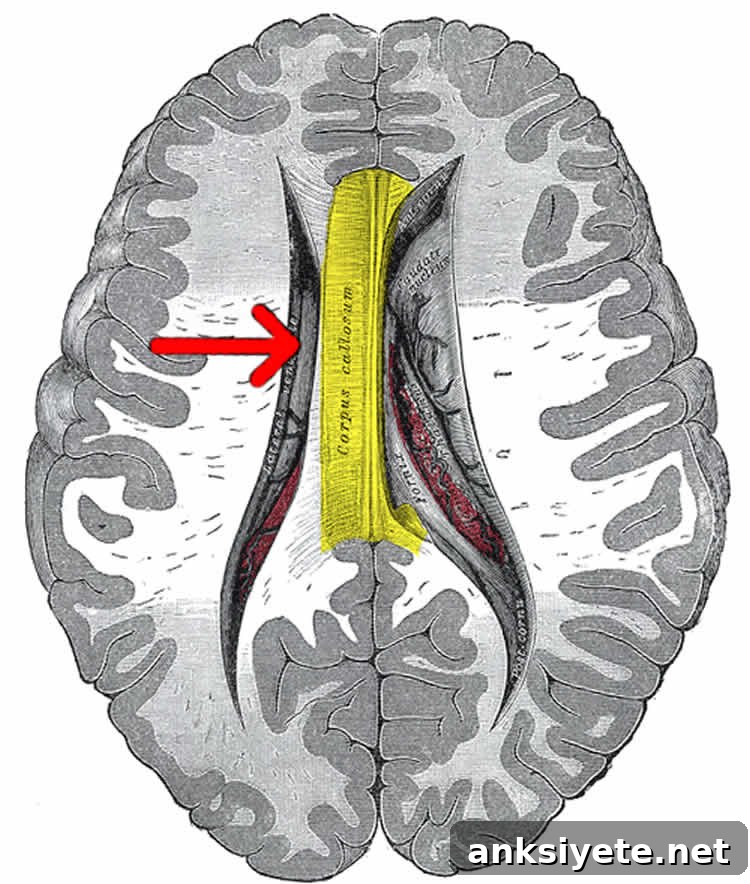
Researchers analyzed MRI and DTI scans from 47 people diagnosed with schizophrenia and 36 healthy control volunteers. The DTI analyses focused on fractional anisotropy (FA), a measure of white matter integrity, and revealed a range of abnormalities across the corpus callosum—the major fiber bundle that connects the brain’s left and right hemispheres and supports interhemispheric communication.
When the team examined patterns of FA reduction across parts of the corpus callosum and other white matter tracts, distinct relationships emerged between anatomical variations and clinical symptoms. For example, abnormalities localized to the genu of the corpus callosum were associated with bizarre or disorganized behavior. Different abnormalities, involving the splenium and posterior internal capsule regions, were linked to negative symptoms such as flattened affect and disorganized speech. Other patterns involving the fornix and external capsule correlated with prominent delusions or hallucinations.
This work builds on earlier genetic analyses by the same group that suggested schizophrenia may consist of multiple genetically distinct disorders, each associated with different symptom clusters. In a prior study, researchers led by Cloninger and Igor Zwir, PhD, identified sets of genes that related to specific clinical features, providing a genetic basis for diagnostic heterogeneity.
In the current study, investigators combined advanced imaging with a novel analytic approach to identify cohesive subgroups within the schizophrenia cohort. They applied a Generalized Factorization Method (GFM) that uses non-negative matrix factorization and other unsupervised techniques to detect biclusters—subsets of patients who share a particular pattern of reduced FA in specific brain regions. This method avoids averaging across a heterogeneous population and instead reveals latent subtypes defined by shared anatomical signatures.
“We did not begin by selecting patients by symptoms and then searching for brain differences,” said Igor Zwir. “Instead, we let the imaging data define patterns, and those patterns naturally aligned with clinical symptom profiles. Integrating this imaging information with genetic data could eventually allow clinicians to tailor treatments to a patient’s specific biological subtype.”
Funding: The research was supported by the National Institute of Mental Health (NIH), the Spanish Ministry of Science and Technology, an R.L. Kirchstein National Research Award, and contributions from Stephen and Constance Lieber and Sidney R. Baier Jr. Relevant NIH grant numbers include 5T32 DA7261-23, 5K08 MH077220, K08 MH085948, and MH066031.
Source: Jim Dryden – WUSTL
Image Source: Public domain image.
Original Research: “Decomposition of brain diffusion imaging data uncovers latent schizophrenias with distinct patterns of white matter anisotropy” by Javier Arnedo, Daniel Mamah, David A. Baranger, Michael P. Harms, Deanna M. Barch, Dragan M. Svrakic, Gabriel A. de Erausquin, C. Robert Cloninger, and Igor Zwir. NeuroImage. Published online July 4, 2015. doi:10.1016/j.neuroimage.2015.06.083
Abstract
Decomposition of brain diffusion imaging data uncovers latent schizophrenias with distinct patterns of white matter anisotropy
Analyses of fractional anisotropy (FA) from diffusion tensor imaging (DTI) in schizophrenia have produced inconsistent results, possibly because studies often average across clinically heterogeneous patients. To address this, the team developed a Generalized Factorization Method (GFM) that identifies biclusters—subsets of subjects that share reductions in FA in specific white matter regions—by combining several unsupervised techniques with non-negative matrix factorization.
DTI tract-based spatial statistics images from 47 individuals with schizophrenia and 36 healthy controls were decomposed using GFM, revealing eight biclusters that grouped subjects according to shared patterns of low FA. These biclusters collapsed into four broader anatomical patterns: (1) genu of the corpus callosum (GCC); (2) fornix (FX) and external capsule (EC); (3) splenium of the corpus callosum (SCC) plus retrolenticular and posterior limbs of the internal capsule (RLIC + PLIC); and (4) anterior limb of the internal capsule. Each pattern showed significant associations with distinct clinical features: GCC reductions correlated with bizarre behavior; FX + EC reductions correlated with prominent delusions; and SCC + RLIC + PLIC reductions correlated with negative symptoms and disorganized speech.
These findings support the view that schizophrenia represents a heterogeneous collection of disorders with separable patterns of white matter disruption linked to specific symptom clusters. Identifying these latent anatomical subtypes could improve understanding of underlying biology and guide development of more precise, symptom-targeted interventions.