
Summary: Multisensory gamma-wave stimulation improves recognition and spatial memory in mice and reduces amyloid burden in the auditory cortex and hippocampal CA1. These findings indicate that combined sensory stimulation strengthens hippocampal function and diminishes Alzheimer’s-related pathology across the neocortex.
Source: MIT
By exposing mice to a coordinated combination of light and sound, MIT neuroscientists have demonstrated improvements in cognitive and memory deficits that resemble those seen in Alzheimer’s disease.
This noninvasive approach induces brain activity known as gamma oscillations and markedly reduced the number of amyloid plaques in treated animals. Plaque clearance occurred across broad regions of the brain, including areas essential for learning and memory.
“When we combine visual and auditory stimulation for a week, we see engagement of the prefrontal cortex and a very dramatic reduction of amyloid,” says Li-Huei Tsai, director of MIT’s Picower Institute for Learning and Memory and senior author of the study.
Further research is required to determine whether these findings translate to patients, although the team has completed preliminary safety assessments of this stimulation in healthy human volunteers.
MIT graduate student Anthony Martorell and Georgia Tech graduate student Abigail Paulson are lead authors of the study, published in the March 14 issue of Cell.
Memory improvement
Neurons generate electrical signals that synchronize to form brain waves across different frequency bands. Gamma-frequency oscillations, which range roughly from 25 to 80 hertz, are implicated in attention, perception, and memory. Prior work has identified impairments in gamma activity in Alzheimer’s patients.
In 2016, Tsai’s group first showed that restoring gamma oscillations in Alzheimer’s-model mice with 40-Hz light flicker reduced beta-amyloid and phosphorylated tau proteins while activating microglia, the brain’s debris-clearing immune cells. However, those benefits were largely confined to the visual cortex.
To reach other brain regions involved in memory, the researchers developed an auditory stimulation protocol. They exposed mice to one hour per day of 40-Hz tone stimulation for seven days. This auditory gamma entrainment significantly lowered beta-amyloid levels not only in the auditory cortex but also in the nearby hippocampus, a central structure for memory formation.
“What we have demonstrated here is that we can use a totally different sensory modality to induce gamma oscillations in the brain,” Tsai explains. “Auditory stimulation can reduce amyloid and tau pathology in both sensory cortex and hippocampus.”
The team tested cognitive effects as well. After a week of auditory stimulation, mice navigated mazes more effectively, using landmarks to guide behavior, and showed improved recognition of previously encountered objects. The researchers also observed changes in microglial activity and alterations in blood vessel responses, which could enhance amyloid clearance.
Dramatic effect of combined stimulation
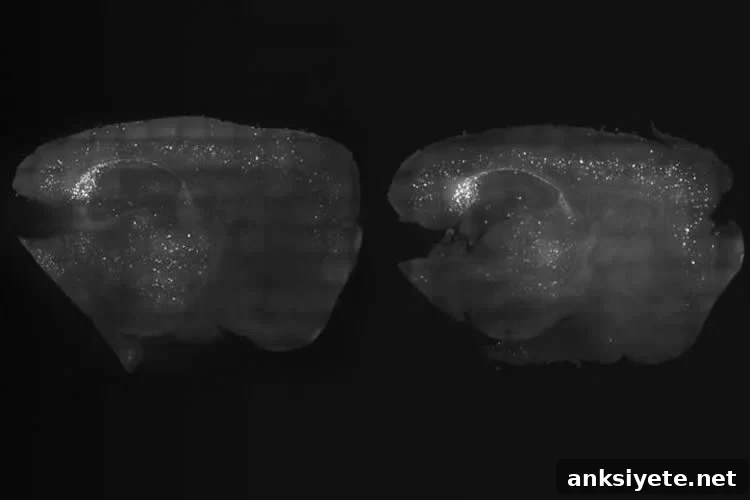
Combining visual and auditory 40-Hz stimulation produced a stronger outcome than either modality alone. Dual stimulation produced widespread amyloid reductions throughout a much larger fraction of the brain, including the medial prefrontal cortex, a region linked to higher cognitive functions. Microglial responses were amplified, with immune cells clustering densely around plaques.
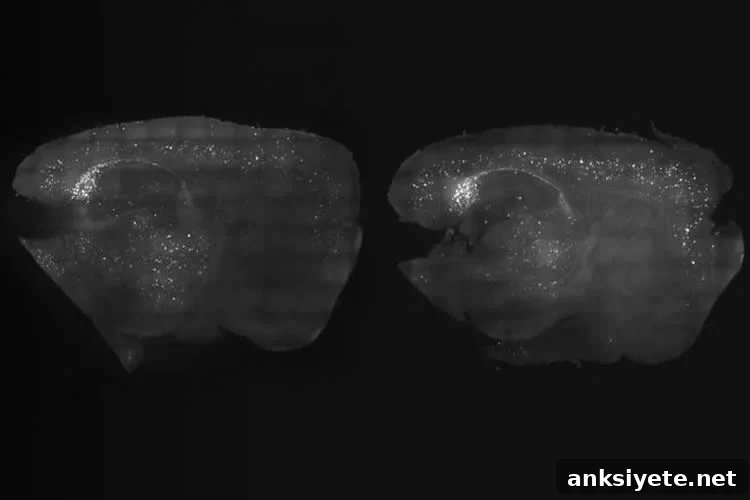
“These microglia just pile on top of one another around the plaques,” Tsai says. “It’s very dramatic.”
The team also found that many beneficial effects wane after stopping treatment. When mice were treated for one week and then tested a week later, several positive changes had diminished, indicating that ongoing or repeated stimulation may be required to sustain benefits.
Current work is focused on identifying how gamma oscillations influence specific cell types and molecular pathways, and why stimulation at 40 Hz appears particularly effective. The combined visual and auditory protocol has already undergone safety testing in healthy human participants, and enrollment has begun for trials in people with early-stage Alzheimer’s disease.
Funding: This research was supported in part by the Robert and Renee Belfer Family Foundation, the Halis Family Foundation, the JPB Foundation, the National Institutes of Health, and the MIT Aging Brain Initiative.
Source:
MIT
Media Contacts:
Sarah McDonnell – MIT
Image Source:
The image is credited to Gabrielle Drummond.
Original Research: Closed access research
Title: “Multi-sensory Gamma Stimulation Ameliorates Alzheimer’s-Associated Pathology and Improves Cognition”
Authors: Anthony J. Martorell, Abigail L. Paulson, Ho-Jun Suk, Fatema Abdurrob, Gabrielle T. Drummond, Webster Guan, Jennie Z. Young, David Nam-Woo Kim, and others. Published in Cell, online March 14, 2019.
Abstract
Multi-sensory Gamma Stimulation Ameliorates Alzheimer’s-Associated Pathology and Improves Cognition
Highlights
• Auditory gamma entrainment using sensory stimuli (GENUS) enhances hippocampal function
• GENUS alters microglia, astrocytes, and vasculature in auditory cortex and hippocampus
• Combined auditory and visual GENUS prompts microglial clustering around plaques
• Combined GENUS reduces amyloid pathology across the neocortex
Summary
Previous work showed that 40-Hz visual flicker (GENUS) affected pathology in the visual cortex of Alzheimer’s mouse models. Here, auditory 40-Hz stimulation drove gamma activity in auditory cortex and hippocampal CA1. Seven days of auditory GENUS improved spatial and recognition memory and reduced amyloid in auditory cortex and hippocampus of 5XFAD mice. The treatment produced measurable changes in microglia, astrocytes, and blood vessels and also reduced phosphorylated tau in a tauopathy model. Combined auditory and visual GENUS, but not either alone, induced microglial clustering and decreased amyloid in medial prefrontal cortex. Whole-brain analysis revealed widespread neocortical amyloid reduction after multisensory GENUS. Thus, GENUS across multiple sensory modalities can produce broad beneficial effects and improve cognitive function.